
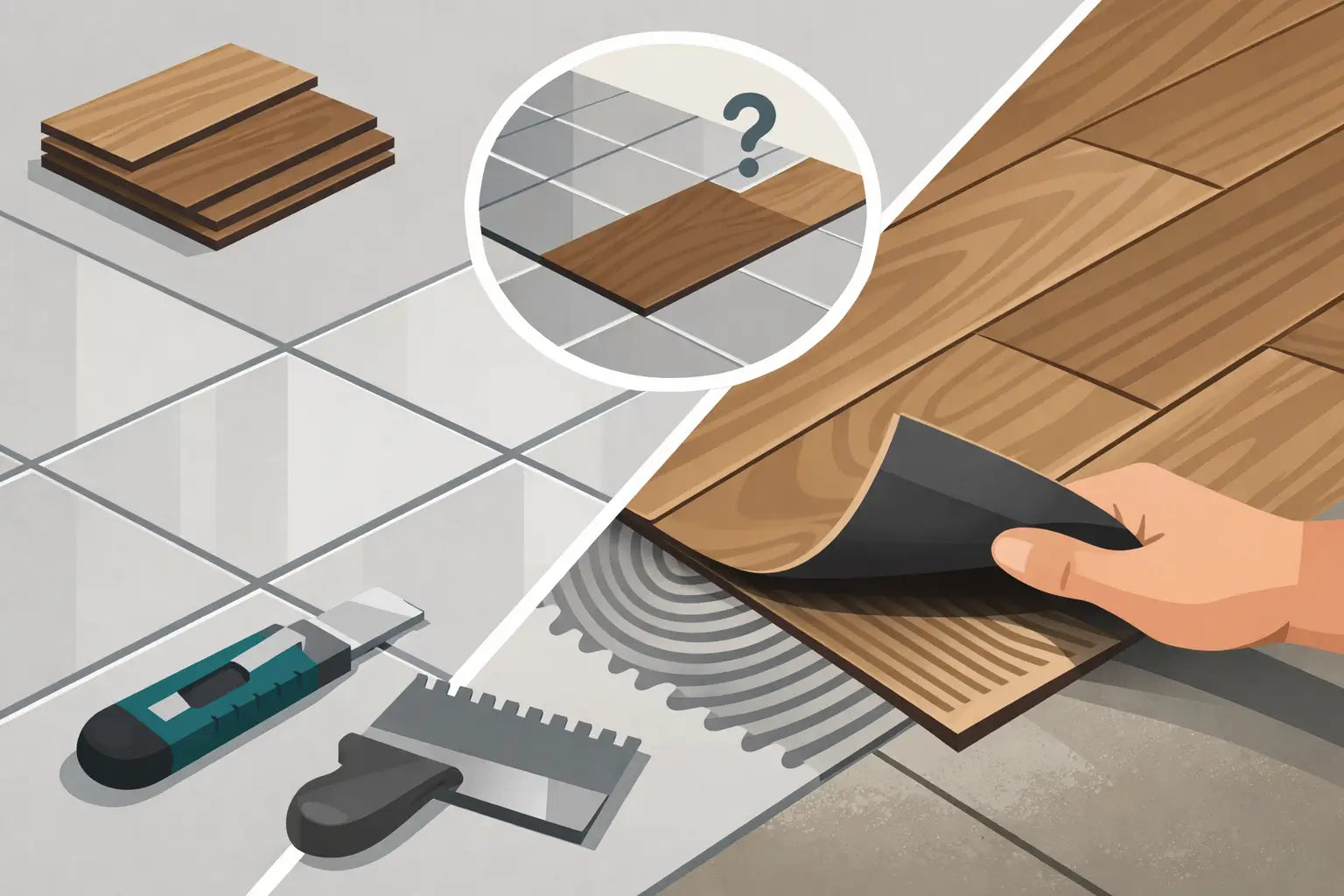
Are your old tiles looking outdated but still firmly in place? Removing them would be noisy, messy, and expensive. That's why many people wonder if they can stick self-adhesive vinyl on tiles without removing everything. The short answer: yes – but not on every tile and never without thorough preparation. Here's when it works, what matters for the subfloor, and how to prevent grout lines from showing through.
Key points
- Possible – but only on firm tiles: loose or hollow-sounding areas must be removed beforehand.
- Grout lines are the critical point: deep/wide grout lines will show through the vinyl later without leveling.
- Usually mandatory: clean surface → prime → level completely → then glue.
- Advantage: no demolition, little mess, low installation height – good for tight door clearances.
- Bathroom: only with product approval + professional sealing.
Table of contents
- When it makes sense – and when it doesn't
- What needs to be checked beforehand
- Grout lines: the critical point
- How to prepare properly
- Adhesive or click on tiles?
- Avoid common mistakes
- Frequently asked questions
- Conclusion
When it makes sense – and when it doesn't
Self-adhesive vinyl on tiles is a good solution if the tiles are firmly attached, the subfloor is stable, and you want a sleek, durable renovation – typical for hallways, kitchens, living areas, or offices. You save on demolition and construction waste and keep the installation height low.
| Situation | Suitable? |
|---|---|
| Tiles firm, even, fine grout lines | ✔ yes, after leveling |
| Deep or wide grout lines | only with full-surface leveling |
| Loose / hollow-sounding tiles | ✘ repair first |
| Cracks, sunken areas | ✘ Risk – subfloor must be repaired |
What needs to be checked beforehand
Before ordering materials, assess the area honestly – this saves money and prevents a second job:
- Adhesion: Remove and repair loose or hollow-sounding tiles. Self-adhesive vinyl needs a consistently stable subfloor.
- Evenness: Small differences can be compensated, larger ones cannot be concealed. Thin self-adhesive vinyl shows every imperfection.
- Cleanliness: Grease, old care products, silicone residues, or sealants impair adhesion – the surface must be clean, dry, and free of release agents.
Grout lines: the critical point
In practice, the problem is rarely with the idea itself, but with the grout lines. Many hope that the adhesive bed will compensate for them – but this is usually too optimistic. Deep grout lines and wide patterns will show through over time, especially with glancing light and smooth, modern decors. Therefore, in most cases, leveling compound is necessary: it creates a closed, even surface and eliminates the effect of the tile grid. Depending on the tile, a primer is required beforehand so that the leveling compound adheres securely.
How to prepare properly
- Clean: Thoroughly remove grease, care product residues, and dust from the surface.
- Check & repair: Fix loose spots, cracks, and problematic grout lines.
- Prime: with an adhesion primer for dense substrates – e.g., Bostik GRIP A500.
- Level: fully level with a suitable leveling compound until no tile pattern shows through.
- Check & glue: After drying, remove burrs; only glue the vinyl completely to an even, clean, dry surface.
Adhesive or click on tiles?
Click vinyl is slightly more forgiving of minor subfloor problems and is faster to install. Self-adhesive vinyl scores with a lower installation height, a firmer feel underfoot, and a very quiet, high-quality look. If doors are tight or you want a particularly uniform surface, self-adhesive vinyl has clear advantages. If the subfloor is difficult and you want to keep preparation simple, click can be more pragmatic. More on this: Click vinyl or self-adhesive vinyl?
Avoid common mistakes
- Underestimating grout lines: the most common reason for patterns showing through.
- Shortened drying times: residual moisture ruins adhesion.
- Incorrect system combination of primer, leveling compound, and adhesive.
- Overlooked old silicone edges or non-load-bearing edge zones.
Frequently asked questions
Can self-adhesive vinyl be glued directly onto tiles?
Only in exceptional cases (very even, finely grouted tiles). In living areas, full-surface leveling is almost always the safe choice to prevent grout lines from showing through.
Do tile grout lines need to be leveled before gluing?
In most cases, yes. Deep or wide grout lines will otherwise show through the thin self-adhesive vinyl over time. A full-surface leveling compound creates the necessary closed surface.
Is a primer needed on tiles?
Mostly yes. Tiles are dense and smooth – an adhesion primer ensures that the leveling compound does not detach. Without an adhesion bridge, the layer will later come loose.
Is self-adhesive vinyl on tiles suitable for the bathroom?
It depends on the product, the sealing, and the moisture exposure. Check the manufacturer's approval – the fact that vinyl is water-resistant is not enough; the entire structure is crucial.
Self-adhesive vinyl or click vinyl on tiles – which is better?
Self-adhesive vinyl for low installation height and a desire for a quiet aesthetic; click vinyl if the subfloor is difficult and preparation should remain simple.
Conclusion
Self-adhesive vinyl on tiles doesn't require a demolition site – but it does require an honest look at the subfloor. If the tiles are firmly in place, the grout lines are properly leveled, and the system is suitable, an old floor covering can be transformed into a modern surface with a lasting good impression. Browse our self-adhesive vinyl collection – or get your free sample beforehand.