
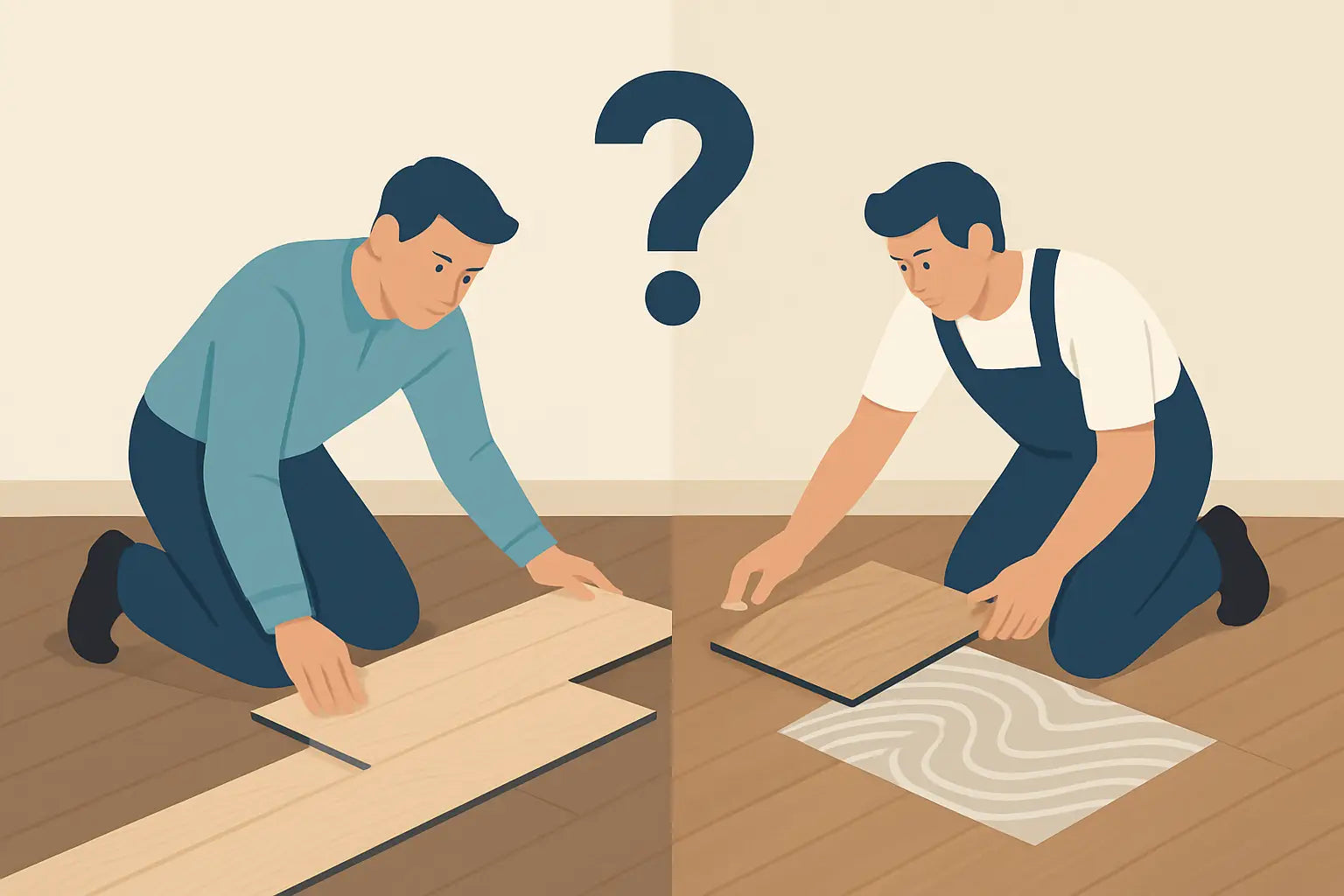
When it comes to renovation, one thing counts above all: the flooring must suit your daily life - and without nasty surprises during installation. This is often where the decision between click vinyl and glue-down vinyl is made. Both look high-quality, both are easy to care for, and both are available in strong brand designs. The difference lies in the construction, the subfloor, and the feel that the floor will later convey.
Click Vinyl vs. Glue-Down Vinyl: The Core Difference
Click vinyl is laid as a floating floor. The planks or tiles are connected via a click system and lie as a "plate" on the subfloor - usually on suitable impact sound insulation or with integrated insulation, depending on the product.Glue-down vinyl (often referred to as dryback) is fully bonded to the subfloor. This sounds like more effort but offers advantages in terms of installation height, stability, and often the walking sensation.
This single decision - floating or glued - entails a whole chain of consequences: how clean the subfloor needs to be, how quickly you'll finish, how stable the floor will later be, and how well it suits large areas or wet rooms.
How to Decide Quickly: Room, Subfloor, Timeline
In practice, it's rarely just a matter of taste. Three factors usually tip the scales.The Room: In typical living spaces like bedrooms, children's rooms, or living rooms, both options are possible. In high-traffic areas, long corridors, or open living-dining-kitchens, glue-down vinyl plays to its strengths because it is fully supported and doesn't "work."
The Subfloor: If the screed or existing floor is not perfectly level, click vinyl is sometimes more tolerant - but only up to a certain point. With glue-down vinyl, subfloor preparation is non-negotiable: filling, priming, careful leveling. In return, you get a very stable floor without hollow spots.
The Timeline: Click vinyl is often the quicker solution, especially for renovators who want to see results quickly. Glue-down vinyl requires more preparation and drying times for filler or primer, but it's worth it if you want maximum long-term stability.
Click Vinyl: When You Need Speed, Cleanliness, and Flexibility
Click vinyl is popular because it's comparatively easy to install. Many homeowners choose it because they want to install the floor themselves or because the construction site should remain as "dry" as possible.A big plus is its flexibility: if a room is redesigned later, a floating floor is generally easier to remove than a fully glued one. This is also interesting for rental apartments - depending on what the lease agreement and the subfloor allow.
Impact sound is also a consideration with click vinyl. Depending on the product, integrated insulation may be included, or separate impact sound insulation may be required. This affects the construction and thus door heights and connections. If you have little clearance, you should calculate carefully here.
In everyday use, click vinyl works reliably if the subfloor is correct and expansion joints are properly planned. It's important to take the installation instructions seriously - especially for large areas or if significant temperature differences are expected, for example, due to floor-to-ceiling windows with a lot of sun exposure.
Glue-Down Vinyl: Thin, Stable, Especially Durable
Glue-down vinyl is often chosen when a seamless, "integrated" look is desired. Due to the full-surface bonding, the floor lies very solidly, the walking sensation is often quieter, and the risk of rattling or micro-movements decreases.A clear advantage is its low installation height. This is invaluable for renovations when doors, skirting boards, kitchen connections, or transitions to other rooms shouldn't require extensive adjustments. Glue-down vinyl can also be the more relaxed solution for stair landings or low thresholds.
In addition, glue-down vinyl is often very suitable for large, open floor plans. Where click systems can reach their limits depending on the product and area, gluing has a structural advantage.
The price comparison is not just a question of the price per square meter. Glue-down vinyl can appear more expensive due to additional services, as filler, primer, and adhesive are added - and because subfloor work takes time. However, those who plan this carefully will get a floor that is extremely durable in the long run.
Subfloor: This is Where Annoyance Later Begins
Many complaints and "the floor makes noise" problems arise not from the material but from the subfloor.With click vinyl, unevenness is the enemy because the click connections can move under stress. In the long run, this leads to creaking noises or, in the worst case, damaged locking mechanisms. A level, load-bearing subfloor is mandatory - even if click vinyl sometimes sounds like "just lay it over" in marketing.
For glue-down vinyl, the subfloor must be almost perfect. Every small dent will show, every edge can later become visible or noticeable. This is not arbitrary but physics - glue-down vinyl is thin and reveals what happens underneath. If you are willing to work carefully here or have it done, glue-down vinyl rewards you with a very high-quality finish.
Moisture, Kitchen, Hallway: Which Option is Less Stressful?
Vinyl as a material is insensitive to water, but that doesn't mean every construction is automatically ideal for every situation.In kitchens and hallways, it often comes down to two things: a lot of movement and occasional moisture. Click vinyl can handle this if properly installed and the joints are not stressed by subfloor movements. Glue-down vinyl scores points because there are no hollow spaces where water could get "under" the floor - provided the bonding is professional and the edge details are well-resolved.
For bathrooms: Here you should pay close attention to product approvals and construction. Not every click vinyl is designed for wet areas, and even with glue-down vinyl, a suitable subfloor construction is needed. If you have a room where standing water can regularly occur, an individual check is advisable - and in case of doubt, a floor that is explicitly approved for it.
Underfloor Heating: Usually Possible, But Not Irrelevant
Both variants can generally work with hot water underfloor heating if the product is suitable. The difference lies in heat transfer.Glue-down vinyl lies directly on the subfloor, so the thermal resistance is usually lower. This can positively impact efficiency and provides a more direct feeling of warmth.
With click vinyl, much depends on the insulation and the overall construction. An overly thick or unsuitable underlay can hinder heat transfer. If underfloor heating is a major consideration for you, it's worth looking at the technical data - not just the decor.
Repair and Replacement: What Happens If Something Breaks?
In real life, things fall, chair wheels go wrong, and sometimes something gets ruined during a move.Click vinyl is often easier to handle for individual damaged spots because planks can theoretically be lifted. In practice, this depends on where the damaged plank is located and how much area you need to open.
Glue-down vinyl can also be repaired, and individual elements can be replaced - but with more craftsmanship required, as the bond needs to be released and re-established. However, due to its fixed connection, glue-down vinyl is often less susceptible to typical "micro-damages" from movement and load changes in everyday use.
Compare Budget Realistically: Material Plus System
For a fair decision, you shouldn't just consider the flooring per square meter. Calculate the entire system.Click vinyl often includes impact sound insulation, possibly a vapor barrier, skirting boards, and neat transition profiles. Glue-down vinyl adds filler, primer, and the appropriate adhesive. Depending on the subfloor, preparation for glue-down vinyl can be the largest cost item - and at the same time, the part that determines whether you have peace of mind for ten years.
When comparing offers, therefore, pay attention to whether the subfloor work is included and which installation accessories have been planned. A low price per square meter quickly becomes less attractive if rework is needed later.
Which Solution Suits You?
If you want to renovate quickly, minimize construction, and are looking for a solid solution for classic living spaces, click vinyl is often the right choice. You make quick progress and maintain flexibility, especially when living situations change.If you value a low installation height, a particularly quiet walking sensation, and maximum stability - or if you are planning large, open areas - glue-down vinyl is often the stronger answer. It requires more preparation but repays it with a very "solid" feel.
If you're unsure, this rule of thumb usually provides a good preliminary selection: click vinyl is the reliable renovation speed model, while glue-down vinyl is the precise project for a lasting finish.
If you want to compare brand lines and order matching installation accessories directly, you can find both - click vinyl and glue-down vinyl - at WaBo Design at https://wabodesign.de with clear square meter prices, availability, and plannable delivery options.
Ultimately, the decision isn't about the "best" vinyl, but about the floor that makes your everyday life quieter: less construction stress, less rework, more joy once the last skirting board is in place.