Anyone with underfloor heating quickly realizes that not all flooring is equally suitable. Especially with click vinyl, it's not just about aesthetics, but primarily about how efficiently heat transfers through the floor into the room. A beautiful design is of little use if the flooring impedes heating performance or behaves unstably with temperature fluctuations.
That's precisely why it's worth taking a closer look at top click vinyl for underfloor heating. The good news: there are many strong solutions. The less good news: the best flooring is not automatically the cheapest, thickest, or quietest. It depends on the interplay of material, construction, and area of use.
What makes top click vinyl for underfloor heating stand out
A suitable vinyl floor for heated rooms must allow heat to pass through well, remain dimensionally stable, and be easy to install cleanly. The thermal resistance is crucial here. The lower this value, the better the underfloor heating works. This not only saves energy but also ensures a more consistent room temperature.
Many buyers first look at the overall thickness. This is understandable but only part of the truth. A thick floor is not automatically worse for heating if its construction is appropriately matched. Conversely, a seemingly slim covering can impede heat more than expected due to an unfavorable backing board or an overly strong integrated insulation.
The click connection also plays a role. A precise system ensures stable joints and a clean surface that remains durable in everyday use. Especially with fluctuating temperatures, this is a point that should not be underestimated.
Which properties are truly important
Low thermal resistance
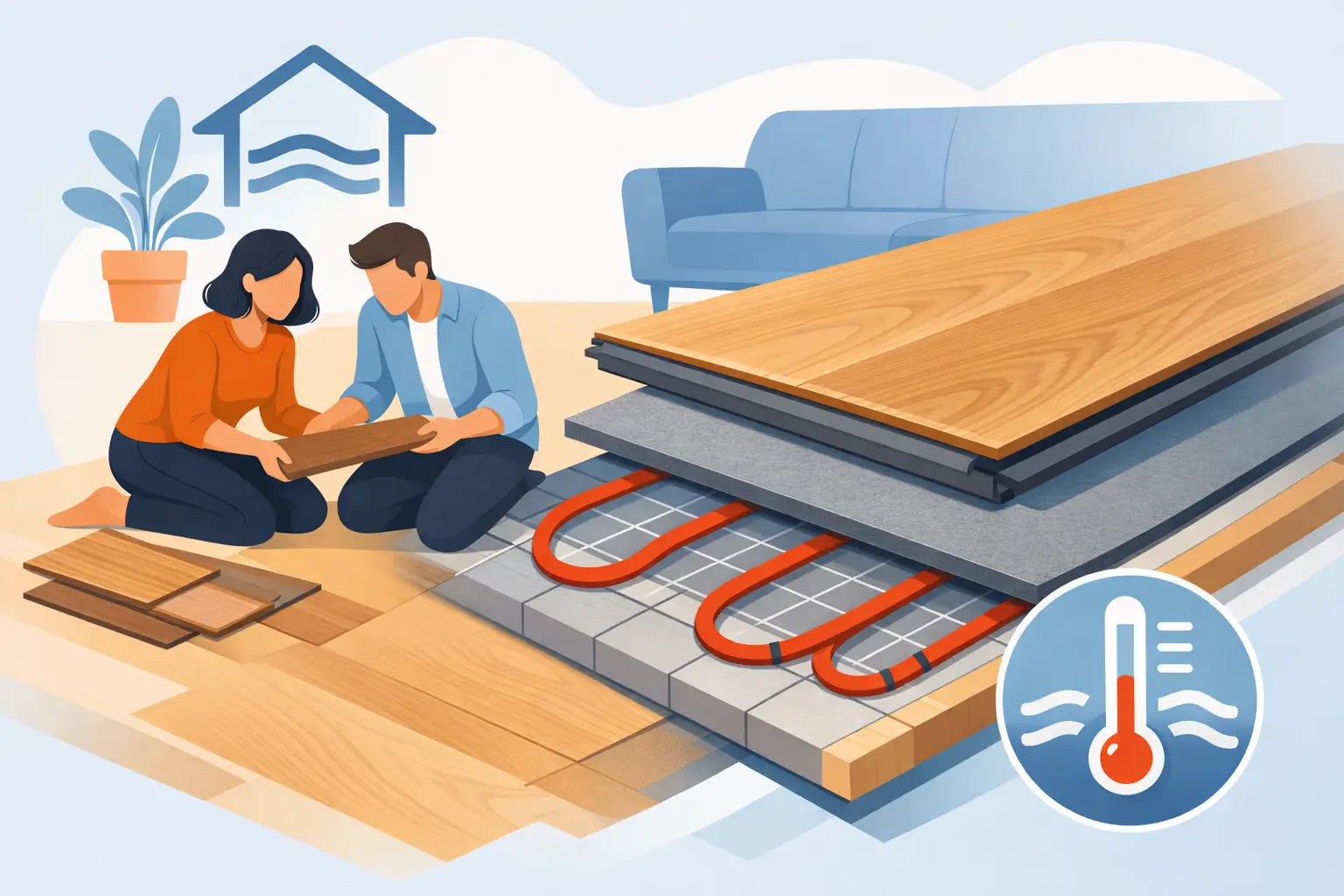
If you want to install click vinyl on a hot water underfloor heating system or an electric surface heating system, the floor should be explicitly approved for it. Manufacturers usually state whether the product is suitable for underfloor heating and up to what surface temperature it can be used.
For many living areas, a low thermal resistance is the central test point. Because the heating only works efficiently if the heat does not get stuck in the floor. It becomes particularly critical if an additional impact sound insulation is installed underneath, which is not designed for heated constructions.
Dimensionally stable construction
Click vinyl is available in different constructions, such as SPC, rigid, or classic vinyl carrier versions. For rooms with underfloor heating, dimensionally stable solutions are often advantageous because they compensate better for temperature fluctuations. This is particularly relevant in large rooms, with floor-to-ceiling windows, or in heavily used living areas.
Nevertheless, rigid is not automatically always the best choice. If you have a very quiet subfloor and prefer a rather soft, comfortable walking surface, other constructions can also work well. It is important that the manufacturer clearly approves the use on heated subfloors.
Suitable use class and wear layer
A floor for the bedroom may have different priorities than one for the kitchen, hallway, or living-dining area. In heavily used rooms, it is worth looking at the use class and wear layer. If you only choose based on heating suitability, you might be saving money in the wrong place.
A good floor for underfloor heating should therefore not only be suitable for heat but also for daily wear and tear. Especially in households with children, pets, or high foot traffic, robust branded products are usually the better decision.
Integrated impact sound insulation - practical, but not always ideal
Many click vinyl floors are offered with integrated impact sound insulation. At first glance, this seems like the perfect complete solution. Installation becomes easier, walking noise more pleasant, and additional material is eliminated.
However, with underfloor heating, this convenience is a trade-off. Integrated insulation can be useful if it has been specially developed for heated subfloors and the thermal resistance remains within the permitted range. However, if the insulation is too thick or thermally unfavorable, heating performance suffers.
Therefore, anyone who wants to get maximum efficiency from their heating always checks the overall construction. Not just the floor, but also any sublayers. This is where an visually attractive product differs from a truly suitable one.
Which types of click vinyl often work well for underfloor heating
SPC and Rigid Vinyl
SPC and rigid floors are often considered strong candidates for heated rooms. The reason is their high dimensional stability. In many installation situations, they react more calmly to temperature changes and offer a solid walking feel. This makes them particularly interesting for living areas with large window surfaces or changing climatic conditions.
However, the individual case is decisive here too. Some products are harder underfoot or less comfortable than classic vinyl. If you spend a lot of time barefoot, you should consider the walking feel in addition to the technical suitability.
Classic Click Vinyl
Classic click vinyl can also work very well with underfloor heating if the construction and approval are correct. It often offers a slightly softer walking feel and pleasant acoustics. For normal living rooms, this is often a good solution, as long as the subfloor, room size, and installation instructions are carefully followed.
Here, it's worth looking at established collections and brands. Products from COREtec, Moduleo, Tarkett or Liberty are interesting for many buyers because they offer clearly positioned series with comprehensible technical data. This helps significantly more with a purchase decision than purely promotional product names.
The subfloor also plays a role
Even the best click vinyl for underfloor heating shows weaknesses if the subfloor is not suitable. The screed must be dry, level, and prepared for installation. Unevenness not only affects the appearance but also the stability of the click connection and the walking feel.
For heated screeds, the professional heating protocol is also important. This ensures that residual moisture and tensions in the subfloor are controlled. If this step is skipped, problems can arise later that are falsely attributed to the floor.
The question of an additional underlay should also not be answered generally. Some click vinyl floors require a specific underlay, others exclude it, especially if insulation is already integrated. Manufacturer specifications are always decisive.
How to choose the right floor for your room
In the living room, the balance of heat output, appearance, and comfort often counts. Here, the floor should have a homely feel, but remain as stable as possible in larger areas. In the kitchen and hallway, durability and ease of care are even more important. In the bedroom, however, a comfortable walking feel is often a strong argument.
If you are planning an open-plan living-dining area, a slightly stricter selection is worthwhile. Large continuous surfaces place higher demands on the floor than small individual rooms. In this case, dimensionally stable click systems and clearly documented approvals for underfloor heating are particularly valuable.
For rented apartments or quick renovations, click vinyl is often attractive because it can be installed quickly and many decors immediately create a modern impression. Those who pay attention to brand quality often save themselves later compromises in terms of durability and dimensional stability.
Typical mistakes when buying
A common mistake is a pure price comparison per square meter. Of course, price plays a role, but with underfloor heating, technical data must also be considered. A supposed bargain can quickly lose its attractiveness due to poorer heat conduction or higher susceptibility in everyday life.
Equally problematic is choosing based on decor alone. Light oak, concrete look, or country house plank - visually, much can be found. But the decisive factor is whether the floor suits the heating system and the room.
Accessories are often underestimated. Transition profiles, matching skirting boards, or a suitable underlay are part of a clean solution. Those who choose everything from one source usually save time and avoid bad purchases.
What you should specifically look for in the shop
When comparing online, don't just look at photos. More important are details on the use class, total thickness, wear layer, suitability for underfloor heating, and integrated insulation if applicable. Clear information on availability, delivery time, and accessories is also useful.
Especially with a flooring project, planning is crucial. A shop that clearly presents brands, technical data, and accessories makes the selection much easier. At WaBo Design, buyers find precisely this combination of a curated brand selection, fast processing, and suitable installation accessories for a harmonious overall project.
The best decision is rarely a general recommendation
The best click vinyl for underfloor heating is not simply the most expensive product in the range, nor is it automatically the one with the thickest wear layer. The decisive factor is how well the floor suits your heating, your room, and your daily use. Those who consider technical suitability, stable construction, and living comfort together will ultimately make a much more secure purchase.
When you are faced with a choice, a simple benchmark helps: the right floor must not only look good but also convince after the first winter. That's how you know if a quick renovation has truly become a dream floor.