
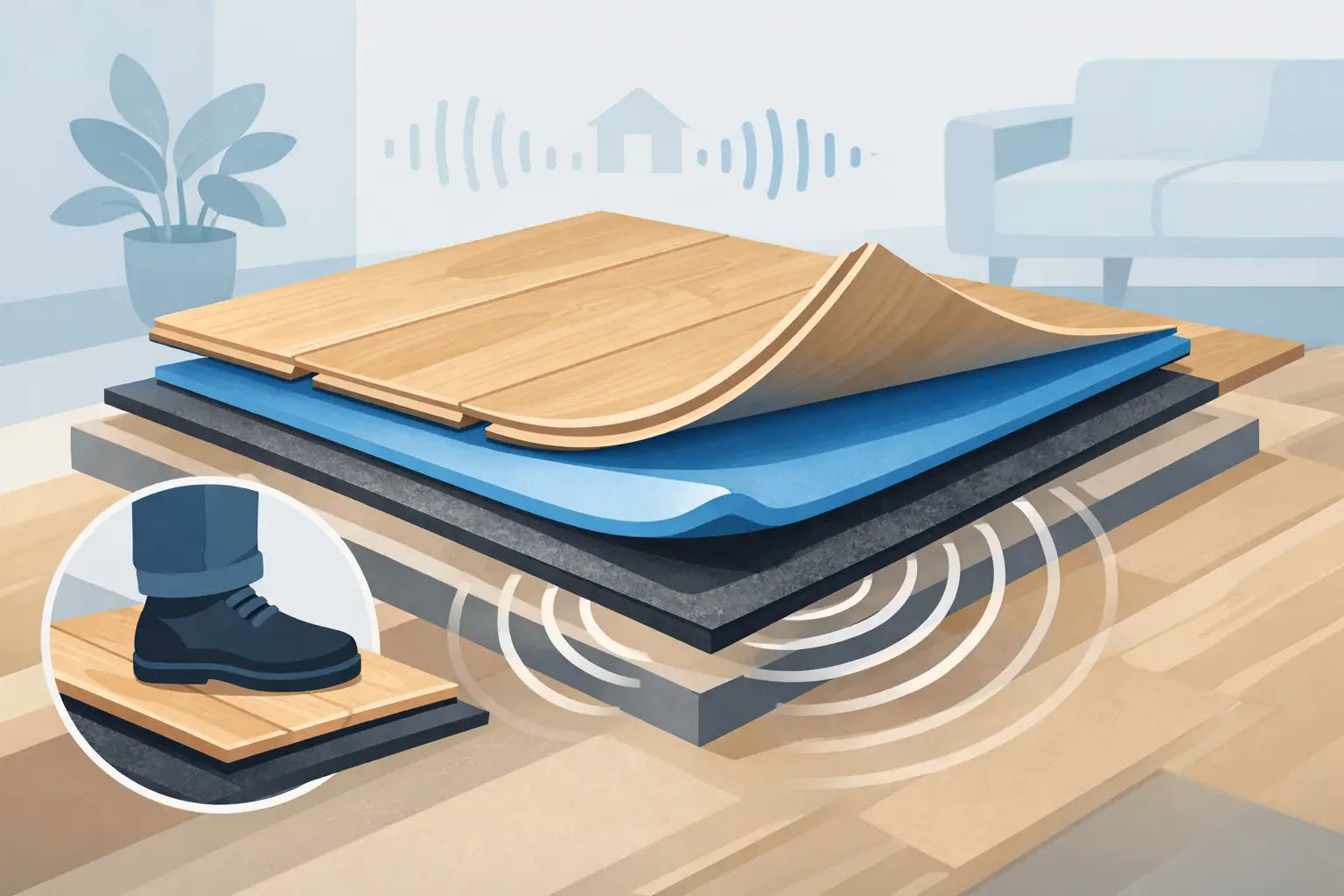
When you install click vinyl flooring, you'll notice the quality not just with the first step, but often by the time you reach the second room. That's precisely why you should carefully select the impact sound insulation under click vinyl – not based on the cheapest package price, but on its construction, subfloor, and area of use. An unsuitable underlay can amplify walking noises, make the floor too soft, or even stress the locking mechanism.
Why the right underlay means more than just "quieter walking"
Many buyers think of sound insulation first when considering impact sound insulation. This is correct, but only part of the story. The underlay also influences how stably the floor lies, how effectively unevenness is compensated, and how pleasant the surface feels in everyday use.
This is particularly crucial for click vinyl. The material is comparatively thin and behaves differently from laminate. Therefore, not just any insulation underlay is suitable. Products that are too soft can cause the click connection to yield under stress. You don't always notice this immediately, but after some time, gaps, cracking noises, or an uneven surface can occur.
So, if you want to select impact sound insulation under click vinyl, you shouldn't just look at decibel values. At least as important are pressure stability, suitability for vinyl, and whether the selected product is even approved by the flooring manufacturer.
Choosing impact sound insulation under click vinyl – these questions should be clarified first
Before adding an underlay to your shopping cart, it's worth a quick look at three points. First: Does your click vinyl already have integrated insulation? Second: What subfloor will it be laid on? Third: Is there underfloor heating?
If the flooring already has integrated impact sound insulation, an additional layer is often not a good idea. A double layer sounds like more comfort, but often leads to too much give. This can unnecessarily stress the click connection and is expressly excluded by some manufacturers.
The subfloor also makes a difference. On mineral subfloors like screed, moisture is an issue; on old wooden floors, movement and evenness are more of a concern. And with underfloor heating, not only sound insulation but also a low thermal resistance is important, so that the heating performance is not hindered.
Which properties really matter
In the shop or on the packaging, you'll encounter many technical specifications. Not all of them are equally important. For click vinyl, you should especially pay attention to its suitability for vinyl. This specification is not a minor detail, but the basic prerequisite.
In addition, there's pressure stability. A good underlay for click vinyl must not be too soft. The flooring needs support to ensure the connection holds permanently. At the same time, the underlay should absorb slight unevenness and improve walking sound. This is precisely where the typical conflict of objectives lies: more comfort is not automatically better if stability suffers.
Material thickness is also relevant. For click vinyl, thinner, specially adapted underlays are often the better choice. Thick universal products, intended for other types of flooring, may seem high-quality at first glance, but are often out of place under vinyl.
If you are laying over underfloor heating, also pay attention to the thermal conductivity. An underlay can be acoustically good yet energetically unfavorable. Especially in frequently used living spaces, this makes a noticeable difference.
Integrated or separate impact sound insulation?
Both can be sensible – it depends on the product. Click vinyl with integrated insulation is particularly practical for many renovation projects. The construction remains slim, the components are coordinated, and installation is faster. For living spaces where uncomplicated modernization is desired, this is often the comfortable solution.
A separate underlay, on the other hand, offers more flexibility. It is useful if the flooring does not have integrated insulation or if the subfloor requires a precisely fitting solution. On slightly uneven surfaces or with special requirements for sound and moisture protection, this can be an advantage.
It is important here: do not mix, just because it sounds logical. Either a vinyl floor with factory-installed insulation or a floor without an integrated underlay plus suitable accessories. Additional layers following the motto "more helps more" are usually not a good idea with click vinyl.
Which material is suitable under click vinyl?
There are big differences in insulation underlays. For click vinyl, specially developed PU-mineral underlays or other highly pressure-stable vinyl underlays are often used. They combine good sound insulation with the necessary dimensional stability and are designed for floating vinyl floors.
Classic, very soft foam underlays from the laminate sector, on the other hand, are often problematic. They can give way too much under vinyl. Cork is also often mentioned, but is not automatically the best solution. It can work in certain constructions, but is not generally the right choice for every click vinyl. The approval for the specific flooring always remains decisive.
For damp rooms or mineral subfloors, an integrated or supplementary vapor barrier can also be relevant. This is not a detail for professionals, but a real protective factor. Anyone who saves here or confuses something risks unnecessary complaints later.
The subfloor is also decisive
A smooth, dry, and load-bearing subfloor is half the battle. Impact sound insulation is no substitute for a poorly prepared floor. It can cushion small irregularities, but cannot compensate for significant height differences.
On screed, the residual moisture must be correct. Especially in new constructions or fresh renovations, this should be thoroughly checked. On old tiles, it depends on how even the surface is and how much grout lines might show through. On wooden subfloors, it is important that nothing springs or moves. Otherwise, even the best insulation underlay will be of little use.
Anyone who prepares thoroughly here not only protects the floor, but also significantly improves the walking feel. Click vinyl then appears calm, closed, and high-quality – exactly as expected after renovation.
Underfloor heating – what you should pay attention to
Click vinyl and underfloor heating are generally a good match. However, the entire construction is crucial. The impact sound insulation must not unnecessarily block the heat. A low thermal resistance is therefore a must, not an option.
At the same time, the floor still needs a stable base. This means: the thinnest underlay is not automatically the best, but the technically suitable one. Some products are specifically designed for vinyl on hot water underfloor heating. Such solutions are more sensible than universal products that can do a little bit of everything, but nothing really well.
If you are unsure, it is worth looking at the manufacturer's specifications for the flooring and the underlay. If both components are technically compatible, installation becomes much more predictable.
Common mistakes when buying
The most common mistake is buying an underlay based on price instead of suitability. Especially online, one roll of impact sound insulation can quickly look similar to the next. However, the differences lie in compressive strength, material, and approval.
Another typical point is double insulation for floors with integrated backing. This often happens with good intentions, but is usually technically incorrect. Equally problematic is the assumption that a thicker underlay automatically means more quality.
The type of room is also often underestimated. In the bedroom, different priorities apply than in the hallway or in the open-plan kitchen-diner. Where there is a lot of foot traffic, the floor primarily needs stability. In quieter areas, comfort can come more to the forefront – as long as the system specifications are adhered to.
How to make a safe decision
When you buy click vinyl, ideally choose the impact sound insulation not separately and in isolation, but as part of the entire floor construction. First, check whether integrated insulation is already present. Then, compare the subfloor, room usage, and any underfloor heating. In the end, there is usually not a huge selection left – and that's a good thing.
A suitable underlay doesn't have to be the most expensive. It must match the vinyl flooring, be sufficiently pressure-stable, and meet the requirements of the room. Combining branded flooring with coordinated accessories saves many typical problems with use and complaints later on.
At WaBo Design, this idea is important: not to sell as many accessories as possible, but to find the combination that works in everyday life. Because a floor should not only convince on the day of installation, but also remain quiet and clean after many steps, chairs, children's feet, and furniture movements.
If you are torn between two underlays, don't just take the softer or cheaper one. Take the one that technically matches your click vinyl – then the new floor will not only feel good, but will remain so.