
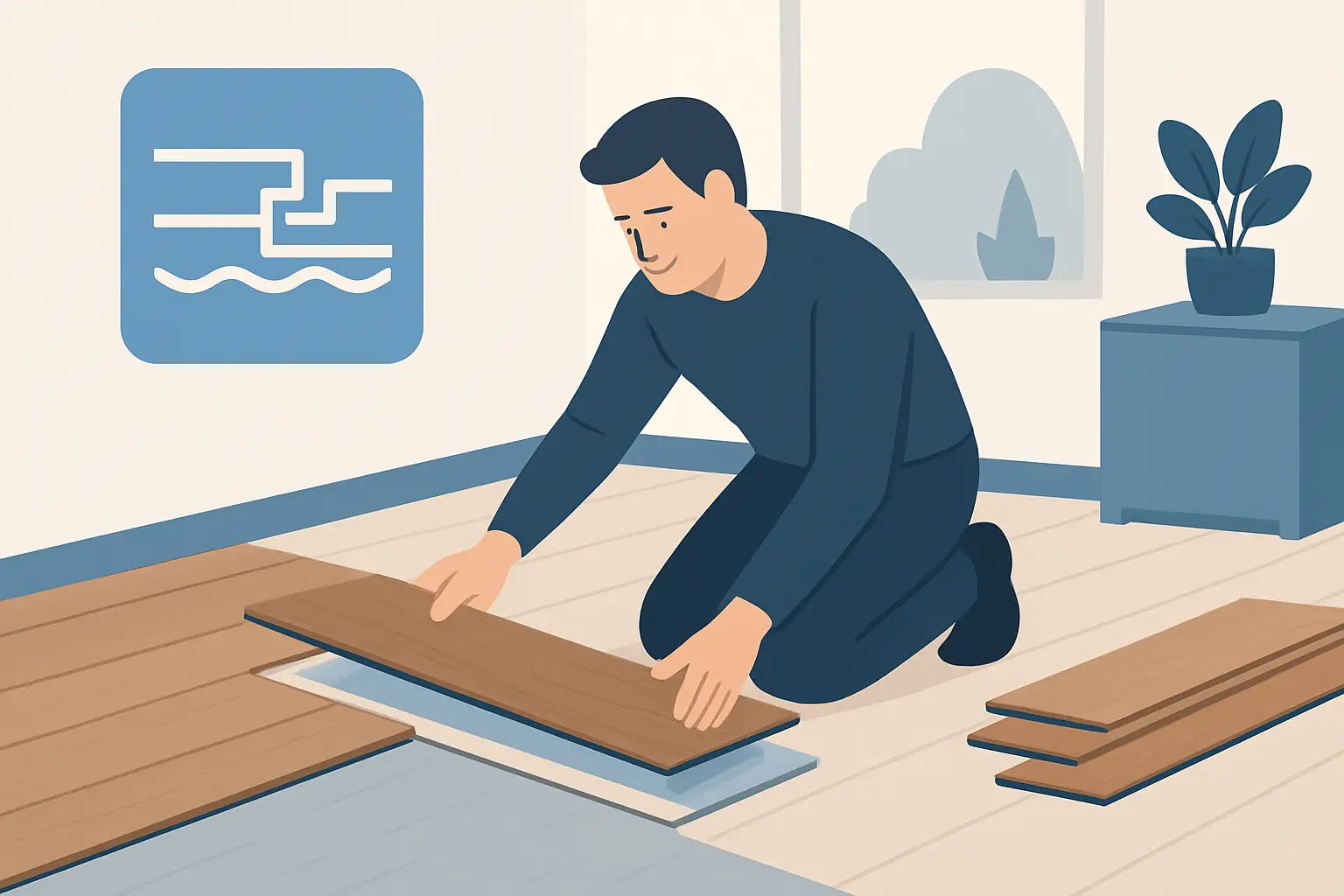
You know the sound: footsteps in the hallway, a chair being moved, children running through the living room. And although the new floor is visually perfect, there's that slight "click-clack" sound that resonates through the room. This is precisely where click vinyl with integrated impact sound insulation comes in – and for many renovators, it's the most convenient shortcut to more peace and quiet.
The appeal is clear: no separate insulation underlay to find, fewer sources of error, quicker installation. At the same time, there are situations where integrated insulation is not the best solution. If you want to know before buying when it's worthwhile, what compromises there are, and what really matters, you've come to the right place.
What "integrated impact sound insulation" means for click vinyl
With click vinyl with integrated insulation, the underlay is attached to the back of the plank at the factory. This is often a thin foam (e.g., IXPE) or a cork layer. The goal is a noticeable reduction of impact sound in adjacent rooms and a more pleasant room acoustics.Important: Impact sound and airborne sound are often confused in everyday life. Impact sound is what your neighbors downstairs hear. Airborne sound is what you perceive in the room as "reverberation" or "harsh acoustics." Integrated insulation can positively influence both, but not to the same extent in every apartment. The subfloor, ceiling construction, and room geometry all play a role.
For whom click vinyl with integrated impact sound insulation is particularly suitable
In practice, this flooring solution is particularly strong when you want to achieve a reliable result quickly. Many customers choose it because they want to complete a project without a long material list – choose the flooring, add accessories, and you're done.Renovation with a clear timeline
If you want to install the floor on the weekend and live normally again on Monday, integrated insulation saves time. You don't have to choose a suitable underlay, cut it, offset seams, or consider whether the pressure stability matches the click connection. Fewer individual parts usually mean fewer typical beginner mistakes.Rental apartments and multi-family homes
In apartments, impact sound is a sensitive issue. Integrated insulation helps to make walking noises more pleasant. However, whether this is sufficient for a particular house rule or technical proof depends on the building. If your landlord or the declaration of division specifies concrete requirements, you should carefully check what values are required.Rooms where comfort matters
Bedrooms, children's rooms, hallways: anywhere you walk frequently, acoustics have an immediate effect. Integrated insulation often makes the floor sound "fuller" and feel slightly more comfortable underfoot.The most important advantages - without marketing bluster
The biggest advantage is not just sound insulation, but predictability.Firstly, the system is coordinated. Manufacturers test the click connection, carrier board, and integrated underlay as a unit. This reduces the risk that an underlay that is too soft will later lead to gapping or clicking noises.
Secondly, you save height. Especially during renovations, every millimeter is relevant: transitions to tiles, doors, skirting boards. If you plan separate insulation plus vinyl, the overall structure quickly becomes thicker. Integrated solutions often keep the structure slimmer.
Thirdly, installation becomes easier for many. Plank by plank, without a loose underlay shifting or waving during work.
The typical disadvantages and when separate insulation is better
As practical as it sounds, there are clear "it depends" cases.If the subfloor is problematic
Integrated impact sound insulation is thin. It cannot "pad away" small unevennesses. If the screed has waves or joints, you first need a suitable subfloor: level, smooth, and prepare cleanly. Otherwise, you will later get rattling noises, a working click connection, or visible shadows in the flooring.If you have special requirements for pressure stability
For heavy furniture, kitchen islands, or very high point loads, the compressive strength of the overall system counts. Some integrated underlays are comfort-oriented but not designed to tolerate additional soft layers. And that's precisely the point: putting a second underlay "for safety" underneath is usually not a good idea. The system becomes too soft, and the click connection suffers.If underfloor heating is involved
Many click vinyl floors are approved for hot water underfloor heating. Nevertheless, you should check how the integrated insulation affects heat transfer. Insulation can slow down heat emission. Whether this is relevant depends on the heating output and your comfort goal. Here, less is often more: a floor with suitable approval and lower thermal resistance feels warm more quickly in everyday use.If you need maximum impact sound values
Integrated insulation is a good standard, but not always the maximum. In special situations (e.g., very poorly soundproofed old buildings), a high-quality separate underlay that precisely matches the floor and subfloor can deliver better results. In such cases, careful system selection is more important than convenience.What you should really pay attention to when buying
Many decisions can be made by taking three looks at the technical data and one look at your room situation.1) Carrier board and stability
With click vinyl, you will encounter different constructions, e.g., Rigid/SPC or other stable carrier systems. More stable carriers forgive subfloor movements better and lie more calmly. This is particularly interesting with integrated insulation, as the underlay is not intended to compensate for unevenness.2) Overall thickness and door details
Measure in advance: door gap, transitions, connection heights to adjacent rooms. Integrated insulation can help to stay within a narrow frame. If you have "extra" height anyway, a separate underlay can come into play again - but then consciously and appropriately.3) Usage class and everyday life
Pets, children, home office with castor chairs: take the stress seriously. The best impact sound is of little use if the surface does not suit your everyday life. Pay attention to suitability for castor chairs and a wear layer that suits your area of use.4) Wet rooms and kitchen
Vinyl is easy to clean, but click systems do not like standing moisture in joints. In the kitchen, guest toilet, or utility room, clean work is crucial: perimeter joints, tightness of connections, no "puddles of mop water." If you have very moisture-stressed areas, glue-down vinyl can also be a worthwhile alternative - it's less "quick" then, but very sensible in some layouts.Installation: What you should do differently with integrated insulation
Installation is usually uncomplicated, but precisely its simplicity tempts people to skip steps.The subfloor must be dry, clean, and level. "Level" does not mean visually smooth, but within the permissible tolerances. If you feel small tipping points when walking over it before installation, it won't get any better later.
Plan for expansion joints. Click vinyl works - even rigid versions. Edge clearances, door openings, and large areas need freedom of movement. Those who install too tightly risk buckling or creaking tension.
And: Do not lay an additional insulation underlay underneath unless the manufacturer explicitly allows it. This is one of the most common reasons for complaints, as the click connection is then subjected to greater stress.
What you should plan for a coherent project
Even if the insulation is integrated, a few accessories remain crucial: matching skirting boards for a clean finish, transition profiles for door areas, and possibly a vapor barrier if the subfloor requires it. Which layer makes sense where depends on the subfloor (e.g., mineral screed) and the room.If you prefer to play it safe when putting things together: at a specialist dealer with a clear selection and accessible support, this is usually quickly clarified. At WaBo Design, many renovators find exactly this mix of branded flooring, installation accessories, and plannable processing in one place: https://wabodesign.de
Price-performance: How to compare fairly
Click vinyl with integrated impact sound insulation sometimes seems more expensive per square meter than "vinyl without." The comparison is only fair if you include the otherwise necessary underlay - and your time.If you factor in a good underlay, cutting, waste, and the risk of a wrong combination, the integrated version is often very competitive. Conversely, a floor without integrated insulation plus an exactly matching premium underlay can end up being more expensive, but deliver more in a difficult acoustic situation. The decisive factor is what problem you want to solve: a quick, solid renovation or maximum optimization.
When you should ask instead of guessing
There are three classic situations where a brief consultation saves you money and nerves: underfloor heating with specific thermal resistance requirements, very uneven subfloors, and old building ceilings where impact sound is a constant nuisance. In all three cases, "just something with insulation" is rarely the best strategy.If you objectively assess your rooms - subfloor, construction height, heating system, and use - the decision becomes surprisingly clear. And that's when the new floor not only feels good but also remains so: quiet, easy to clean, and suitable for your everyday life.