
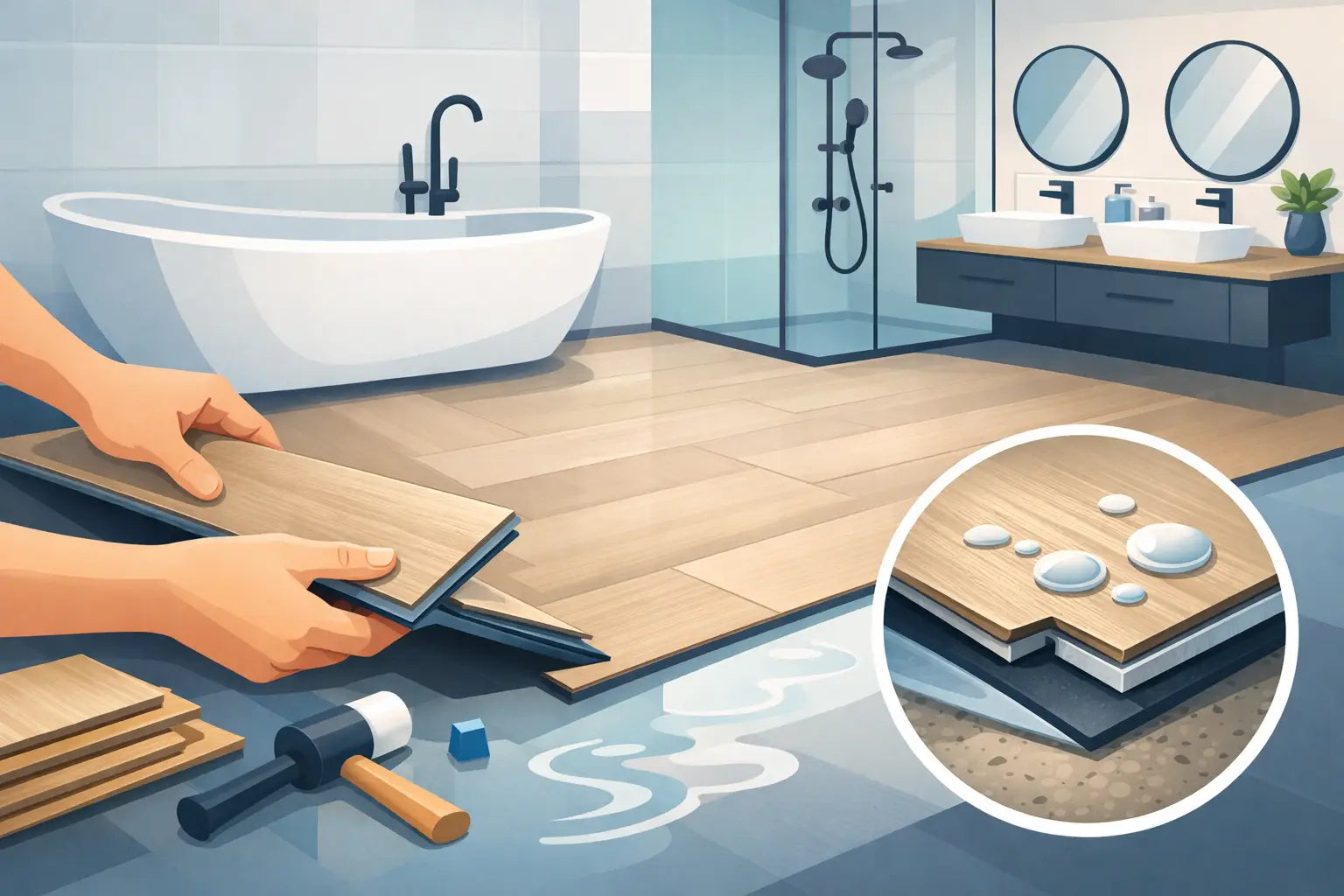
Anyone renovating a bathroom knows the problem: tiles are cold, labor-intensive, and often too much of a construction site for a partial renovation. This is precisely why click vinyl in the bathroom is at the top of many renovators' lists. The look is modern, the surface is pleasantly warm underfoot, and installation is significantly faster than with traditional coverings. Nevertheless, a different standard applies in the bathroom than in the living room or bedroom. Here, not only the design matters, but above all, how well the floor copes with moisture, temperature fluctuations, and everyday wear and tear.
Installing click vinyl in the bathroom – is that even possible?
Yes, but not every product is equally suitable. This is where most wrong decisions are made. Many buyers only see the wood look or the low square meter price and overlook the fact that bathrooms place higher demands in the long term.
In principle, vinyl as a material is insensitive to moisture. This is a clear advantage over laminate or some wood-based materials. However, the construction of the floor is crucial. Click vinyl with an HDF core is usually not a good choice for wet rooms because the core can swell if moisture penetrates. More suitable are rigid or solid vinyl variants with a water-resistant core, such as SPC or Rigid boards.
So, if you want to install click vinyl in the bathroom, you should first check whether the manufacturer explicitly approves its use in wet rooms. This information is more important than any quick product description. In case of doubt, the technical approval always counts.
What really matters in the bathroom
In the bathroom, it's not just about splashing water in front of the sink. Moisture also comes from wet feet, shower mats, condensation, and small puddles that are often left lying around in everyday life. A floor must therefore not only be waterproof but also properly installed and reliably sealed at the edges.
The click system, in particular, is often understood as completely waterproof. This is too general. The plank itself can be water-resistant, but the joints remain a sensitive spot. If moisture penetrates there for a long time, it can cause problems depending on the product and the subfloor. Therefore, edge sealing in the bathroom is more important than in dry rooms.
Then there's the subfloor. A beautiful floor is of little use if there's residual moisture underneath or unevenness puts stress on the click system. In the bathroom, preparation and material selection must match perfectly. Those who cut corners here usually pay double later.
The right subfloor is also crucial
Before the first plank is laid, the subfloor must be checked. It should be dry, load-bearing, clean, and level. Old tiles can often be retained as a subfloor if they are firmly in place and the surface is generally stable. However, wide joints or significant height differences should be filled so that the pattern does not show through later and the click connection is not stressed.
On mineral subfloors such as screed, residual moisture is particularly important. A bathroom is not a room where you work on a whim. If the subfloor is still too moist, even a high-quality covering can be damaged in the long term. In case of doubt, a moisture measurement or consultation with a specialist company is advisable.
The installation height also plays a role. Click vinyl is often a good solution when doors, connections, and existing fixtures leave little room. Nevertheless, you should check beforehand whether door leaves can still move freely and how transitions to adjacent rooms are to be executed.
Which underlay is useful?
Not all click vinyl needs an additional underlay. Many modern rigid or SPC floors already have integrated impact sound insulation. If this is the case, a second layer should not be laid underneath if the manufacturer excludes it. Underlays that are too soft can make the click system unstable.
In the bathroom, it is also important that the underlay is suitable for wet rooms. On mineral subfloors, a vapor barrier is often additionally required, provided the manufacturer specifies it. There is no blanket answer here, as it depends on the product structure and the subfloor. Those who want to install safely should follow the technical specifications of the chosen floor and not general forum tips.
Installing click vinyl in the bathroom – how to ensure a clean installation
The installation itself is quite manageable with a little preparation. It is important that the planks acclimatize in the room beforehand, if the manufacturer recommends it. This allows the material and room temperature to equalize.
Start with a straight wall. As in other rooms, work with an expansion joint to the edge. In the bathroom, however, this joint must not simply remain open. It will later be executed in the area of skirting boards, silicone, or transition profiles in such a way that no water can run uncontrollably under the floor.
When cutting around the toilet, washbasin, or pipe penetrations, the quality of the work becomes apparent. These details are particularly crucial in the bathroom. The more precise the cutouts, the better the final sealing. Large open areas not only look untidy but also pose a functional risk.
In areas with direct and frequent water exposure, for example, in walk-in showers or directly in the splash zone without a partition, click vinyl is not always the best solution. There, adhesive vinyl or a classically sealed tile solution may be the better choice, depending on the bathroom situation. So, it depends on the layout and usage.
Sealing at edges and connection points
The most important point in the bathroom is often only taken seriously at the very end: sealing. Transitions to the shower, bathtub, doorway, and sanitary ceramics must be executed in such a way that water does not get under the covering.
Depending on the situation, suitable transition profiles and elastic sealants are used for this. Silicone joints are not a substitute for poor installation, but they are an important part of a functional finish. It is crucial that they are placed where moisture can actually occur.
Skirting boards are also an issue in the bathroom. Classic MDF skirting boards may fit visually, but they are not always the first choice in wet rooms. Water-insensitive variants or clean finishes that suit the room situation are better.
Which product type is best for the bathroom?
When it comes to wet rooms, rigid click vinyl floors with a mineral or water-resistant core are usually the safer choice. They are dimensionally stable, durable, and often very practical for renovations. Solid vinyl can also work well if the subfloor is level enough.
Click systems with a swelling-prone core are less recommendable. They may suffice in living areas, but in the bathroom, the risk of moisture significantly increases. Even very cheap no-name products appear attractive at first glance, but often skimp on the wear layer, locking mechanism, or dimensional stability. Especially in the bathroom, brand quality pays off because fit and technical approvals carry more weight.
Those who value a long-lasting solution therefore pay attention not only to decor and price but also to the utility class, construction, suitability for wet rooms, and accessories. Because a good floor is only as strong as the system of covering, underlay, and clean finish.
Typical mistakes when installing in the bathroom
Many problems arise not from the material itself, but from shortcuts in execution. An uneven subfloor, missing expansion joints, incorrect underlays, or unprotected connection points are among the most common causes.
Expectations are sometimes also the problem. Click vinyl is easy to maintain and durable, but not an invitation for permanently standing water. Those who regularly leave large amounts of water on the floor after showering unnecessarily stress any construction. A bathroom floor should be suitable for everyday use, but it should not be treated like a swimming pool.
Another mistake is buying solely based on aesthetics. Especially in the bathroom, it is worth looking at the technical details. A slightly higher investment often saves trouble during installation and use.
Care and suitability for everyday use
Once professionally installed, click vinyl in the bathroom scores with low maintenance. Sweeping or vacuuming combined with damp mopping is usually sufficient. Aggressive cleaners are not necessary and often even counterproductive. It is more important not to let water accumulate for hours and to keep an eye on room ventilation.
In everyday life, click vinyl is pleasantly quiet, warm underfoot, and visually versatile. Especially wood and stone looks appear much cozier in the bathroom than many standard tiles. This makes the room more modern without making the renovation unnecessarily complicated.
For whom is click vinyl particularly worthwhile in the bathroom?
For owners who want to modernize their bathroom without undertaking a complete tile renovation, click vinyl is often a strong solution. Tenants also benefit if a removable and visually high-quality option is sought and the structural conditions are suitable. For heavily used family bathrooms, product quality and clean execution are more important.
If you want to compare different brands, decors, and suitable installation products, it is worth taking a look at wabodesign.de. There, you can quickly see which solutions fit your project in terms of price and technology.
In the end, what matters in the bathroom is not the fastest completion, but a floor that still lies cleanly, looks good, and withstands everyday life even after months. That is precisely why it is worth taking a closer look at the material, subfloor, and details.