
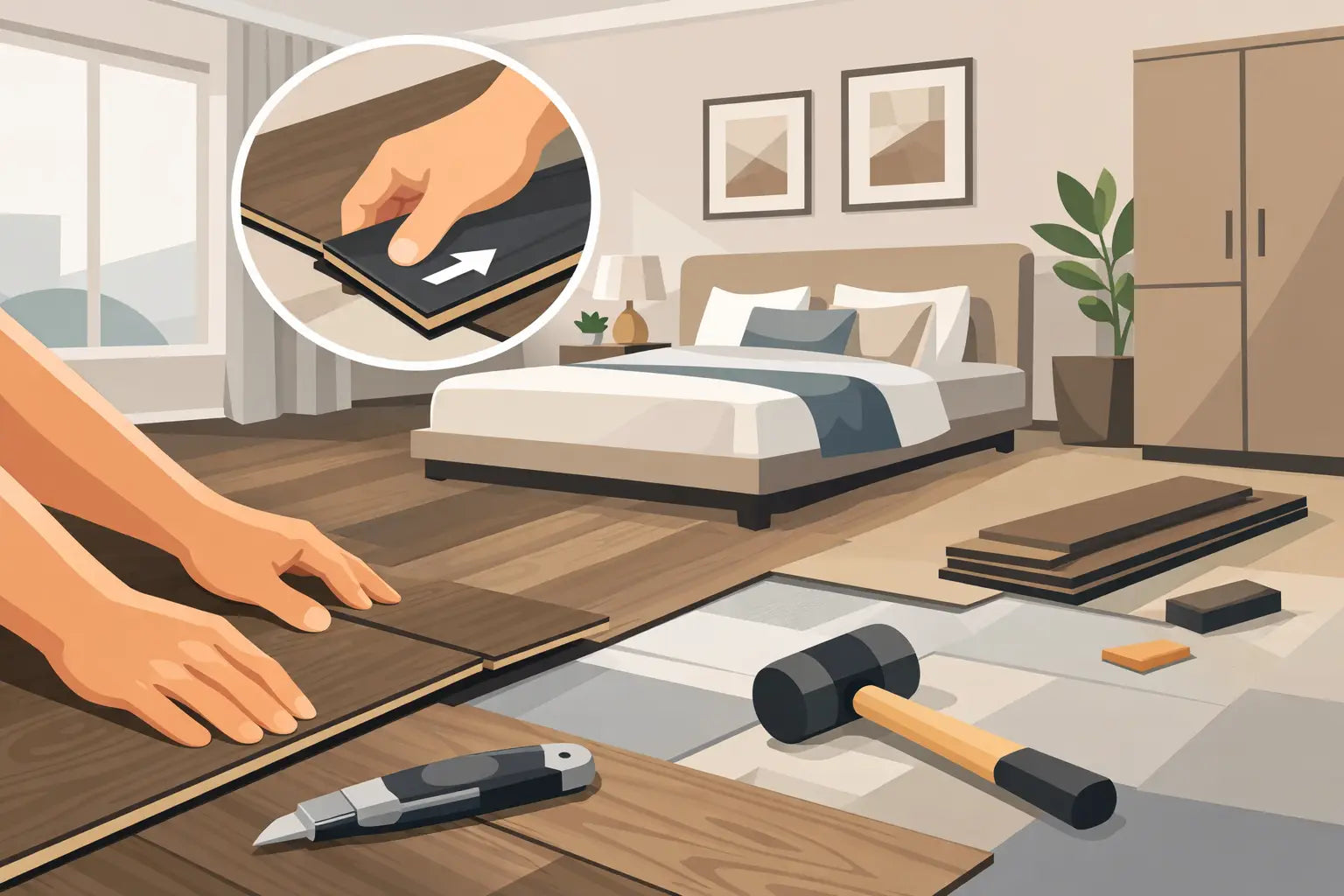
Anyone renovating a bedroom quickly realizes: The flooring determines whether the room feels calm, warm, and tidy – or looks like a half-finished construction site. This is precisely why installing click vinyl flooring in the bedroom yourself is a sensible solution for many. The material is easy to maintain, pleasant underfoot, and, with a little preparation, can be installed neatly even without a professional.
Especially in the bedroom, it's not just about aesthetics and price. The floor should feel pleasant barefoot in the morning, appear quiet, and require little maintenance in everyday life. Click vinyl often meets these requirements better than many expect. The only important thing is that the subfloor, insulation, and laying direction match. Then the result looks high-quality and remains stable in the long term.
Why click vinyl is often the right choice for the bedroom
The bedroom is not a high-traffic area like a hallway or kitchen, but it has its own requirements. People often walk barefoot there, don't want a cold surface, and expect a quiet atmosphere. Click vinyl offers good prerequisites for this. The surface is warm to the touch, resistant, and, depending on the product, significantly quieter than traditional laminate.
There's also the practical aspect for renovations: click vinyl can often be laid floating, meaning without full-surface gluing. This saves time and makes the project realistic even for DIYers. Especially with branded products with precise click connections, this works much more stress-free than with cheap products where fit and locking quickly become a problem.
However, there are also limitations. Click vinyl does not forgive a very uneven subfloor. And if you're working with creaky floorboards in an old building, you first need to fix the base. Otherwise, the new floor might look good at first but will show problems later.
Installing click vinyl in the bedroom yourself - first check the subfloor
The most important step happens before the first plank. The subfloor must be dry, clean, load-bearing, and as even as possible. Small crumbs, old adhesive residue, or noticeable height differences will take their toll later because the click connection will be under tension or the floor will flex.
With screed, the starting situation is usually simpler. Vacuum, check for cracks or holes, and level out any unevenness if necessary. With old floor coverings, it depends on what is already there. A firmly glued, even old covering can sometimes serve as a subfloor. A soft carpet, on the other hand, cannot.
You should pay particular attention to wooden floorboards. If individual boards give way or creak, it's not enough to simply lay over them. Loose areas must be screwed down, height differences leveled, and the surface stabilized. Otherwise, the movement will transfer to the new floor.
Residual moisture also plays a role, especially on the ground floor or with fresh screed. Moisture from below is a silent risk for many floor constructions. In case of doubt, a suitable vapor barrier is part of the system. It's worth not cutting corners here.
Which underlay makes sense in the bedroom
In the bedroom, people often first think of strong impact sound insulation. This is understandable, but not every additional layer is automatically better. What the click vinyl manufacturer specifies is crucial. Some products already have integrated insulation. In such cases, another soft underlay often cannot be used.
If a separate underlay is intended, it should be pressure-stable and suitable for the floor. In the bedroom, it's less about extreme impact loads and more about walking comfort and noise reduction. A good underlay improves the walking sensation, can compensate for slight unevenness within limits, and reduces noise in the room.
Special caution applies to underfloor heating. Here, both vinyl and underlay must be approved for it. Excessive thermal resistance reduces heating performance. Checking this point carefully prevents later disappointment.
How to plan the installation neatly and without unnecessary waste
Before you start, measure the room precisely. Calculate the required area plus waste. In a bedroom with straight walls, about 5 to 8 percent extra is often sufficient. For intricate rooms or diagonal installation, it may be more.
Allow the packages to acclimatize in the room before installation, if required by the manufacturer. Temperature and humidity affect the material. This step is often skipped but can help avoid tension in the floor structure.
The laying direction determines the room's effect. It usually looks calmer if the planks run parallel to the main light source. In narrow bedrooms, laying them lengthwise can also be sensible. There's no strict rule here, but a clear line in the flooring almost always looks higher quality than a spontaneously chosen direction.
It's also important to look at the first and last rows. If the last row would only be a few centimeters wide, you should plan the cut differently from the start. More even rows look better and are easier to install neatly.
Installing click vinyl in the bedroom yourself - step by step
Start at a straight wall and use spacers to maintain the necessary expansion gap. This gap is not a flaw, but technically necessary. It will later disappear under the baseboard.
The first row must be laid precisely. If it's started crookedly, the error will run through the entire room. Therefore, it's better to spend a few extra minutes measuring and aligning. The planks are clicked together on the end and long sides, depending on the system. Make sure not to force the locking mechanism with excessive force. If a plank doesn't fit neatly, there's often an angle or dirt issue.
Offset the joints according to the manufacturer's instructions. This not only creates a harmonious appearance but also distributes the load better. Sections from the end of one row can often be used as the starting piece for the next, if the minimum size fits. This reduces waste.
At door frames, heating pipes, and corners, it will be a bit slower. Precise marking pays off. For pipes, cutouts can be cleanly drilled and opened with a suitable cut. For door frames, the result looks significantly better if the plank is slid underneath rather than butting directly against it.
The last row almost always requires longitudinal cuts. Don't just measure at one point, as walls are rarely perfectly straight. With a little patience, this finish can also be achieved neatly.
Typical DIY mistakes
Most problems don't arise during the clicking itself, but beforehand. An uneven subfloor is the classic. This is followed by incorrect or double underlays, too small expansion joints, and hasty cuts in visible areas.
Another point is product selection. Very inexpensive click vinyl can seem attractive at first glance, but often compromises on the connection or material stability. Especially in the bedroom, you want peace – not a floor that gives way slightly with every step or shows unsightly edges. Brand quality is noticeable here not only visually but also during installation.
Furniture is also underestimated. Heavy cabinets are generally possible, but the floor must be installed correctly. Depending on the product and room situation, it may be sensible to include large built-in furniture in the planning beforehand. This is not a disqualifying factor, but a point that should not be considered only after installation.
How to keep your bedroom floor looking good for a long time
After installation, the floor should first be thoroughly vacuumed and then wiped only damp. Aggressive cleaners are unnecessary. Click vinyl is easy to care for but not indestructible. Felt glides under nightstands, dressers, and chairs help keep the surface looking attractive long-term.
If you value a calm, high-quality overall appearance, you should also not improvise with baseboards and transitions. Clean finishes transform a tidy installation into a harmonious overall picture. Especially in the bedroom, every imperfect edge stands out because the room is usually less cluttered than other living areas.
If you want to choose suitable materials, underlays, and accessories, it's worth looking at a clearly sorted specialist assortment. WaBo Design focuses on strong-brand vinyl floors and suitable installation accessories so you don't have to puzzle over individual components.
Installing click vinyl in the bedroom yourself is not a project for blind activism, but it is very manageable if the basics are right. Anyone who prepares thoroughly, plans sensibly, and doesn't just look at the lowest price when choosing materials will create a floor that starts every morning pleasantly – quiet, easy to clean, and harmonious with the room.