
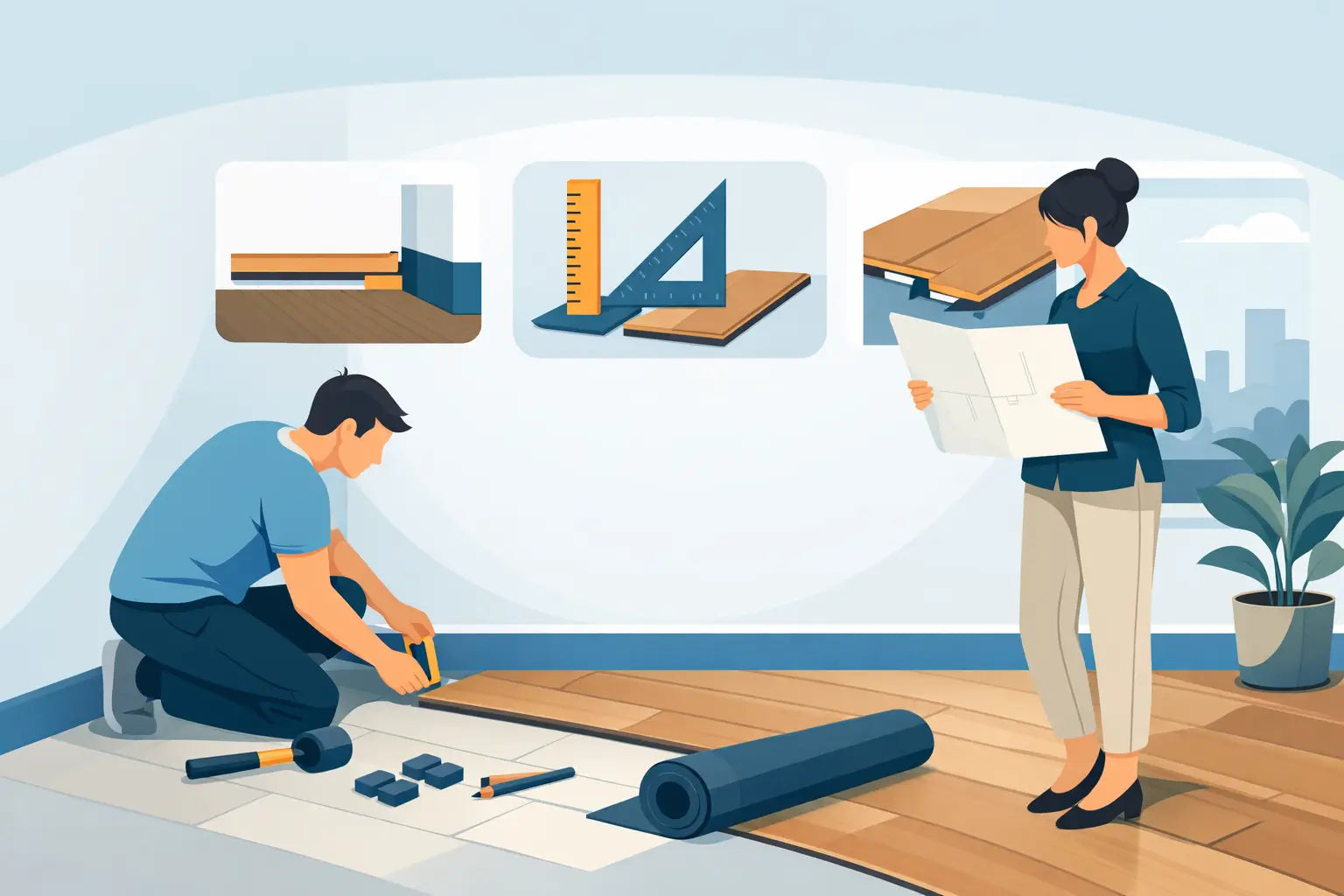
If you lay click vinyl and cut too close to the edges, you often only notice the mistake later: the floor pushes against the wall, individual rows are under tension, or unsightly bulges appear. This is precisely why expansion gaps for click vinyl should be properly planned - not as a minor detail, but as an integral part of the installation.
Click vinyl is rightly considered a quick and clean solution for renovations. The material is easy to maintain, robust, and, depending on its construction, also very dimensionally stable. Nevertheless, a vinyl floor also reacts slightly to temperature differences, room conditions, and subfloor movements. The expansion gap ensures that these movements are absorbed without damaging the surface.
Why expansion gaps are crucial for click vinyl
The expansion gap is the distance between the floor covering and all fixed structural elements. These include walls, door frames, heating pipes, stairs, pillars, kitchen islands, or floor-to-ceiling window profiles. This gap later remains hidden under the skirting board or cover but fulfills an important function: it gives the floor the necessary play.
If this movement joint is missing or too small, the covering cannot move freely. Then, a warmer room phase or localized pressure is enough to cause the surface to shift against each other. The result is tension in the click system, visible edges, or, in the worst case, damaged connections.
This is particularly noticeable in heavily used living areas. In hallways, open-plan kitchens, or long passageways, every small dimensional deviation has a greater impact than in a small side room. Those who plan carefully from the start will save rework later and avoid reasons for complaints, which often go back to simple installation errors.
How wide must the expansion gap be?
There is only a limited general answer, as it depends on the product, the room format, and the manufacturer's specifications. As a rough guide, an edge distance of about 5 to 10 millimeters is recommended for many click vinyl floors. In smaller, normally tempered rooms, the lower range is often sufficient. For larger areas or demanding room situations, it is better to plan more generously.
It's not just the wall that matters. Transitions to other floor coverings, fixed built-in furniture, and heavy structural elements must also be considered. A kitchen unit standing directly on the floating floor can be problematic if the floor is fixed at individual points as a result. Here, it strongly depends on the construction, the weight, and the respective installation recommendation of the product.
When choosing a brand-name click vinyl, you should always first look at the technical data sheet. High-quality collections, in particular, differ in carrier board, overall thickness, and dimensional stability. This also affects the recommended joint width and the maximum possible surface areas without an additional expansion joint.
Small rooms, large rooms, open floor plans
In a guest toilet or a compact office, the risk is more manageable than in an open-plan living-dining area. The larger the contiguous area, the more important a clean expansion gap becomes. For long rooms, intricate floor plans, or connections over several rooms, a separation or transition solution may also be necessary.
Many renovators underestimate precisely this point. The floor looks aesthetically more consistent, but technically, this is not always the best decision. If the manufacturer recommends expansion profiles at transitions, you should not forgo them. This is not a step backward aesthetically, but protection for the surface.
Proper implementation of expansion gaps for click vinyl
In practice, this does not start with the last board at the wall, but already before the first click. The subfloor must be level, dry, and load-bearing. If the floor covering is to lie cleanly later, the subfloor must not already introduce tension.
During the installation itself, spacers help to maintain a constant edge distance. This is especially useful on long walls, as it is easy to become inaccurate with the naked eye. The joint should run evenly all around and not be 3 millimeters on one side and 10 millimeters on the other.
It often gets tricky at door frames. Here, the click vinyl should be neatly pushed underneath without losing the necessary freedom of movement. If you cut too short or jam the material, you create a hidden tension point. Heating pipes also need circulating air, which is later neatly covered with rosettes.
Skirting boards are always fastened to the wall, not to the floor. This sounds obvious, but it is repeatedly done incorrectly. As soon as the skirting board firmly clamps the floor downwards or sideways, the expansion gap is functionally gone - even if it theoretically existed.
Typical errors on the construction site
The most common mistake is simply too little distance. This is followed by irregular joints, firmly clamped edge areas, and heavy built-in elements on a floating surface. Also critical: if the floor is laid at cold temperatures and later needs more expansion at normal room temperature than planned.
Even leftover pieces or small, narrow strips on the last row can be problematic if they are installed under tension. It is better to plan the laying pattern beforehand so that the starting and ending rows are sensible. This looks neater and reduces force on the click connection.
What matters for underfloor heating and sun exposure
Click vinyl is suitable for underfloor heating in many cases. However, this does not change the fact that temperature plays a big role. Especially with floor-to-ceiling windows, south-facing orientations, or conservatories, significantly higher loads occur at specific points than in uniformly tempered rooms.
Here it becomes clear whether expansion joints for click vinyl have been properly considered. A dimensionally stable SPC or rigid core is significantly more tolerant than simple constructions, but even this material is not completely free of movement. If you have strong sun exposure, you should take the manufacturer's limits seriously and not calculate to the last millimeter.
With underfloor heating, the heating protocol of the subfloor also comes into play. The screed must be ready for covering, and the surface temperatures must not exceed the floor's approvals. The expansion joint does not replace a professional subfloor inspection - it is only one component of the overall system.
When silicone is not a solution
Some people want to neatly seal edge areas with acrylic or silicone, especially in damp rooms or at transitions. Visually, this can initially look tidy, but technically, it is often the wrong idea for a floating click vinyl surface. If the joint is elastically filled, the floor loses freedom of movement depending on the design, or the joint compound later tears uncleanly.
In normal living areas, expansion joints are therefore usually covered with skirting boards or suitable profiles. In special areas, such as at a shower, entrance, or problematic connections, the specific product recommendation should be observed. Especially there: do not improvise, but work system-compliant.
Is more distance than prescribed worthwhile?
Too little is risky, but too much distance is not automatically better either. If the joint becomes too wide, the skirting board may not be able to cover it cleanly anymore. In addition, at critical points such as door passages or heating pipes, unsightly cuts are more quickly visible.
Therefore, the best solution is almost always the medium, clean solution: stay within the manufacturer's specifications, work evenly, and measure problematic areas beforehand. If you are unsure, it is better to have some reserve than a press fit. 2 millimeters will not become a tolerant floor later.
Particularly important for renovators: old buildings, transitions, existing walls
In new construction, walls and angles are often more predictable. In old buildings, it looks different. Crooked walls, uneven connections, and older door frames make it more difficult to maintain even expansion joints. Especially there, it is worthwhile to accurately mark the first row and not just stubbornly start straight away.
Transitions to tiles, parquet, or existing coverings also require a clean solution. The most beautiful decorative floor loses its effect if the connecting piece is subsequently pieced together or squeezed. Those who choose matching materials and accessories from the start save time during installation and ultimately get a coherent overall picture.
At WaBo Design, many customers pay attention not only to the floor itself but also to the matching profiles, skirting boards, and installation aids. This makes sense because a good floor only really looks finished with clean accessories.
When you should measure again
If the room is very large, has a lot of glass, is operated with underfloor heating, or if several areas are to be connected without interruption, gut feeling is not enough. Then, dimensions, laying direction, and transitions should be carefully planned in advance. The same applies to heavy built-in furniture or if manufacturer specifications mention special restrictions.
Click vinyl is uncomplicated, but not arbitrary. Those who treat the expansion joint as a mandatory detail instead of a secondary reserve will lay more calmly, work more cleanly, and enjoy the floor longer in the end. That's exactly what makes a quick renovation a permanently good solution.