
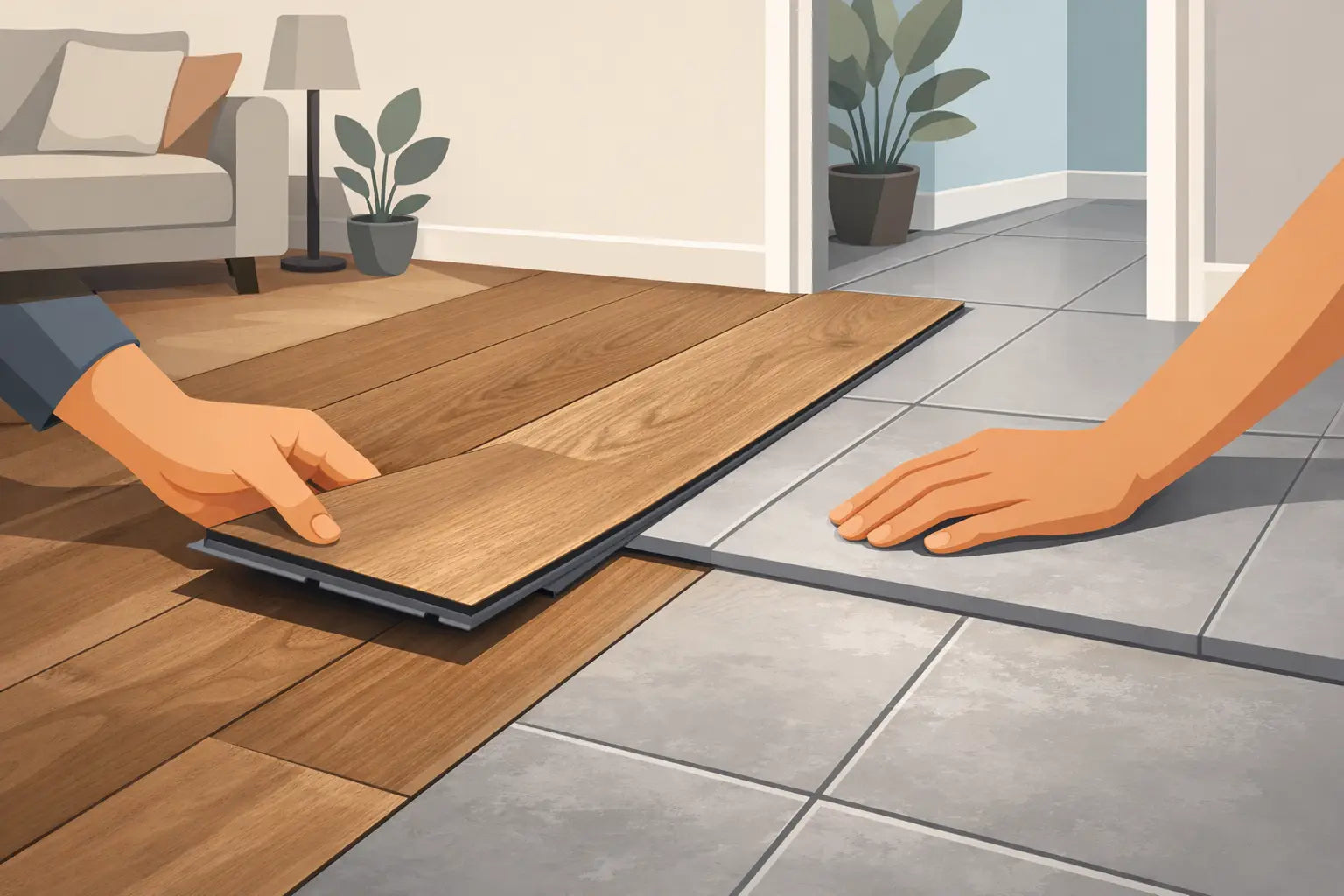
Those who want to lay click vinyl without transition strips usually have a clear goal: a quiet, modern floor surface without visible interruptions between living and dining areas, hallways, or kitchens. This can work very well - but only if the subfloor, room geometry, and product are compatible. Those who decide too quickly here do not save a strip but risk gaps, tensions, or untidy connections.
Laying click vinyl without transition strips - when it makes sense
A continuous installation looks spacious and high-quality. Rooms appear visually larger, the floor makes the furnishings look calmer, and there is no tripping hazard at the door. Especially in open-plan layouts, this is a strong argument.
Nevertheless, installation without a transition profile is not automatically the best solution. Although click vinyl works significantly less than classic laminate, this flooring also reacts to temperature, use, and subfloor. Therefore, the desire for a seamless look is not the only deciding factor; technical feasibility is key.
This solution is particularly suitable when adjacent rooms are on the same level, the subfloor has been properly prepared, and the total area remains within the manufacturer's approved dimensions. It becomes more critical with long hallways, heavily angled layouts, different room climates, or old building subfloors with height offsets.
The most important question first: Can the product be laid continuously?
Not every click vinyl is approved for large continuous areas without separation. Here, intuition does not decide, but the technical data sheet. Manufacturers specify maximum laying areas or maximum lengths and widths beyond which expansion joints or transition strips become necessary.
Especially with branded products such as COREtec, Moduleo, Tarkett, or Liberty, it is worth taking a close look at the installation instructions. Some systems are designed for larger areas, while others require an interruption at door passages or from certain room dimensions. Those who ignore these specifications not only risk damage but often also problems with warranty or complaints.
For private renovators, this is the point where a quick inquiry before purchase pays off. A floor that visually fits perfectly is only the right choice if it also suits the planned installation method.
Laying without a transition strip means: the subfloor must be right
The most common cause of later problems is not the click system but the subfloor. If the floor has minimal height differences from room to room, if old tile joints show through, or if an area is slightly dished, laying without a profile quickly becomes tricky.
Click vinyl needs a stable, level, and dry subfloor. Every error is particularly visible at door passages. Movements from two rooms meet there, traffic is frequent, and tensions arise first. A small edge that could still be concealed with a transition strip is immediately noticeable without one.
In practice, this means: unevennesses must be compensated for before laying. For mineral subfloors, leveling compound is often the clean solution. For existing tiles, it depends on how wide and deep the joints are and whether the chosen click vinyl is approved for them. Those who work cleanly at this point save themselves later rework.
Door passages are the critical point
Many want to lay click vinyl without transition strips but mainly think of open living areas. The real test is enclosed rooms with door frames. This is where it is decided whether the surface remains calm or whether the system comes under tension.
A door passage combines several requirements in a small space. The laying direction must be continued cleanly, the expansion gaps at the edge must be maintained, and the locking mechanism must not be installed under force. If, in addition, the floor in one room is exposed to stronger sunlight than in the next, the risk of movement increases.
Therefore: the more individual rooms are connected, the more precisely planning should be done. An open living-dining area without hard room separation is usually less complicated than a complete apartment with several small rooms, a hallway, and a storage room.
Do not underestimate room climate, sunlight, and usage
Click vinyl is suitable for everyday use and easy to care for, but not completely insensitive to temperature differences. Large window fronts, south-facing sides, or conservatories can significantly increase the surface temperature. If a large area is then laid without separation, the demands on the product and execution increase.
Usage also plays a role. In heavily frequented areas such as hallways, kitchens, or entrances, different stresses apply than in the bedroom. A continuous installation is visually attractive there but must technically fit the situation. So there is no blanket yes or no - it depends on the area, product class, and installation situation.
Those who want to play it safe should pay attention not only to the decor choice but also to construction height, backing board, click system, and manufacturer approvals. This is often more important than the pure appearance of the surface.
How to properly plan click vinyl without transition strips
Good planning begins with precise measurements. Not only the square meters are crucial, but also the longest continuous stretches. A floor plan with two open areas can be technically simpler than a narrow, long hallway with several branches.
Afterward, the laying direction should be determined. It usually looks harmonious if the floor runs over the main light source or along the longest room axis. For a continuous surface, however, not only the optics count, but also the technical stability in the system. Changes of direction in the middle of connected areas make laying unnecessarily complicated.
The edge joint is also important. Even without transition strips, the floor needs space for movement at walls, fixed components, heating pipes, kitchen islands, or heavy built-in furniture. These joints later disappear under skirting boards or suitable finishing profiles at the edge - but not in the middle of the walkway.
Which mistakes happen particularly frequently
The first mistake is the assumption that click vinyl can always be laid everywhere without a separation profile. That sounds good, but it is too general. Without manufacturer approval, it remains a risky decision.
The second mistake is a seemingly level subfloor. Especially in existing properties, floors look neat at first glance and only show small depressions or elevations during installation. In individual rooms, this is sometimes hardly noticeable, but in a continuous area, such deviations add up.
The third mistake concerns time pressure. Click vinyl is often chosen because it modernizes quickly and requires little maintenance. That's true. Nevertheless, the material should acclimatize before laying, and the subfloor must maintain the necessary residual moisture. Those who cut corners here can easily incur later tensions.
When a transition strip is the better choice despite the desired solution
As clear as the advantages of a seamless surface are - sometimes the transition strip is simply the cleaner solution. For example, with different floor heights, problematic door passages, very large overall areas, or when several rooms have strongly differing temperatures.
A profile can also be useful for rental properties or quick renovations. It creates a controlled separation, facilitates later partial repairs, and reduces the risk that movement in one room affects the adjacent area. Visually, this is not always the first choice, but technically often the more sensible one.
This is not a step backward but a weighing of options. A good floor should not only convince on the day of installation but also lie cleanly after years.
What role product selection plays
If you lay click vinyl without transition strips, the product selection should be made consciously. Not every decor and not every construction is equally suitable for every living situation. Especially for larger areas, it is worth paying attention to stable click systems, durable wear layers, and clearly documented installation instructions.
Especially in online shops, it is tempting to only look at the price per square meter first. This is understandable, but for a continuous installation, the overall package of quality, dimensional stability, and approval counts much more. A cheap floor quickly becomes expensive if it is not technically sensible in the planned area.
Those who prefer a brand-based selection with clear product specifications will find exactly this orientation at WaBo Design. This helps especially when optics, budget, and installation method are to match without long detours.
Clean optics are not only created on the surface
Often, all attention is focused on doing without transition strips. However, the overall impression is just as much determined at the edges. Skirting boards, door frames, connections to tiles, or floor-to-ceiling windows must be precisely executed so that the surface truly looks high-quality.
The result is particularly beautiful when door frames are cleanly undercut and the click vinyl visually runs underneath. This looks much calmer than if the floor is only cut up to the frame. Here, too, however, the rule applies: neatly planned is done faster than corrected later.
If you have a desire for a continuous, modern floor surface, that is absolutely understandable. The best decision in the end is the one that not only looks good in the sample but also functions permanently in everyday life. That is precisely why a brief, sober look at room dimensions, subfloor, and manufacturer approvals before buying is worthwhile - so that a beautiful idea becomes a floor that convinces every day.