
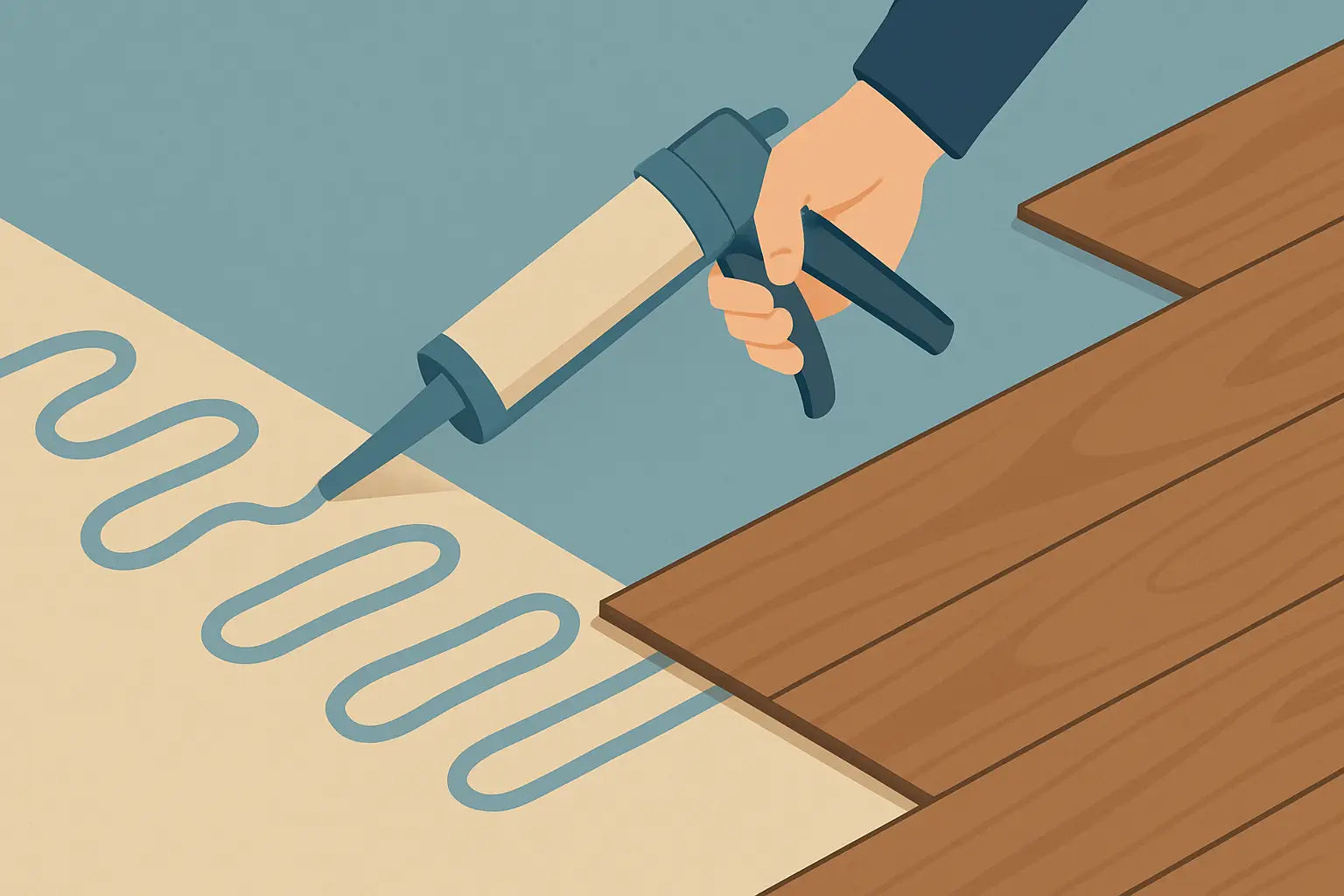
Anyone who has ever laid vinyl knows the moment: the plank is down, the look is right, and yet the question remains whether the glue is really the right one. Assembly adhesive sounds like an uncomplicated solution. For some areas, that is true. For others, it is the direct path to open joints, ripples, or a floor that comes loose after a few months. Here you get the straight talk on when assembly adhesive is suitable for vinyl flooring and when it is not.
The most important things in brief
- Assembly adhesive (cartridge, usually MS polymer) is for baseboards, profiles, and repairs, not for entire floors.
- Glue-down vinyl areas are bonded over the entire surface using flooring adhesive and a notched trowel.
- Click vinyl is installed as a floating floor; no adhesive belongs on the surface.
- The subfloor must be firm, dry, and level; otherwise, no bonding will hold.
- Wrong adhesive = expensive rework (ripples, hollow spots, detachment).
Table of Contents
- Assembly adhesive vs. flooring adhesive
- When assembly adhesive is suitable
- When it is not suitable
- The subfloor is the deciding factor
- Correctly bonding glue-down vinyl over the entire surface
- Avoiding common mistakes
- Do I need adhesive for click vinyl?
- Frequently asked questions
- Conclusion
Assembly adhesive vs. flooring adhesive, the difference
In everyday life, "assembly adhesive" is often used as a collective term. Technically, it is a high-viscosity adhesive (often MS polymer or hybrid) for spot or linear bonding, baseboards, profiles, and transition rails. Glue-down vinyl, on the other hand, is bonded over the entire surface with a dedicated flooring adhesive applied with a notched trowel, which accommodates movement in the system.
| Assembly adhesive | Flooring adhesive | |
|---|---|---|
| For what? | Baseboards, profiles, stair nosings, repairs | full-surface bonding of glue-down vinyl |
| Application | spot / as a bead (cartridge) | surface-wide with a notched trowel |
| For whole floors? | no | yes |
When assembly adhesive is suitable
There are three typical cases where assembly adhesive is a good solution for vinyl:
- Baseboards & finishing profiles: fast, clean, reliable, provided the wall is load-bearing and dust-free.
- Stair nosings, transitions, small repairs: clearly defined components on a clean, dry, grease-free surface with sufficient contact pressure.
- Individual elements on a very small area: only in exceptional cases; as soon as the area, temperature changes, or usage increase, the risk rises.
When it is not suitable
Assembly adhesive is not designed to support an entire floor. On large areas, tensions arise between rigid beads of adhesive and free areas, resulting in ripples, hollow spots, cracking noises, or open joints. With thin glue-down vinyl, the adhesive bead can show through under the plank, especially in grazing light. And for damp subfloors, assembly adhesive does not solve the moisture problem; here, you need a proper system consisting of primer, leveling compound, and flooring adhesive.
The subfloor is the deciding factor
Regardless of the adhesive, the subfloor is the actual foundation. Vinyl is brutally honest: every imperfection, every layer of dust, and every soft spot will take its toll. A good subfloor is firm, dry, crack-free, and level. On old tiles, there is usually no way around leveling compound, and on absorbent surfaces, a primer is often mandatory.
Correctly bonding glue-down vinyl over the entire surface
For a floor that remains lastingly stable, full-surface bonding is the gold standard. First, acclimatize (bring vinyl and adhesive to room temperature), then prepare the subfloor (vacuum, prime, level, vacuum again). When gluing, choose the notch size appropriate for the flooring and adhere to the flash-off time; if placed too early, the flooring will "float," and if too late, it will not stick. After laying, rub down or roll, then give the adhesive time to cure. You can find a suitable adhesive such as the Bostik STIX A540 Multi Plus directly in our shop.
Avoiding common mistakes
- Insufficient preparation: joints, pores, or dust residue result in the flooring not lying flat on the surface.
- Wrong timing: flash-off time and open time are not just theory. Too wet = planks shift; too dry = no adhesion.
- Wrong adhesive: using assembly adhesive as a substitute for full-surface LVT bonding is an unnecessary risk in most rooms.
Do I need adhesive for click vinyl?
No. Click vinyl is designed for floating installation; adhesive has no place on the surface, as it would negate the necessary expansion joints. Assembly adhesive is used at most for edge details (baseboards, profiles). Unsure which system you should use? Then our guide Click vinyl or glue-down vinyl? How to decide will help.
Frequently asked questions
Can I glue vinyl to tiles with assembly adhesive?
For individual edge details, yes, but for flooring, generally no. Tile joints and the grazing light problem speak clearly in favor of leveling and full-surface bonding if you choose glue-down vinyl.
Does assembly adhesive hold on screed?
It can stick to firm, dry screed, but for a floor area, a full-surface flooring adhesive is the much better choice because it provides uniform support.
What if I just want to fix a few planks?
As a short-term repair, this can work. A professional repair with suitable adhesive and a level subfloor is cleaner. Recurrent detachment almost always indicates an underlying subfloor or moisture problem.
Conclusion
When gluing, think less in terms of "fast" and more in terms of "predictable." Assembly adhesive is great for baseboards and profiles, but it is no substitute for full-surface bonding. The best bond is the one you won't think about in two years because it simply stays put. You can find the right flooring and accessories at WaBo Design from a single source, or get your sample in advance.