
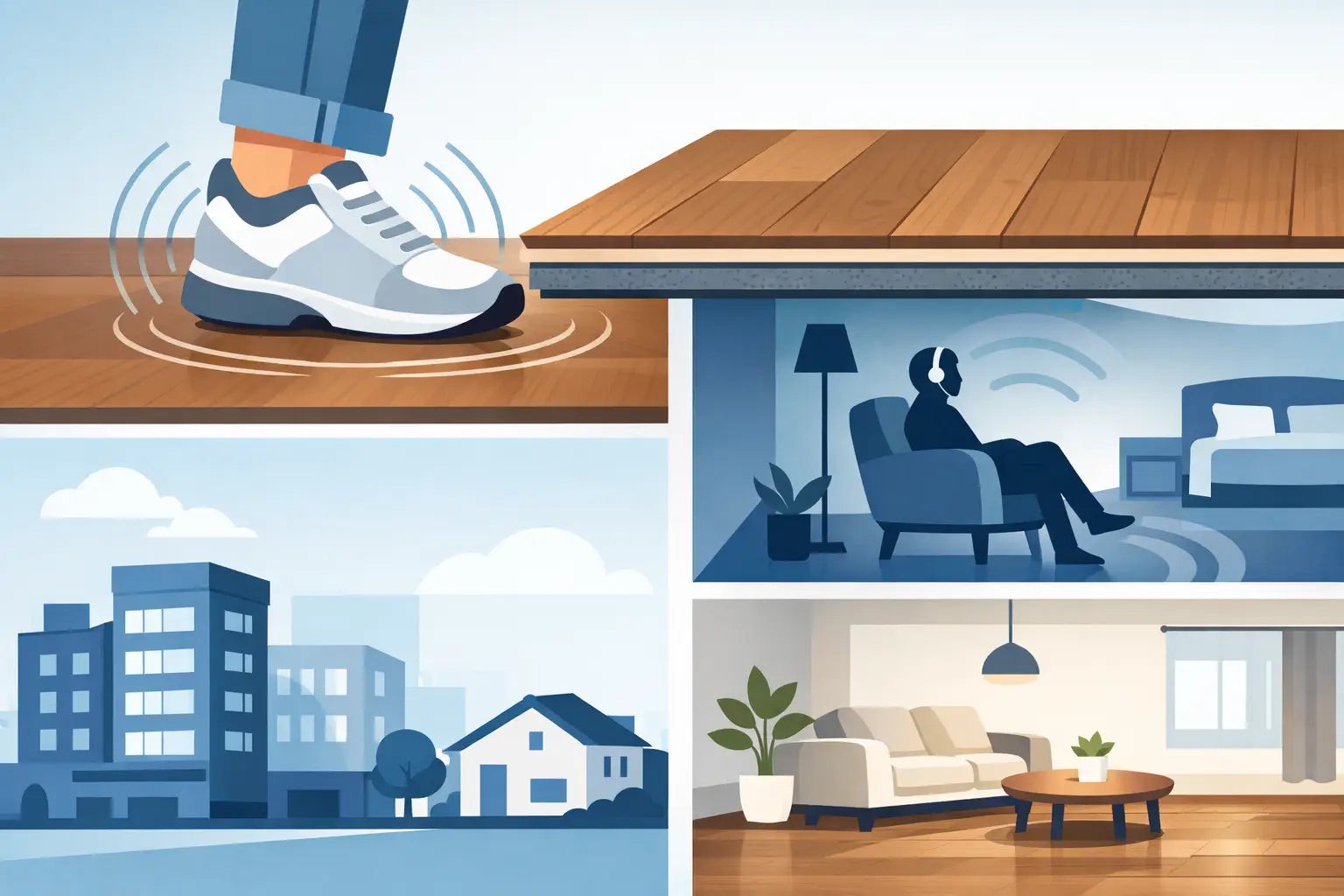
If you hear every step from the hallway in your apartment or notice a loud clacking sound on the upper floor, you're rarely just looking for a beautiful floor. Most of the time, it's about peace and quiet in everyday life. That's precisely why reducing impact sound with vinyl flooring is so relevant for many renovators: vinyl looks pleasant, modern, and easy to maintain, but the actual noise development largely depends on the correct subfloor structure.
Vinyl flooring can effectively reduce impact sound – but not automatically. It depends on whether you choose click vinyl or glue-down vinyl, the condition of the subfloor, and whether a suitable sound-insulating underlay is part of the system. If you only look at decor and price here, you often save in the wrong place.
Reducing impact sound with vinyl flooring – what really matters
In everyday life, two things are often confused: impact sound and footfall sound. Impact sound is the sound transmitted through the structural components when the floor is walked on, reaching the rooms below. Footfall sound is the noise you hear directly in the room, such as the typical clacking of shoes on a hard floor.
If you want to reduce impact sound with vinyl flooring, you need to consider both levels. A floor can sound pleasantly quiet in the room and still transmit a relatively large amount of sound downwards. Conversely, a technically good impact sound insulation can be achieved, but the room itself might still feel quite hard. For a good result, not only the material but the entire system counts.
Vinyl generally has an advantage over many hard floor coverings. Its surface is more elastic than tile or laminate, which already positively influences noise development. Nevertheless, vinyl remains a thin floor covering. Especially with click systems, the result is very sensitive to the subfloor and the underlay.
Click vinyl or glue-down vinyl – which structure is quieter?
Click vinyl is popular because it can be installed quickly and is particularly suitable for renovations. The system is laid floating, meaning it is not permanently connected to the subfloor. This is precisely where the acoustic crux lies. Small vibrations can occur between the subfloor, underlay, and floor, amplifying footfall noise if the components are not perfectly matched.
Glue-down vinyl is often the quieter solution. It is fully glued down, thus lying directly and stably on the prepared subfloor. This reduces cavities and minimizes movement in the material. The floor often feels calmer, firmer, and acoustically more pleasant in the room. Impact sound can also behave more favorably as a result, especially if the subfloor has been properly leveled and smoothed.
However, this does not mean that click vinyl is automatically loud. Modern click vinyl floors with integrated impact sound insulation or with approved premium underlays can deliver very good results. It is only important not to use just any insulation mat. Underlays that are too soft or unsuitable not only impair the acoustics but also the stability of the click connection.
The underlay often matters more than the floor itself
Many buyers first look at the wear layer, appearance, and format. Acoustically, the underlay is often the invisible main factor. It decouples the floor from the subfloor, compensates for minor unevenness, and influences how strongly footsteps are transmitted or audible in the room.
For click vinyl, the underlay may only be as thick and pressure-resistant as permitted by the manufacturer. A classic laminate underlay is often unsuitable. Vinyl is thinner and more flexible. If a too-soft material is placed underneath, the floor works more, the connection suffers, and the walking sensation becomes unstable. This can ultimately be louder rather than quieter.
In practice, this means: pay attention to the approval for vinyl flooring, sufficient pressure stability, and suitability for underfloor heating, if present. Integrated insulation can be useful, but it does not completely relieve you of the system check. Even then, the subfloor must be suitable.
With glue-down vinyl, the classic underlay is usually omitted. Instead, the quality of the subfloor is decisive. A smooth, leveled surface ensures that the covering lies flat and no disturbing resonances occur. Those who work carefully here often achieve the acoustically most convincing result.
The subfloor – often the real weak point
Even the best vinyl flooring cannot effectively reduce impact sound if the subfloor is problematic. Unevenness, loose old coverings, or unstable surfaces transmit noise differently than intended in the data sheet. This applies to old buildings as well as quick renovations where an existing floor is simply to be covered.
A mineral, even, and dry subfloor is the best basis. On old tiles, click vinyl can work if grout lines and height differences are compensated. For significant unevenness, only preparation helps. Otherwise, you will not only hear more later but also feel every transition under your feet.
With wooden floorboards, a little more caution is required. The subfloor vibrates more strongly and can itself generate noise. Here, vinyl alone rarely brings the desired quiet. Only when the construction is stabilized and properly prepared does the floor show its acoustic advantages.
Reducing impact sound with vinyl flooring in apartments and houses
Whether you are renovating in a single-family house or want to live more quietly in a rented apartment makes a difference. In an apartment, what is transmitted downwards often matters most. There, a systematically planned floor structure is particularly important. A good vinyl solution can help, but it does not replace structural decoupling if the ceiling is generally poorly insulated.
In your own house, footfall sound is more often the focus. Many want children's rooms, hallways, or living areas to feel quieter and sound less harsh. Here, vinyl clearly scores over tiles and often also over laminate. Especially in combination with a suitable underlay, the floor feels more pleasant to walk on and sounds less bright.
If pets live in the household, the difference also quickly becomes apparent. Claws on a hard, floating floor sound different from those on a firmly glued covering. Those who are sensitive to such noises should seriously consider glue-down vinyl.
What to look out for when buying
Acoustics cannot be determined by a single advertising value. Damping specifications in decibels are useful, but only in the right context. They indicate test conditions, not automatically your specific living situation. An old building with a wooden beam ceiling reacts differently than a new building with a solid screed.
It is useful to look at the complete product environment: Is the underlay approved for exactly this floor? Is there integrated insulation? Is the floor intended for quick renovation or for a full-fledged, permanent structural height with leveling and gluing? Brand-name products usually offer clearer technical specifications and more reliable system recommendations.
For many customers, this is precisely the decisive factor for purchase. Those who are looking not just for any floor, but for a suitable solution, ultimately save time, complaints, and unnecessary modifications. With a curated selection with clear product lines, it is easier to recognize which floor suits which requirements - whether for the bedroom on the upper floor, the rented apartment, or the heavily used family hallway.
Typical mistakes that make the floor louder
In practice, it's often not major planning errors, but small shortcuts. An unsuitable underlay, an wavy subfloor, or overlooked manufacturer approval are enough to audibly worsen the result. Edge areas also play a role. If the floor is clamped at the sides, tensions can arise that have a negative acoustic impact.
Equally problematic is the assumption that more insulation is automatically better. Especially with click vinyl, this is not true. Too much elasticity harms the system. A floor does not become quiet due to the softest possible layers, but due to the technically correct structure.
If you are laying on underfloor heating, you should also keep an eye on the thermal resistance. An acoustically good solution does not automatically have to be the best for heating performance. Here, too: it depends on the combination.
Which solution suits which requirement?
If you want to renovate quickly, lose as little structural height as possible, and want a clean, uncomplicated installation, high-quality click vinyl with a suitable insulation underlay is often the right choice. The result can be very neat and suitable for everyday use, especially on a well-prepared screed.
If maximum quiet, a firm walking sensation, and particularly high-quality installation are paramount, glue-down vinyl is usually advantageous. It requires more preparation, but often pays off acoustically. Especially in bedrooms, apartments with sensitive neighbors, or for high demands on walking comfort, this approach is worthwhile.
If you are unsure, you should not consider the floor in isolation, but as a system consisting of covering, subfloor, and accessories. This is precisely where a quick compromise differs from a solution that truly convinces in everyday life. WaBo Design therefore relies on brand-oriented vinyl floors and suitable installation accessories so that appearance, quality, and function fit together.
A quiet room does not happen by chance. If you choose the right structure for vinyl flooring, you will hear the difference every day - and usually with the very first step.