
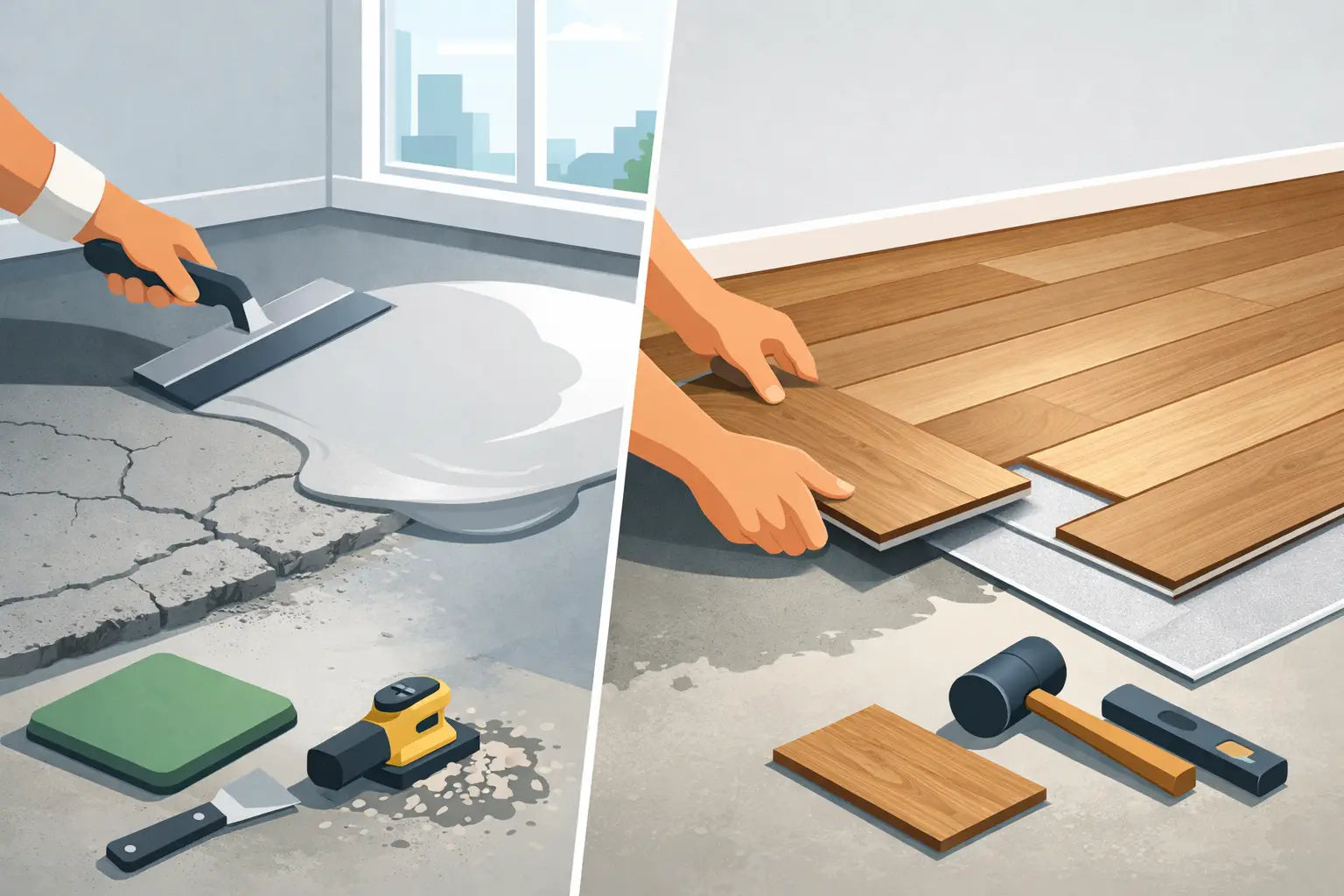
Anyone who lays click vinyl and later notices creaking spots, gaps, or slight waves almost always has the same problem: not the material, but the subfloor. That's why you should prepare the subfloor for click vinyl before the first plank is even laid. A good floor covering can tolerate a lot – a bad subfloor tolerates almost nothing.
Why the subfloor is so crucial for click vinyl
Click vinyl is considered a fast and clean solution for renovations. This is true – but only if the floor underneath is suitable. Even rigid and high-quality click systems require a subfloor that is level, dry, load-bearing, and clean. If any of these conditions are not met, it can become noticeable when walking later or put a strain on the connection of the elements.
Especially in existing buildings, this is a common issue. Old tiles, screed with fine cracks, floorboards, or small height differences often look harmless. However, under click vinyl, such weaknesses do not become invisible but transfer to everyday use. Working meticulously here saves trouble and unnecessary rework.
Preparing the subfloor for click vinyl – these four points must be correct
Before moving on to primer, filler, or impact sound insulation, a sober assessment is worthwhile. The subfloor must meet four requirements above all.
First: It must be level. Small depressions or elevations are enough to cause click connections to work under stress. Second: It must be dry. Residual moisture in the screed or a damp basement floor can cause long-term problems. Third: It must be load-bearing. Loose old coatings, crumbling filler spots, or springy wooden floors are not a good base. Fourth: It must be clean. Dust, paint residue, or adhesive residue impair the support and the effectiveness of further preparatory work.
These four points are not an extra for perfectionists, but the basis for the new floor to lie quietly and look visually clean.
What kind of subfloor is present?
The correct preparation depends heavily on what is already in the room. On cement screed or anhydrite screed, the starting situation is usually clear. Here, it is primarily about moisture, flatness, and any leveling work.
The situation is different with old floors. Old tiles can fundamentally be suitable if they are firmly seated and the joints are not too deep. For clear joint patterns or individual damaged areas, filling is usually the safer solution. Wooden subfloors such as floorboards or OSB panels are possible if they are stably screwed and do not yield. Carpet, on the other hand, usually needs to be removed. It is too soft, hygienically problematic, and not a durable base for click vinyl.
PVC, linoleum, or old glued coverings must also be assessed individually. If the covering is firmly seated, level, and shows no damage, laying on it can work. In case of doubt, removal is often the cleaner way – especially if the old floor is uneven or it remains unclear how load-bearing the surface really is.
Checking for flatness – not by eye
Many subfloors appear smooth at first glance. However, what matters is not the appearance, but whether the floor lies flat across the surface. A long straightedge or a straight spirit level is suitable for checking. This allows depressions, edges, and small bulges to be reliably identified.
Click vinyl does not require a perfectly smooth subfloor, but it should not have localized loads. Even small height differences can later stress click connections. If the floor is noticeably uneven, it should be repaired. Sanding helps with elevations, a suitable filler helps with depressions or joints.
Anyone who plays for time and skips this phase usually only saves until the first creak when walking.
Dryness is a must, especially on screed
A common mistake in renovations is laying on subfloors that still have residual moisture. This particularly affects new screeds, but also older basements or areas with unclear moisture exposure. Click vinyl itself is insensitive, but the overall structure underneath is not infinitely so.
For mineral subfloors, moisture should be checked, professionally if in doubt. Especially for new construction, renovation, or underfloor heating, this is not a minor matter. Depending on the product and structure, an additional vapor barrier may be required. It is always worth checking the installation instructions of the respective manufacturer here.
This is also the point where quality differences in the system become apparent. Not every click vinyl has the same requirements for underlay, residual moisture, or pressure stability. Therefore, when choosing branded goods, one should not only be guided by the decor but also by the technical specifications of the floor.
Establish load-bearing capacity – loose areas have no place under click vinyl
A subfloor can be dry and clean and yet unsuitable. Namely, if it is not stable enough. Loose tiles, brittle filler spots, creaking floorboards, or poorly fastened panels must be repaired before installation.
For wooden floors, this often means: re-screwing, bracing, and eliminating disturbing movements. For mineral subfloors, it means: removing loose components, filling defects, and priming if necessary. It is important that the surface does not move under load. Click vinyl, as a floating floor, is comfortable, but not a repair cover for problematic old subfloors.
Cleanliness is more than just sweeping once
Dust, sanding residue, old paint splatters, or adhesive residue are often underestimated. However, they are relevant for the support of the floor and the adhesion of primers or fillers. The subfloor should therefore be thoroughly vacuumed and not just superficially cleaned.
On oily or heavily soiled surfaces, simple sweeping is not enough. Here, it is really necessary to work down to the load-bearing layer. This takes a little more time, but ensures that subsequent layers function reliably.
Filling, leveling, smoothing – when it is necessary
Not every floor needs to be filled over the entire surface. If the subfloor is already level, load-bearing, and stable, sometimes localized repairs are sufficient. However, for old tiles, visible joints, uneven screed, or several small imperfections, a leveling compound is often the better decision.
It creates a homogeneous surface and reduces the risk of unevenness becoming visible later. Especially in renovations, this is usually more cost-effective than half-hearted repairs at many individual spots. The only important thing is to choose the right material for the respective subfloor and to observe the drying time.
Anyone who continues too early here will directly create the next mistake.
Don't forget the right underlay
When preparing the subfloor for click vinyl, the question of the underlay also arises. Not every impact sound insulation is automatically suitable. Crucial factors are pressure stability, construction height, and approval for the respective product.
Some click vinyl floors already have integrated insulation. In this case, an additional underlay may often not be used. Other systems require a suitable underlay to ensure walking comfort, room acoustics, and resilience. For underfloor heating, thermal resistance also comes into play.
Here too, more material is not automatically better. An underlay that is too soft can put more strain on click connections than protect them.
Typical mistakes when preparing the subfloor
Many problems do not arise during the installation itself, but in the hours before. It is typical to simply lay directly on old tiles, even though the joints are deep. Also common: a new screed is assumed to be dry, although no reliable measurement has been taken.
Another classic is the idea that click vinyl compensates for small unevennesses. It only does so to a very limited extent. The wrong underlay or a springy wooden subfloor also often lead to complaints that could have been avoided with proper preparation.
Anyone who wants to modernize a room understandably wants to finish quickly. That's precisely why it's worth taking a clear look at the subfloor – once properly prepared, the actual installation is much more relaxed.
How to make a better decision before buying
If it is not yet decided which click vinyl should go into the room, it is worth honestly evaluating the subfloor first. In an apartment with a stable screed and a smooth surface, the selection is large. In old buildings with floorboards, transitions, or slightly uneven existing conditions, the product should match the structure.
Branded floors from manufacturers such as COREtec, Moduleo, or Tarkett differ not only in appearance but also in construction and technical requirements. This is relevant in everyday life. Those who buy appropriately save time during installation and reduce the risk of later problems. For questions about floor structure, accessories, and suitable products, it is worth taking a look at https://wabodesign.de – especially if you plan to get flooring and installation accessories from a single source.
A beautiful floor does not begin with the decor, but with what lies underneath. If the subfloor is right, click vinyl will ultimately look just as high-quality as it promised when purchased.