
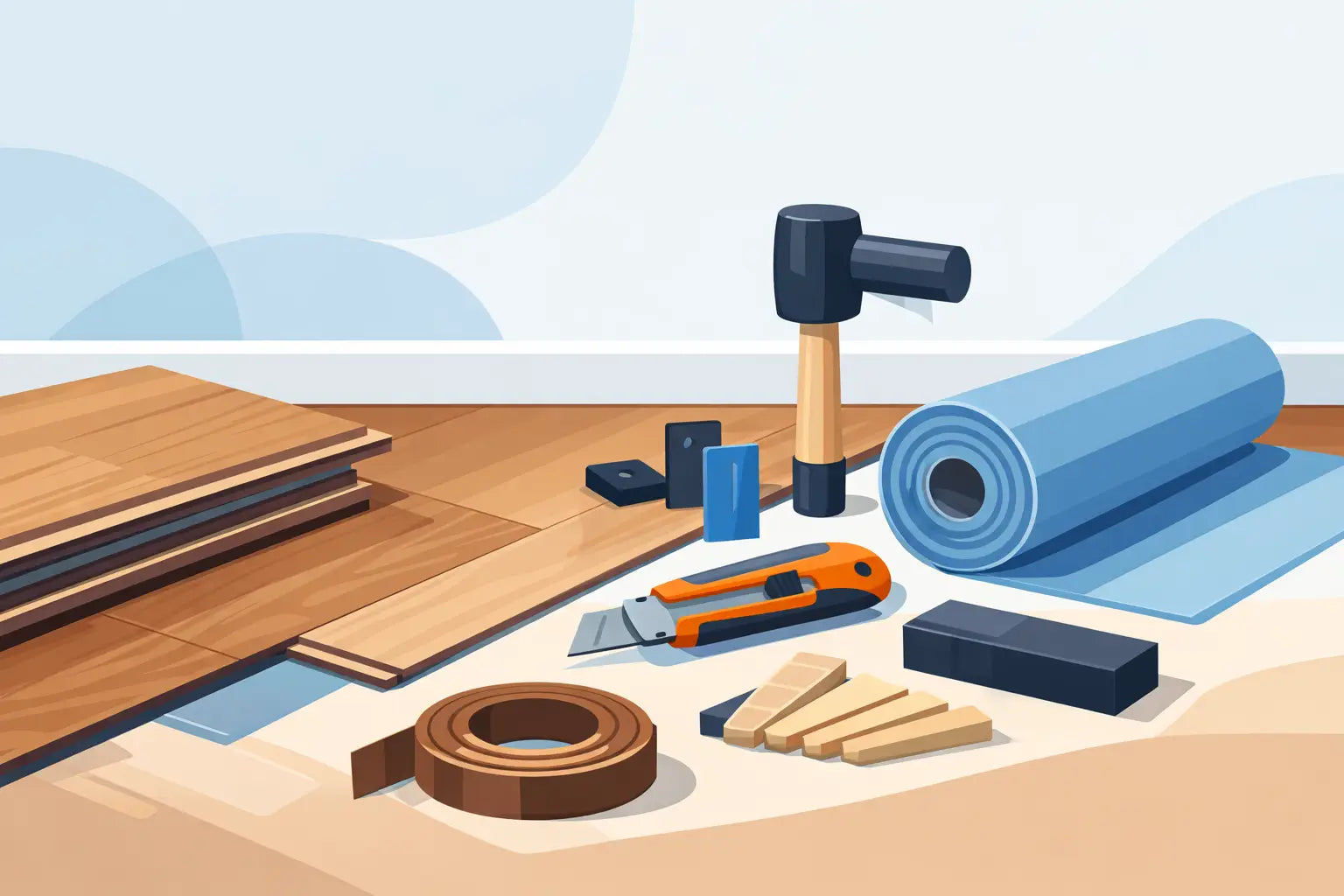
Anyone who lays vinyl quickly realizes: the flooring alone is not enough. The right vinyl flooring accessories determine whether the result lies smoothly, finishes cleanly, and looks good for a long time in everyday use. Especially with click vinyl and adhesive vinyl, it makes a noticeable difference whether the underlay, adhesive, leveling compound, and finishing profiles truly match the room and the subfloor.
Which Vinyl Flooring Accessories You Really Need
The most important question is not which accessories are "most sold," but what suits your installation method. Click vinyl requires different accessories than adhesive vinyl. In addition, there are room size, subfloor, moisture, existing doors, and the question of whether the floor should be laid on screed, tiles, or an old covering.
With click vinyl, the underlay is often the focus. It influences walking comfort, impact sound, and the stability of the connection. With adhesive vinyl, the focus is more on subfloor preparation. Without a suitable primer, leveling compound, and the right adhesive, even a high-quality covering will quickly become uneven, wavy, or visually inconsistent.
Those who plan too sparsely here rarely truly save. Often, this leads to rework on transitions, untidy baseboard finishes, or audible unevenness that cannot be easily corrected after laying.
Accessories for Click Vinyl: Less Material, but Not Arbitrary
Click vinyl is popular because it can be laid relatively quickly. However, this does not mean that every underlay and every profile is suitable. Especially with modern click systems, the accessories must match the construction height and the manufacturer's approval.
The Right Underlay for Click Vinyl
Not every click vinyl requires a separate impact sound insulation. Some products already have an integrated underlay. In this case, an additional layer can even be problematic because it puts too much strain on the locking system. The floor then springs more than intended, which can weaken the click connection in the long run.
If no underlay is integrated, it is worth taking a closer look at pressure stability and the compensation of small unevenness. A soft insulation may sound pleasant at first, but it is not automatically the better choice. It is crucial that the floor lies stably and that the load is cleanly absorbed in everyday life.
On mineral subfloors such as screed, a vapor barrier is also often included. It protects the covering from rising residual moisture. Especially in ground-floor rooms or with newer screeds, this is not a secondary issue, but a basic prerequisite for durable installation.
Spacers, Cutting Tools, and Pull Bars
These small helpers are often underestimated. Spacers ensure the necessary expansion joint at the walls. Without this joint, the floor can buckle due to temperature changes. A suitable cutting tool not only saves time but also ensures clean edges on door frames, heating pipes, and niches.
A pull bar and a tapping block are particularly helpful in edge areas where planks can no longer be cleanly connected by hand. Those who lay larger rooms quickly realize how much cleaner and more relaxed the work becomes with them.
Accessories for Adhesive Vinyl: The Subfloor Does the Work
With adhesive vinyl, the subfloor almost determines the entire result. The material itself is thin and transfers unevenness much more strongly than click vinyl. This is precisely why accessories are not a minor matter here, but part of the flooring system.
Primer and Leveling Compound
A primer improves adhesion and regulates the absorbency of the subfloor. This is especially important when old screed, leveled surfaces, or different partial areas are present in the room. Without primer, the adhesive can cure unevenly.
Leveling compound creates a smooth, resilient surface. Even small depressions, edges, or old adhesive residues can later show through the covering. Those who lay adhesive vinyl on an inadequately prepared subfloor often do not immediately see the error - but very clearly after a few weeks or with oblique light incidence.
The Right Adhesive
Not every vinyl adhesive fits every product and every room situation. Crucial factors include stress, room temperature, moisture exposure, and the size of the area. Different requirements apply in living rooms than in hallways, kitchens, or small commercial areas.
Improvisation is not worth it here. An unsuitable adhesive can complicate installation, shorten the open time, or later lead to adhesion problems. Those who rely on branded products should therefore also pay attention to compatible systems for accessories.
Finishing Profiles, Rails, and Baseboards
Even a high-quality laid floor looks unfinished if the finishes are not right. This is exactly where the importance of well-thought-out vinyl flooring accessories for the overall effect becomes apparent. Transitions to tiles, carpet, or parquet must not only look good but also cleanly compensate for height differences.
Transition Profiles and Adaptor Profiles
A transition profile is usually required between two floor coverings. It protects edges, reduces tripping hazards, and creates a clean visual finish. If different construction heights meet, an adaptor profile is often useful.
In open living areas, optics also play a role. A profile should not dominate, but it should be stable. Especially with frequently used passages, quality pays off. Thin or poorly fitting rails quickly stand out negatively.
Baseboards for a Clean Edge Finish
Baseboards cover expansion joints and visually frame the floor. This is not just about white or wood look. It is important that the height, shape, and color effect match the room. A too small strip quickly looks lost, a too massive one can unnecessarily weigh down light rooms.
Systems that can accommodate small cables are practical. This saves additional solutions along the wall and keeps the room tidy. In rental apartments, it is also interesting how cleanly strips can later be removed or replaced.
What is Often Forgotten
Many plan only the visible floor and overlook details that ultimately cost time. These include leveling compound for problematic subfloors, suitable door finishing solutions, or material reserves for cutting waste. Cleaning cloths for adhesive residues, a pressure roller for adhesive vinyl, or suitable knife blades are also often only missed when the work is already underway.
Another point is the room edge at balcony doors, kitchen connections, or transitions to tiled areas. More than standard accessories are often needed there. Moisture, movement, and stress converge here. Those who plan these areas in advance avoid visible compromises.
How to Buy Vinyl Flooring Accessories Without Making a Mistake
The easiest way is to think from the specific floor. First, the decision between click vinyl and adhesive vinyl is made. This is followed by the subfloor, room type, and finishing details. Only then does it become clear which products are really necessary.
For private renovators, it makes sense not to just look at the cheapest individual price. If accessories and flooring are not technically compatible, the supposed bargain quickly turns into an expensive correction. For craftsmen and smaller businesses, it is also important that material is planably available and can be ordered without lengthy coordination.
That's why a shop-oriented purchase with a clear brand and product structure is often the better way. At WaBo Design, you will find vinyl flooring, installation accessories, and brand-related selection in one system - with understandable prices, fast order processing, and the possibility to directly plan the appropriate construction cleanly.
Evaluate Vinyl Flooring Accessories by Room
Not every room has the same requirements. In the bedroom, walking comfort is often more important. In the hallway, it is more about durability, clean transitions, and insensitive finishes. In the kitchen or utility room, moisture and ease of cleaning play a greater role.
This has direct consequences for the accessories. A good underlay in the living area does not automatically have to be the best choice for heavily used passages. With adhesive vinyl, a different adhesive may be sensible in heavily frequented rooms than in little-used rooms. Baseboards and profiles should also not only match the color of the floor but also the use of the room.
Those who modernize several rooms at once save time if the accessories are thought through completely from the beginning. This prevents reorders, avoids unnecessary interruptions, and ensures that the floor not only looks good in the end but also convinces in everyday life.
A good floor therefore rarely begins with the plank itself. It begins with the question of what lies beneath, what holds it, and how it ends cleanly. If you choose the right accessories correctly from the start, an installation will not become a compromise, but a result that looks consistent every day.