
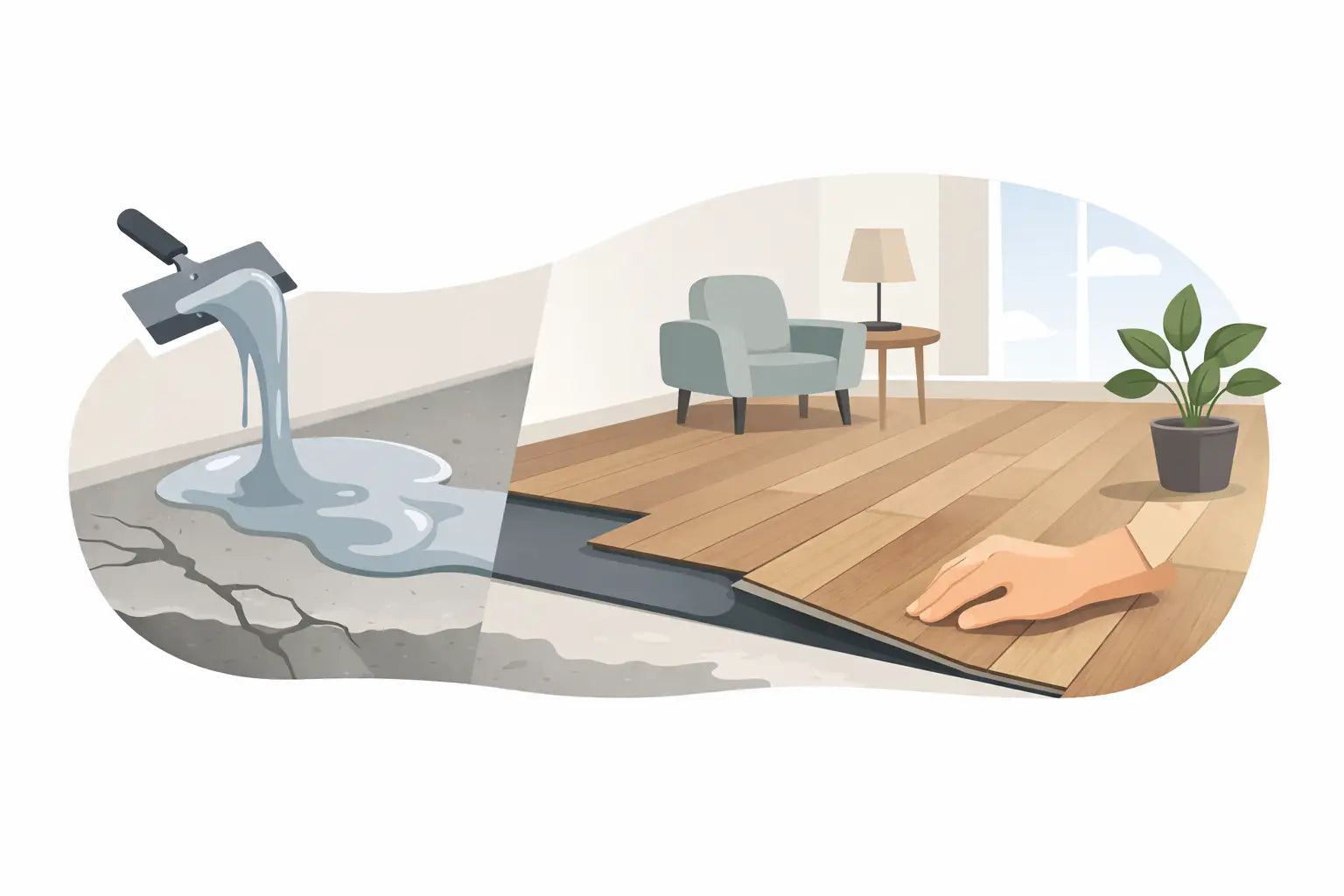
Anyone who wants to lay vinyl and discovers waves, cracks, or small height differences at first glance at the screed needs one thing above all: a clear decision. The appropriate vinyl flooring solution for uneven screed is not to simply lay the covering over it and hope for the best result. Especially with click vinyl and glue-down vinyl, the subfloor determines whether the floor will lie quietly, close neatly, and look good for a long time in everyday use.
Many problems do not become apparent on the first day, but after a few weeks. Then edges begin to lift, joints become visible, or a slightly springy walking sensation develops. This is annoying because the fault often lies not in the vinyl itself, but underneath it. Therefore, it is worth taking a close look at the screed before ordering or cutting material.
Vinyl flooring on uneven screed - which solution really works
The right solution depends on how severe the unevenness is and which vinyl is to be laid. Small pores, fine scratches, or minimal trowel marks are different from significant waves, open cracks, or palpable height differences between individual areas. Likewise, it makes a difference whether you use click vinyl with a slightly higher installation height or a thinner glue-down vinyl that quickly conforms to every unevenness.
Glue-down vinyl often offers particularly precise optics but places the highest demands on the subfloor. Even minor unevenness can later show through visibly. Click vinyl is a bit more forgiving, especially if it is high-quality, dimensionally stable products. Nevertheless, here too: an unstable screed remains a risk. Anyone who wants a consistently clean result cannot avoid subfloor preparation.
When the screed is still acceptable - and when it is no longer
A screed does not have to be as perfect as glass for vinyl, but it must be level, load-bearing, dry, and clean. It's not just the eye that matters. Many surfaces look neat at first glance, but when you draw a straightedge across them or walk over them, they show clear depressions and edges.
Typical warning signs include old adhesive residues, crumbling areas, hairline cracks, breakouts at the edges, or noticeable transitions between individual screed panels. Even slight dishing or hollows in traffic areas should be taken seriously. Especially where daily stress occurs, vinyl reacts sensitively to movement in the subfloor.
If the screed is uneven in certain spots, a partial repair is often sufficient. For large-area waves or multiple problem zones, a full-surface leveling is usually the better and ultimately more economical solution. Saving money at this point often means paying double - through rework, material loss, or a floor that never truly looks convincing.
Minor unevenness
Fine pores, slight scratches, and minimal height differences can often be compensated for with suitable leveling compound. It is important that the surface is then sanded and dedusted. Simply filling it is not enough.
Medium damage
Cracks, edges, or clearly palpable transitions require more than cosmetic correction. Here, it must be checked whether the screed is stable or whether components are moving against each other. Moving cracks must not simply be filled over, otherwise the damage will return.
Significant unevenness
If the surface is extensively wavy or shows height differences of several millimeters, there is usually no way around using a leveling compound. For vinyl, this is often the decisive step to make it even ready for installation.
The best vinyl flooring solution for uneven screed by floor type
Not every vinyl floor reacts the same way. Therefore, the solution should always match the chosen product type.
Glue-down vinyl requires the most precise subfloor. The covering is thin, lies directly on top, and reveals even small imperfections more quickly. For a high-quality result, a full-surface, smooth, and load-bearing area is almost always the safe choice here. Anyone who opts for glue-down vinyl also opts for greater care in preparation.
Click vinyl is a little more tolerant, but not infinitely so. Integrated insulation or a stronger carrier board can somewhat mitigate minor irregularities. However, this does not replace proper floor preparation. Click connections in particular suffer if the subfloor yields in certain spots or edges create pressure. Then joints open or creaking noises occur.
Rigid vinyl or particularly dimensionally stable variants can have advantages with slight unevenness. In practice, they are often more resilient than very flexible products. Nevertheless, here too: the more level the screed, the better the installation pattern and the lower the risk of complaints.
How to properly prepare an uneven screed
The first step is always inspection. The subfloor must be dry, clean, and load-bearing. Loose areas, dust, paint residues, and old adhesive residues must be removed. Afterwards, it usually becomes clearer whether it is a minor cosmetic flaw or a real problem area.
In the second step, cracks and breakouts are repaired. Depending on the damage, resin injection, sealing, or local filling may be necessary. It is important to understand the cause. An old, dormant crack is different from an area that continues to move.
Then follows the priming. It improves adhesion and ensures that leveling or filling compounds cure evenly. Especially on absorbent or very dense subfloors, this step is crucial. Without suitable priming, the entire subsequent layer often suffers.
Only then, if necessary, comes the leveling compound. It is applied selectively or over the entire surface, depending on the condition. For vinyl, the surface should be neatly sanded and dedusted again after drying. This fine sanding often makes the difference between an adequate and a truly professional result.
Common mistakes that become expensive later
The most common mistake is underestimating unevenness. What seems harmless in an empty room suddenly becomes noticeable after installation - in backlighting, at joints, or in traffic areas. Many rely too much on the statement that click vinyl is uncomplicated. This is only partially true.
Another mistake is the wrong combination of subfloor and covering. Thin glue-down vinyl on an unstable screed is almost always a bad idea. It is equally problematic to try to compensate for unevenness with underlays or insulation mats that actually belong in the screed. Underlays are no substitute for leveling compound.
Time pressure is also a classic problem. Screed, primer, and leveling compound need the correct drying time. If you continue working too early, you risk adhesion problems, residual moisture, or tension in the structure. Especially with renovations, patience is often cheaper than rework.
Is click vinyl a good quick solution?
If the screed is only slightly uneven and shows no structural damage, click vinyl can indeed be the more pragmatic choice. Installation is faster, removal is easier, and high-quality products offer a lot of comfort in everyday use. For rental properties, quick renovations, or rooms with normal traffic, this often makes sense.
But even here there are limits. For significant waves or edges, click vinyl is not a shortcut. The stress then transfers to the connection systems and becomes noticeable sooner or later. If you want lasting peace of mind, it is better to level cleanly once, rather than merely patching up the subfloor.
When professional help pays off
As soon as the screed shows cracks, moisture problems, larger level differences, or unclear old coatings, a professional assessment is advisable. This not only saves nerves but also protects against bad purchases. Because the best choice of decor is of little use if the floor is technically not suitable for the subfloor.
Especially with larger areas, open living spaces, or high-quality branded floors, it is worth looking beyond just the price per square meter. The interaction of covering, accessories, and prepared subfloor is crucial. At WaBo Design, many customers pay close attention to this point, because a good floor only convinces when it lies quietly and neatly for a long time after installation.
Which solution fits which room
In the bedroom or guest room, smaller subfloor problems can often be managed more easily than in the kitchen, hallway, or living area. There, the load is higher, furniture is moved, and traffic areas are used more intensively. The more daily life impacts the floor, the more important an precisely prepared screed becomes.
In damp rooms or adjacent areas, another point comes into play: secure overall planning. Here, not only the level must be correct, but also the suitability of the vinyl and the installation system for the room. Those who want to renovate quickly will do well with a clear sequence: check the subfloor, repair damage, choose the appropriate floor type, and carefully coordinate accessories.
The best floor purchase therefore does not start with the decor, but with the subfloor. If you approach the vinyl flooring solution for uneven screed properly, you will avoid later damage and get exactly what you expect from your new floor: a high-quality, easy-care, and lastingly convincing surface for a home with character.