
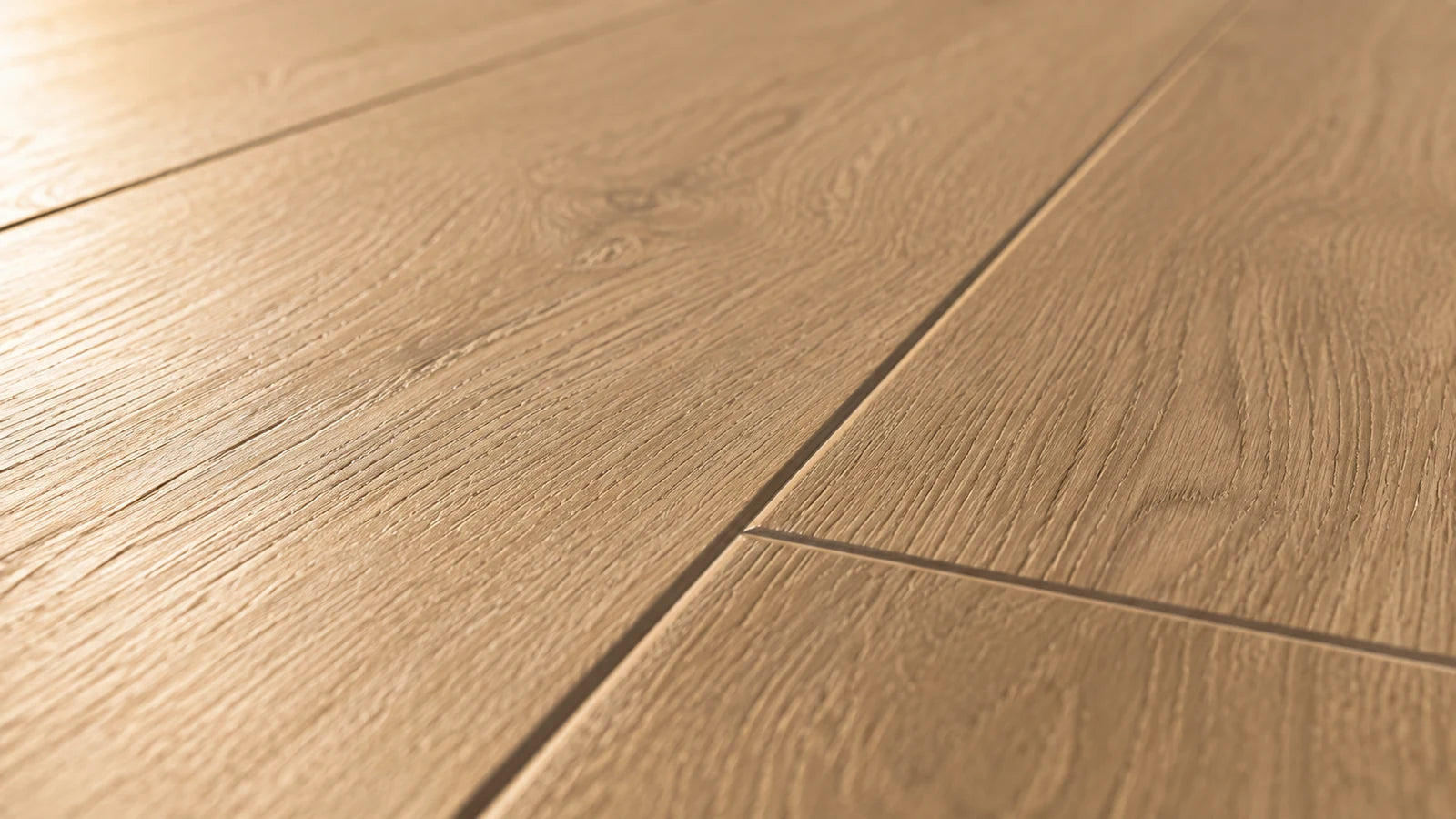
A vinyl floor with a bevel is one of the most popular looks in modern interior design because the beveled edge on each plank creates a visible joint, giving the floor a particularly authentic appearance. But is a bevel really worth it for every room, or is a smooth, jointless vinyl floor ultimately the better choice for you? Which type of bevel suits your home, and what do you need to look out for regarding cleaning and care? This guide provides the answers.
The most important points in brief
- A bevel is a chamfered edge on the long sides or all around the plank that replicates a visible joint.
- Vinyl flooring with a bevel highlights the individual plank and looks especially natural, but requires slightly more care in the joint than a smooth floor.
- There is the micro-bevel, the bevelled edge around all four sides, and the V-groove look without an actual depression.
- Without a bevel, the floor looks calmer and more unified and is easier to maintain overall, especially in large, open spaces.
- For kitchens, bathrooms, and high-traffic rooms, a small micro-bevel is usually the best compromise between aesthetics and cleaning.
Overview of contents
- What is a bevel on vinyl flooring?
- Types of bevels available
- Vinyl flooring with a bevel: the advantages
- Disadvantages and what you should consider
- Vinyl flooring with or without a bevel: what suits you?
- Bevels in click vinyl and glue-down vinyl
- Cleaning and care for beveled vinyl flooring
- Comparison table: with bevel vs. without bevel
- Frequently asked questions
- Conclusion
What is a bevel on vinyl flooring?
The bevel is a narrow, chamfered edge on the long sides of a vinyl plank. When installed, it creates a small, visible channel between two planks that acts like a real joint, as you might know from solid wood planks or tiles. Technically, a distinction is made between a "true" bevel, where the edge is actually chamfered, and a mere V-groove look, where the surface structure only suggests a joint without the edge itself being recessed. You can also find more about the terminology on Wikipedia.
Types of bevels available
Not every bevel looks the same. When buying, you will mainly encounter three variants:
- Micro-bevel: A very fine, barely noticeable chamfer, usually only on the two long sides. It ensures a subtle joint look without allowing much dirt to accumulate in the groove.
- Beveled edge (four-sided): All four edges of the plank are chamfered. This makes the joint pattern look particularly realistic because the short butt edges also become visible. This variant is often found in click vinyl with a country-house plank look.
- V-groove without a real bevel: Here, only the surface is embossed accordingly; the edge itself remains straight. This variant is the easiest to maintain because no actual depression is created.
Vinyl flooring with a bevel: the advantages
Vinyl flooring with a bevel primarily scores points for its visual appeal. These advantages speak in its favor:
- Realistic, three-dimensional look that makes individual planks and joints clearly visible.
- Often hides minor subfloor imperfections better than a completely smooth floor.
- Looks particularly high-quality in wood finishes, for example with planks from COREtec or Gerflor in oak or country-house plank designs.
- Goes well with classic, rustic, and Scandinavian interior design styles.
Disadvantages and what you should consider
The realistic look comes with a certain amount of maintenance effort. Over time, dust and fine dirt can collect in the joint, especially with a four-sided bevel. In very sleek, minimalist interiors, a pronounced bevel can sometimes look cluttered, whereas a jointless floor visually enlarges the area. You also need a little more care when installing beveled planks to ensure the joints run evenly and cleanly.
Vinyl flooring with or without a bevel: what suits you?
The decision depends primarily on the room and interior style. In living rooms and bedrooms, hallways, or rooms with a country-house or vintage character, a bevel creates atmosphere and makes the floor feel like real solid wood. In high-traffic or moisture-prone rooms such as kitchens or bathrooms, however, a micro-bevel or a completely smooth floor is often the more practical choice because less dirt and moisture can settle in the joints. For very large, open spaces, a floor without a pronounced bevel often appears calmer and more modern.
Bevels in click vinyl and glue-down vinyl compared
You can find planks with and without bevels for both click vinyl and glue-down vinyl. In click vinyl, the four-sided bevel is particularly common because the slightly thicker rigid or SPC core boards allow for a clean chamfer. Glue-down vinyl, on the other hand, is more frequently offered with a fine micro-bevel or completely smooth, as the thinner planks are bonded over the entire surface and a result that is as homogeneous as possible is desired. Many manufacturers such as Moduleo, Tarkett, or Liberty offer both variants in the same decors, so you can choose your preferred look regardless of the installation method.
Cleaning and care for beveled vinyl flooring
In principle, a vinyl floor with a bevel can be maintained in the same way as a smooth floor, but you should pay a little more attention to the joint when mopping. A soft mop with little water and a pH-neutral cleaner will prevent moisture from collecting in the joints. For more stubborn dirt, a soft brush helps to loosen dust and crumbs from the depression. You can find detailed instructions for daily and deep cleaning in our guide Cleaning and caring for vinyl flooring. We explain how you can generally recognize the quality of a floor, for example by the wear layer and workmanship, in our guide How to recognize good vinyl flooring.
Comparison table: with bevel vs. without bevel
| Criterion | Vinyl flooring with bevel | Vinyl flooring without bevel |
|---|---|---|
| Aesthetics | Natural, individual planks clearly visible | Calm, unified, spacious effect |
| Cleaning | Slightly more intensive, joint needs occasional attention | Very easy to maintain, no depressions |
| Well-suited for | Living rooms, hallways, country and vintage styles | Kitchens, bathrooms, modern minimalist rooms |
| Typical bevel types | Micro-bevel, four-sided bevel | Pure V-groove look or completely smooth |
| Common with | Click vinyl in wood look | Glue-down vinyl, large-format tile look |
Frequently asked questions about vinyl flooring with a bevel
What exactly is a bevel on vinyl flooring?
The bevel is a chamfered edge on the plank that creates a visible, usually V-shaped joint between two installed planks. It mimics the joint pattern of solid wood or tiles.
Is vinyl flooring with a bevel harder to clean?
Somewhat, yes, because more dust and fine dirt can collect in the depression than on a smooth surface. However, with a soft mop and regular cleaning, the effort remains manageable.
What is the difference between a bevel and a V-groove?
With a "true" bevel, the edge of the plank is actually chamfered, so a real depression is created. With a pure V-groove look, the joint is only suggested by pressure or embossing on the surface; the edge itself remains straight.
Does a bevel suit every living style?
Not necessarily. In classic, rustic, or Scandinavian interiors, a bevel looks very cohesive. In very reduced, modern rooms, many people prefer a jointless, calmer floor look.
Is vinyl flooring with a bevel also available for glue-down vinyl?
Yes, there are also planks with a micro-bevel for glue-down vinyl, usually executed slightly more subtly than with thicker click vinyl planks. However, completely smooth variants are also very common for glue-down vinyl.
How many samples should I look at before buying?
It is best to order several vinyl flooring samples with different bevel types to your home. This allows you to see which variant you like best in your own lighting and room.
Conclusion
Whether you choose a vinyl floor with a bevel or a smooth, jointless variant depends primarily on your desired interior style and how the room is used. For a natural, plank-focused look in living areas, the bevel is a clear recommendation, while high-traffic or damp rooms often benefit from a fine micro-bevel or a smooth surface. You will make the safest decision if you get a suitable sample sent home and test the look in your home at your leisure.
Find your perfect vinyl floor now
Whether with a striking bevel or completely smooth: you will find the right floor for every room in our assortment.
Discover vinyl flooring now