
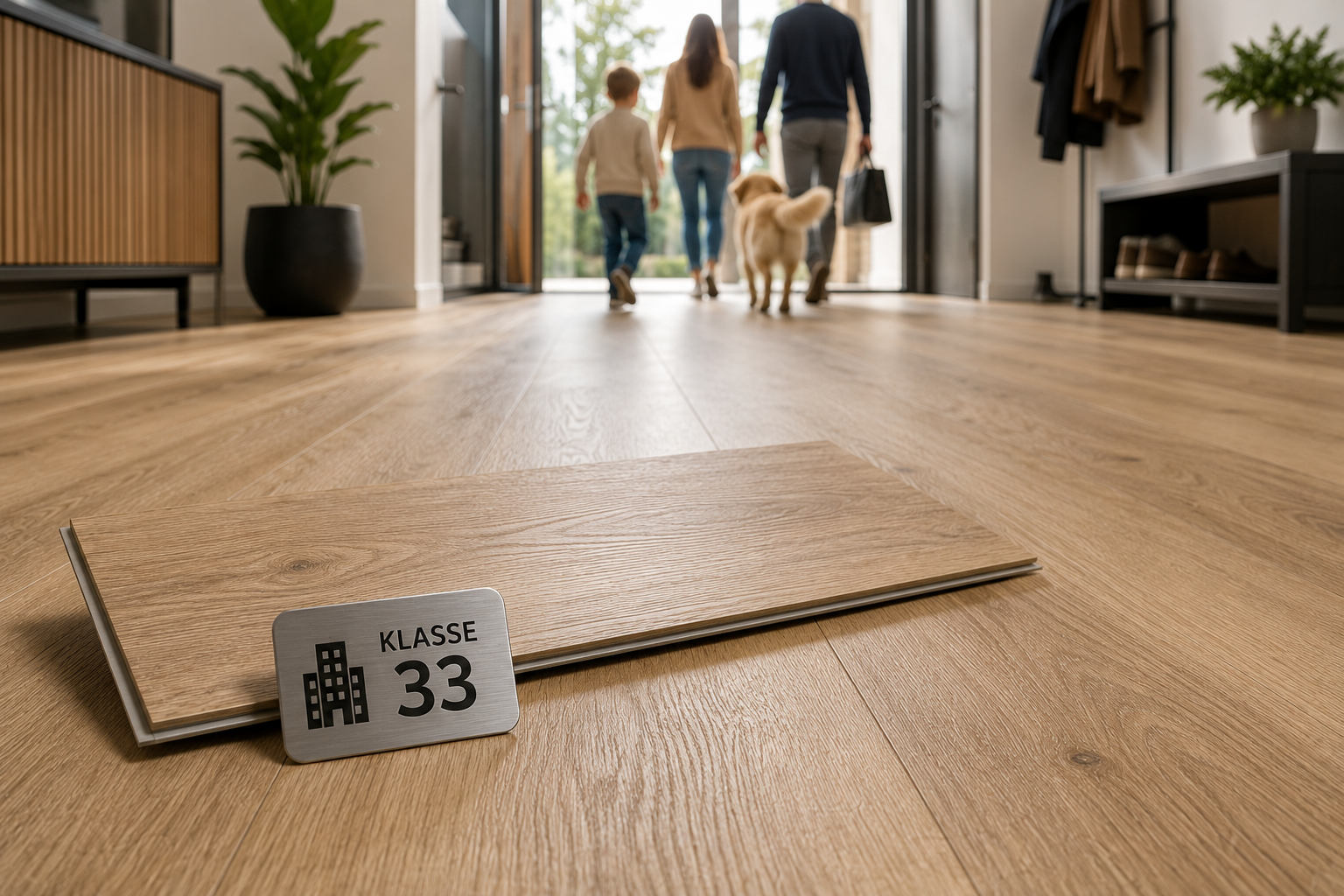
Vinyl flooring usage class 33 appears in almost every product data sheet, and the core question behind it is simple: What exactly does this number mean, and do you really need it for your home? In this guide, we explain what lies behind the usage classes from 21 to 43, why class 33 is recommended so often, and when a lower or higher class makes more sense for you.
Key takeaways
- The usage class (according to EN ISO 10874) indicates how much wear and tear a vinyl floor can withstand, from 21 (moderate residential) to 43 (heavy industrial).
- Usage class 33 stands for heavy commercial use, for example in shops, offices, or medical practices with high foot traffic.
- For private households, usage class 33 is not a must, but a sensible reserve for hallways, kitchens, home offices, or households with children and pets.
- Usage class and wear layer are two different values; both should be considered together.
- The class is listed on the product data sheet and usually directly in the product description in the shop.
Table of contents
- What is the usage class for vinyl flooring?
- Overview of usage classes (table)
- What exactly does usage class 33 mean?
- Usage class 33 compared to 32 and 34/43
- Who is usage class 33 worth it for?
- Wear layer vs. usage class, what really counts?
- How do you identify the usage class when buying?
- Frequently asked questions
- Conclusion
What is the usage class for vinyl flooring?
The usage class is a standardized indicator (according to EN ISO 10874, formerly EN 685) that specifies how much wear a floor covering can withstand without the wear layer prematurely deteriorating. This classification applies not only to vinyl flooring but also to laminate and other resilient floor coverings. Two numbers are included in each class: the first digit stands for the area of use (2 for residential, 3 for commercial, 4 for industrial), and the second digit for the intensity of use (1 moderate, 2 normal, 3 heavy, 4 very heavy).
Overview of usage classes
To help you correctly categorize the numbers, here are the common classes with typical areas of use:
| Usage class | Area of use | Intensity | Typical rooms |
|---|---|---|---|
| 21 | Residential | moderate | Bedroom, guest room |
| 22 | Residential | normal | Living room, children's room |
| 23 | Residential | heavy | Hallway, kitchen, home office |
| 31 | commercial | moderate | Small offices, meeting rooms |
| 32 | commercial | normal | Open-plan offices, boutiques |
| 33 | commercial | heavy | Shops, practices, high foot traffic |
| 34 | commercial | very heavy | Department stores, cafeterias |
| 41 to 43 | industrial | heavy to very heavy | Workshops, production halls |
What exactly does usage class 33 mean?
Usage class 33 belongs to the commercial category for heavy use. The floor is therefore designed for rooms where many people are walking, such as shops, medical practices, law firms, or reception areas. Rolling loads, frequent walking in outdoor shoes, and constant strain over many hours a day are not meant to cause the wear layer to age faster than planned. For you as a private individual, this means one thing above all: a vinyl floor with usage class 33 will generally last much longer in a residential area than it needs to, because your home is subjected to less frequent and less intense use than a retail store.
Usage class 33 compared to 32 and 34/43
The difference between the classes lies in the reserve capacity you have. Class 32 is perfectly sufficient for normal commercial use and for most private households. Class 33 adds an extra margin and is the standard choice if you want to be on the safe side, for example with pets, several children, or high-traffic hallways. Class 34 and the industrial classes 41 to 43 are generally oversized for private households, but they are rarely significantly more expensive, as manufacturing often barely differs across several classes.
Who is usage class 33 worth it for?
Not every room needs the highest class, but in some cases, usage class 33 pays off for private use too:
- Households with dogs or cats whose claws put more strain on the surface
- Families with several children who play and romp around a lot
- Hallways, entryways, and mudrooms with frequent contact with shoes
- Kitchens and home offices with office chair rollers or kitchen carts
- Rented apartments where the floor should last for many years and through multiple tenants
For quiet bedrooms or guest rooms, usage class 23 is usually sufficient, and you will save money. You can find an overview of suitable floors for high-traffic rooms in our vinyl flooring collection, filtered by look, format, and installation method.
Floors from class 32 upwards for kitchens and hallways can be found under vinyl flooring for the kitchen, and commercial quality under contract and commercial vinyl.
Wear layer vs. usage class, what really counts?
Usage class and wear layer are often confused, but they mean different things. The usage class is the overall assessment based on standardized test procedures, while the wear layer is just one of several factors that go into this assessment, alongside the core board, surface treatment, and bonding. A thicker wear layer value does not automatically mean a higher usage class. We explain in detail how the wear layer is measured and what thickness makes sense for which room in our article Vinyl flooring wear layer, explanation with table. It makes the most sense to check both values together before you make your decision.
How do you identify the usage class when buying?
The usage class is usually stated directly in the product data sheet or in the product description in the shop, often together with information on the wear layer, impact sound, and installation method. Also pay attention to the following points:
- Check whether the class is specified for residential, commercial, or industrial use; the number alone is not enough.
- Compare the class with the intended use of the room, not with the highest available value.
- If in doubt, order a vinyl flooring sample; this way, you can see and feel the surface and quality before purchasing.
- For click vinyl, it is also worth taking a look at the locking system, as it determines the durability of the floating floor; more on this in our click vinyl collection.
Brands like COREtec, Gerflor, Tarkett, Moduleo, or Liberty each offer several collections with different usage classes. Take a look, for example, at our COREtec collection if you are specifically looking for robust floors with a higher class. For added comfort, it is also worth looking at models from our vinyl flooring with impact sound insulation collection, as a high usage class alone does not make for a quiet apartment. You can also read more about flooring in general on Wikipedia.
Frequently asked questions about usage class for vinyl flooring
What exactly does usage class 33 mean for vinyl flooring?
Usage class 33 means commercial use with heavy foot traffic, for example in shops or medical practices. In private homes, this class offers you a generous reserve against daily wear and tear.
Is usage class 33 also sensible for private living areas?
Yes, especially in high-traffic rooms like hallways, kitchens, or home offices, as well as in households with children and pets. For quiet rooms, a lower class is usually sufficient.
What is the difference between usage class 32 and 33?
Class 32 stands for normal commercial use, class 33 for heavy use. Class 33 is therefore more durable and the safer choice for intensive use.
Wear layer or usage class, what matters?
Both values should be considered together. The wear layer is an individual factor, while the usage class is the total result of several factors including the wear layer, core board, and surface.
How do I identify the usage class when buying?
The usage class is in the product data sheet and usually directly in the product description in the shop, often along with details on the wear layer and installation method.
Is usage class 33 worth it for a rental apartment?
Yes, especially with frequent tenant changes and long periods of use, the additional reserve provided by usage class 33 is sensible to ensure the floor looks good for many years.
Conclusion
The usage class tells you how much wear a vinyl floor can tolerate over the long term. Usage class 33 is originally intended for the commercial sector, but at home, it provides you with a comfortable reserve, especially in the hallway, kitchen, home office, or if you have children and pets. Always check the usage class and wear layer together when buying, and you will make the right choice for your room.
Ready for a floor that really keeps up?