
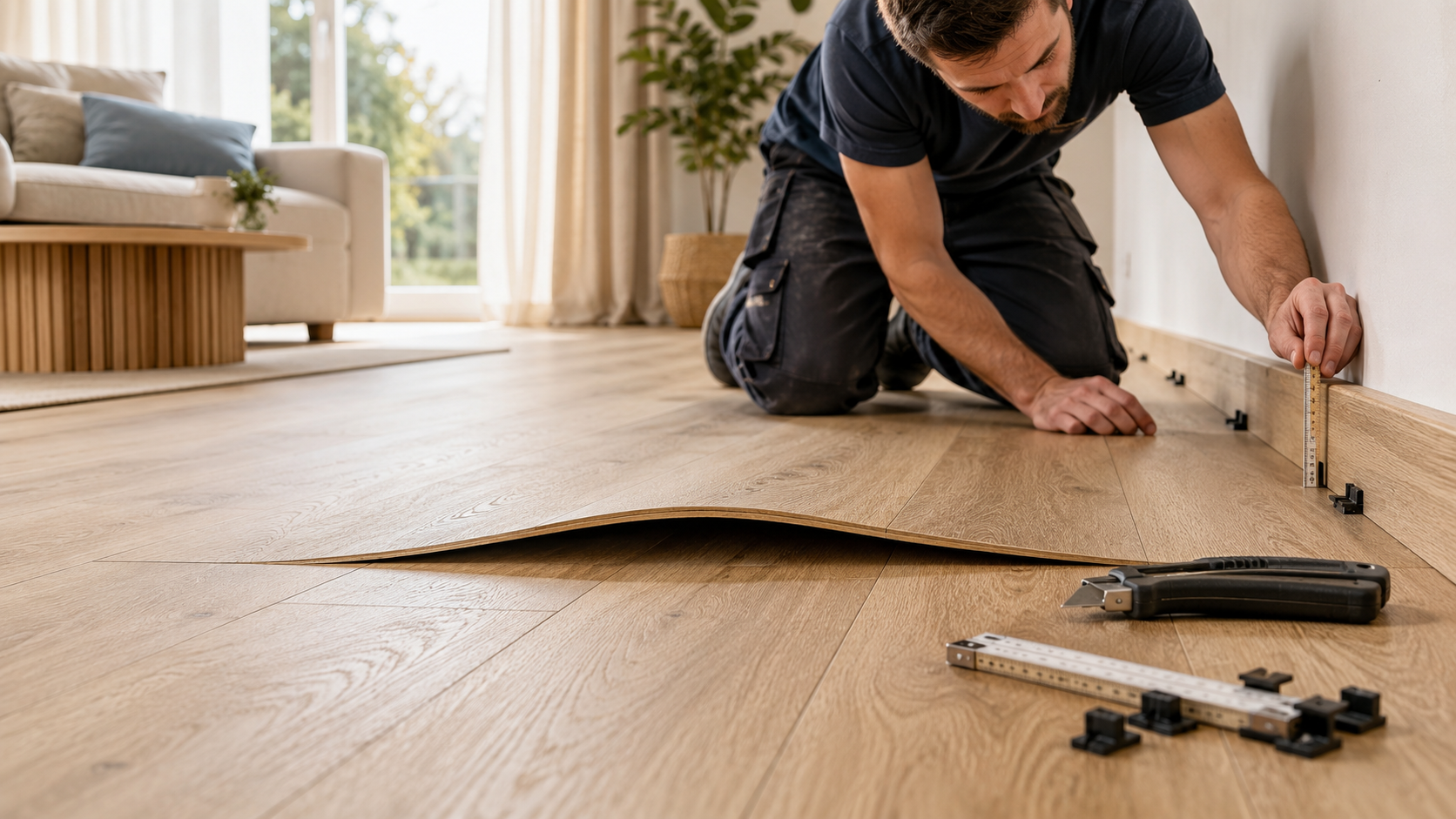
Is your vinyl flooring buckling and you're wondering what to do? What are the most common causes for vinyl flooring to buckle, and how can you get rid of the bulge? In most cases, it is due to a lack of acclimatization, insufficient edge spacing, or moisture in the subfloor. The good news: in many cases, you can fix the problem yourself with a few targeted steps without having to replace the entire floor.
The most important points in brief
- Most common cause: lack of acclimatization before installation or insufficient edge spacing (expansion joint).
- Moisture in the subfloor, in particular, causes glue-down vinyl to come loose and buckle.
- Small, recent buckles often disappear on their own as soon as the floor and room have adjusted to a stable climate.
- For larger waves, the solution is usually: remove skirting boards, check edge spacing, and reinstall individual planks if necessary.
- Prevention is simple: allow to acclimatize for 24 to 48 hours at 18 to 24 °C, maintain an edge gap of 5 to 10 mm all around (8 to 10 mm for large rooms and underfloor heating), and ensure a dry, level subfloor.
Table of contents
- What does it mean when vinyl flooring buckles?
- Cause 1: Lack of acclimatization
- Cause 2: Insufficient edge spacing and expansion joints
- Cause 3: Moisture in the subfloor
- Cause 4: Uneven or incorrectly prepared subfloor
- Cause 5: Errors with glue-down vinyl
- Fixing buckles: step by step
- Preventing buckles from the start
- Frequently asked questions
- Conclusion
What does it mean when vinyl flooring buckles?
Buckling occurs when individual planks or tiles bend upwards, form waves, or lift at the edges. Sometimes the problem only appears weeks after installation, but often it manifests in the first few days as soon as the temperature and humidity in the room change. Vinyl flooring expands slightly with heat and contracts when cold. If the material lacks the necessary leeway, it pushes itself upwards. This is the root cause in almost all cases.
Cause 1: Lack of acclimatization
Vinyl flooring must get used to the temperature and humidity in the room before installation. If it is unpacked directly from a cold warehouse or transport vehicle and laid immediately, it will expand in the following days and buckle. Therefore, store the planks or tiles flat for 24 to 48 hours in the room where they will be installed, at a room temperature of 18 to 24 °C. If you are unsure how long your specific floor needs to acclimatize, you will find the precise recommendation on the manufacturer's packaging, such as COREtec, Gerflor, Tarkett, Moduleo, or Liberty.
Cause 2: Insufficient edge spacing and expansion joints
Vinyl flooring requires an edge gap of 5 to 10 mm all around walls, door frames, and heating pipes; for large rooms and underfloor heating, 8 to 10 mm is preferable; the manufacturer's installation instructions are decisive. For larger rooms with an edge length of approx. 8 meters or more, an additional expansion joint must be placed across the surface. If this room to move is missing, the floor has no space to expand when it gets warm and pushes itself upwards instead. This is the classic cause when freshly laid vinyl flooring buckles or ripples, even though the subfloor was fine. It is best to check the edge spacing immediately after installation, before the skirting boards are mounted.
Cause 3: Moisture in the subfloor
Screed that was not sufficiently dry at the time of installation will continue to release moisture afterwards. With glue-down vinyl, this breaks the bond between the adhesive and the subfloor, causing the floor to lift and form blisters. With click-vinyl, rising moisture can cause the underlay to swell, which appears as buckling on the surface. A CM moisture test prior to installation provides clarity and is mandatory anyway for glue-down vinyl on mineral subfloors.
Cause 4: Uneven or incorrectly prepared subfloor
Small bumps, cracks, or remnants of old flooring will eventually show through the vinyl floor, creating visible waves in certain spots. Before installation, the subfloor should be level, clean, dry, and load-bearing. For larger uneven areas, a leveling compound helps before laying the new floor to prevent localized buckling later.
Cause 5: Errors with glue-down vinyl
With glue-down vinyl, buckling is often caused by using too little adhesive, incorrect flash-off times, or laying without the appropriate primer on absorbent subfloors. Air pockets trapped when pressing down the sheets or tiles also lead to blisters later. Apply the adhesive evenly using the appropriate notched trowel, adhere to the manufacturer's specified flash-off time, and press down the entire surface with a floor roller so that no cavities remain.
Fixing buckles: step by step
Here is how to proceed if a buckle has already occurred:
- Keep the room temperature constant at around 20 degrees for a few days and observe whether small buckles recede on their own.
- Remove the skirting boards on the affected wall and check the edge spacing. If it is too tight, trim some material with a jigsaw or utility knife.
- For individual raised click-vinyl planks, undo the locking mechanism, check for dirt or unevenness in the subfloor, and click the plank back into place.
- For glue-down vinyl with blisters, carefully cut open the affected area, apply new adhesive, and press down firmly with a floor roller.
- If the buckling persists after these steps or affects larger areas, it is worth consulting a professional before consequential damage occurs.
| Cause | Typical sign | Solution |
|---|---|---|
| Lack of acclimatization | Buckling in the first days after installation | Maintain constant room climate, often recedes on its own |
| Insufficient edge spacing | Floor pushes up against walls or door frames | Remove skirting boards, adjust edge spacing to 5-10 mm (8-10 mm for large rooms/underfloor heating) |
| Moisture in the subfloor | Blisters, loose adhesive surface, musty odor | CM moisture test, let subfloor dry, re-glue affected areas |
| Uneven subfloor | Localized waves in individual areas | Fill and level the subfloor before installation |
| Installation error with glue-down vinyl | Blisters, air pockets, loose edges | Cut open the spot, re-glue, and press down the entire surface |
Preventing buckles from the start
The easiest way to prevent a buckle is before it occurs. Plan for 24 to 48 hours of acclimatization in the room, consistently maintain an edge gap of 5 to 10 mm (8 to 10 mm in large rooms or with underfloor heating; check the manufacturer's installation instructions), and check the subfloor beforehand for moisture, levelness, and cleanliness. Feel free to order a vinyl flooring sample in advance so you can check the look and material thickness in peace before buying. For glue-down vinyl, an appropriate primer is worth the effort; for click-vinyl, a floor with integrated acoustic underlay is recommended. If you are unsure which system fits your subfloor, our guide on the 8 most common mistakes when installing vinyl flooring provides further practical tips, and in our article on planning expansion gaps for click-vinyl, you will learn how to plan the edge spacing for your click-vinyl accurately. General background information on the structure and material types of flooring can also be found in the Wikipedia article on flooring.
For rooms with lots of sun and temperature changes, opt for dimensionally stable Rigid vinyl with an SPC core or fully bonded glue-down vinyl.
Frequently asked questions
Why is my vinyl floor buckling?
It is most often due to a lack of acclimatization before installation or insufficient edge spacing from the wall. Both deprive the floor of the space it needs to expand when it gets warm. Moisture in the subfloor or an uneven floor can also cause buckling.
My vinyl floor is lifting, what should I do?
First, check the edge spacing at the walls by removing the skirting boards. If it is too narrow, trim some material. If the plank remains lifted, check the subfloor underneath for dirt or moisture before re-installing it.
My vinyl floor is forming waves, what helps?
Keep the room temperature constant for a few days; this often makes small, fresh waves disappear on their own. If the waves persist, check the edge spacing and subfloor as described above, or consult a professional company.
Why is my vinyl floor peeling off the subfloor?
This mainly affects glue-down vinyl and usually points to too little adhesive, an incorrect flash-off time, or moisture in the screed. Typically, the affected area can be opened, re-glued, and pressed down fully.
Can a buckle smooth itself out again?
Yes, if the cause was a lack of acclimatization, small buckles often disappear within a few days once the floor and room climate have equalized. However, if the cause lies in the subfloor or edge spacing, it will not disappear on its own.
How do I prevent my vinyl floor from buckling again?
When reinstalling, consistently ensure 24 to 48 hours of acclimatization at 18 to 24 °C, a 5 to 10 mm edge gap all around (8 to 10 mm for large rooms and underfloor heating), and a dry, level subfloor. These three points will reliably prevent the vast majority of buckles.
Conclusion
If your vinyl floor is buckling, it is annoying, but in most cases, it is not a reason for a complete replacement. Check the acclimatization, edge spacing, and subfloor first—these are the three most common causes. With the right edge spacing, sufficient time for acclimatization, and a cleanly prepared subfloor, the problem can be avoided from the outset when laying the next floor.
Are you planning a new installation and want to do everything right from the start?
Discover vinyl flooring