
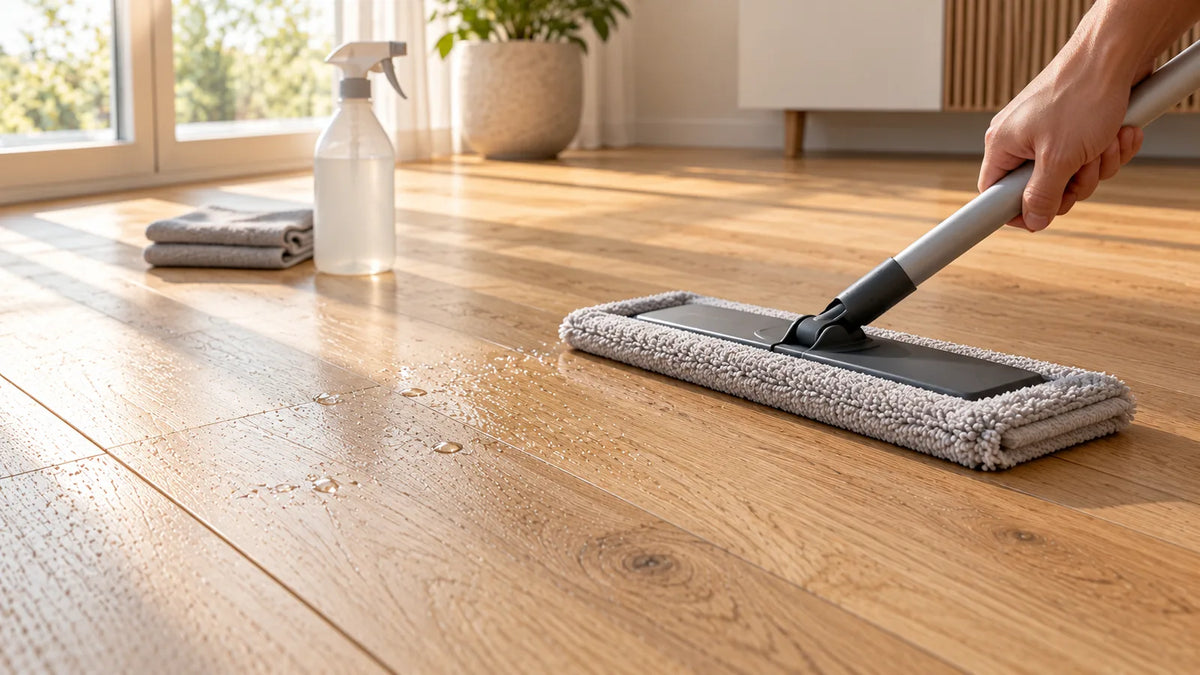
The right vinyl floor cleaner determines whether your floor will shine for years or look dull and scratched after just a few weeks. Which cleaning agent is truly suitable for vinyl flooring, and which ones damage the sensitive wear layer? We clarify exactly this question here: with a clear overview, a reference table, and answers to the questions we are asked most frequently by customers.
- A pH-neutral vinyl floor cleaner or simply clear water is almost always sufficient for normal care.
- Vinegar cleaners, scouring creams, and strongly alkaline all-purpose cleaners damage the wear layer and cause the floor to become dull over time.
- Steam cleaners are unsuitable for most vinyl floors because heat and moisture can accumulate at seams and edges.
- Mild dish soap only works when heavily diluted and in exceptional cases, never undiluted.
- For stubborn stains, a targeted approach helps more than an aggressive cleaner.
- Vinyl floor cleaners: These types are truly suitable
- Why a pH-neutral cleaner is the safest choice
- Household remedies checked: Dish soap, vinegar, and all-purpose cleaners
- Vinyl floor cleaners you are better off avoiding
- Overview of cleaning agents for vinyl floors
- How to apply the cleaner correctly
- Treating stubborn stains and discolorations
- Frequently asked questions
- Conclusion
Vinyl floor cleaners: These types are truly suitable
For normal cleaning, you almost never need more than clear, lukewarm water and a well-wrung microfiber mop. If your floor is heavily soiled, use a special vinyl floor cleaner, such as those recommended by manufacturers like COREtec, Gerflor, and Tarkett for their click and glue-down vinyl floors. These cleaners are formulated for the PU-sealed wear layer and do not leave behind a film that later magnetically attracts dust and crumbs. When buying, look for the "for vinyl" or "for design floors" label, as cleaners for tile or natural stone are usually too aggressive.
Why a pH-neutral cleaner is the safest choice
A pH-neutral cleaner falls in the range of about 6 to 8 and does not attack the sealant of your floor. Strongly acidic agents like undiluted vinegar cleaner and highly alkaline agents like many all-purpose cleaners or scouring creams alter this protective film over time. The result is matte streaks, a slightly sticky feeling underfoot, and in the worst case, fine cracks in the surface. Anyone who regularly reaches for the wrong product usually has to have the floor elaborately refinished after just two to three years instead of utilizing its original service life of ten to twenty years.
Household remedies checked: Dish soap, vinegar, and all-purpose cleaners
Many ask us whether household remedies are suitable for vinyl flooring, and the answer is: partly, but with clear limitations. A splash of mild dish soap in a bucket of water can help with light greasy dirt in the kitchen, as long as you dilute it heavily and wipe it down afterward with clear water. We generally advise against vinegar, however, because its acidity attacks the sealant and dulls the floor over time, even though it is often recommended as a household remedy on the internet. Washing soda, curd soap, and self-mixed all-purpose cleaners are also unsuitable for vinyl flooring because their pH value can hardly be estimated reliably.
Vinyl floor cleaners you are better off avoiding
There are some products and devices you should completely banish from your cleaning cabinet when it comes to vinyl flooring. These include scouring creams and powders, as their abrasive particles cause fine scratches in the wear layer. Wax polishes and floor wax clog the pores of the sealant and cause the floor to shine unevenly. Solvents such as nail polish remover, turpentine, or universal thinners chemically dissolve the surface and leave permanent stains. A steam cleaner is also not part of the standard equipment for vinyl flooring, as the combination of heat and moisture can accumulate at seams and edge areas, weakening the adhesive bond or the click system over time.
Overview of cleaning agents for vinyl floors
This table summarizes what is suitable for cleaning your vinyl floor and what you should avoid.
| Product | Suitable? | Why |
|---|---|---|
| Clear, lukewarm water | Yes | Gentle, usually sufficient for daily care |
| pH-neutral vinyl floor cleaner | Yes | Matched to the sealant, no film buildup |
| Mild dish soap, heavily diluted | Limited | Only for greasy dirt, wipe down with clear water afterward |
| Vinegar cleaner | No | Acid attacks the sealant, makes the floor dull |
| Scouring cream or powder | No | Abrasives cause fine scratches |
| Wax polish, floor wax | No | Clogs pores, uneven shine |
| Solvents (nail polish remover, turpentine) | No | Dissolves the surface, permanent stains |
| Steam cleaner | No | Heat and moisture accumulate at seams |
How to apply the cleaner correctly
Vacuum or sweep your floor first so that sand and crumbs do not act like sandpaper when mopping. Add the chosen cleaner to a bucket of lukewarm water according to the manufacturer's instructions and dip in a soft microfiber mop. Wring out the mop thoroughly, because while vinyl flooring handles moisture, it does not tolerate standing water at seams and transitions. Mop in steady strokes without flooding the floor and let it air dry afterward. For rooms with heavy foot traffic, such as the hallway or kitchen, once or twice a week is enough; in quieter rooms, every two weeks is sufficient.
Treating stubborn stains and discolorations
Some stains cannot be removed with the normal cleaning routine, such as dried-on grease, felt-tip pen, or limescale marks from standing water. In such cases, apply the cleaner directly and undiluted only to the affected area, let it work for a short time, and then wipe it off with clear water. Our guide, Removing vinyl floor discoloration, shows you step-by-step how to remove yellow stains and stubborn marks. If you are dealing with mechanical damage like fine scratches, you will find the right instructions in our article Removing scratches from vinyl flooring.
Frequently asked questions about vinyl floor cleaners
Can I clean my vinyl floor with dish soap?
Yes, but only heavily diluted and only for greasy dirt. A splash of mild dish soap in a full bucket of water is sufficient; you should then wipe with clear water so that no film remains.
Is vinegar suitable as a cleaner for vinyl flooring?
No. Vinegar is too acidic for the sealant of your vinyl floor and causes it to become dull over time, even if it is considered a classic household remedy.
May I use a steam cleaner on vinyl flooring?
We advise against it. The combination of heat and moisture can accumulate at seams and edges and stress the adhesive bond or the click system over time.
Which household remedies are truly suitable for vinyl floors?
Clear water and heavily diluted, mild dish soap are the only household remedies we recommend without restrictions. You should avoid vinegar, washing soda, and self-mixed cleaners.
How often should I clean my vinyl floor?
In high-traffic rooms like hallways or kitchens, damp mopping once or twice a week is sufficient; in quieter rooms, every one to two weeks is enough.
What should I do if I have already used the wrong cleaner?
Wipe the area thoroughly with clear water as quickly as possible. If there is visible damage, such as matte spots or fine cracks, only a professional refurbishment of the wear layer usually helps.
Conclusion
The right vinyl floor cleaner is usually the most unspectacular: clear water for everyday use and a pH-neutral specialty cleaner for deeper cleaning. Consistently refrain from using vinegar, scouring creams, wax, solvents, and steam cleaners, and the sealant of your floor will remain intact for many years. With the right care and suitable cleaning agents, the investment in a high-quality vinyl floor truly pays off. Read more about daily care in our guide Cleaning and maintaining vinyl flooring; you can find suitable care accessories in our accessories collection.
Are you looking for the right vinyl floor for your home? Order up to 3 samples for €19.95, which we will credit back to you upon purchase, or browse through our assortment directly.
Discover vinyl flooring