
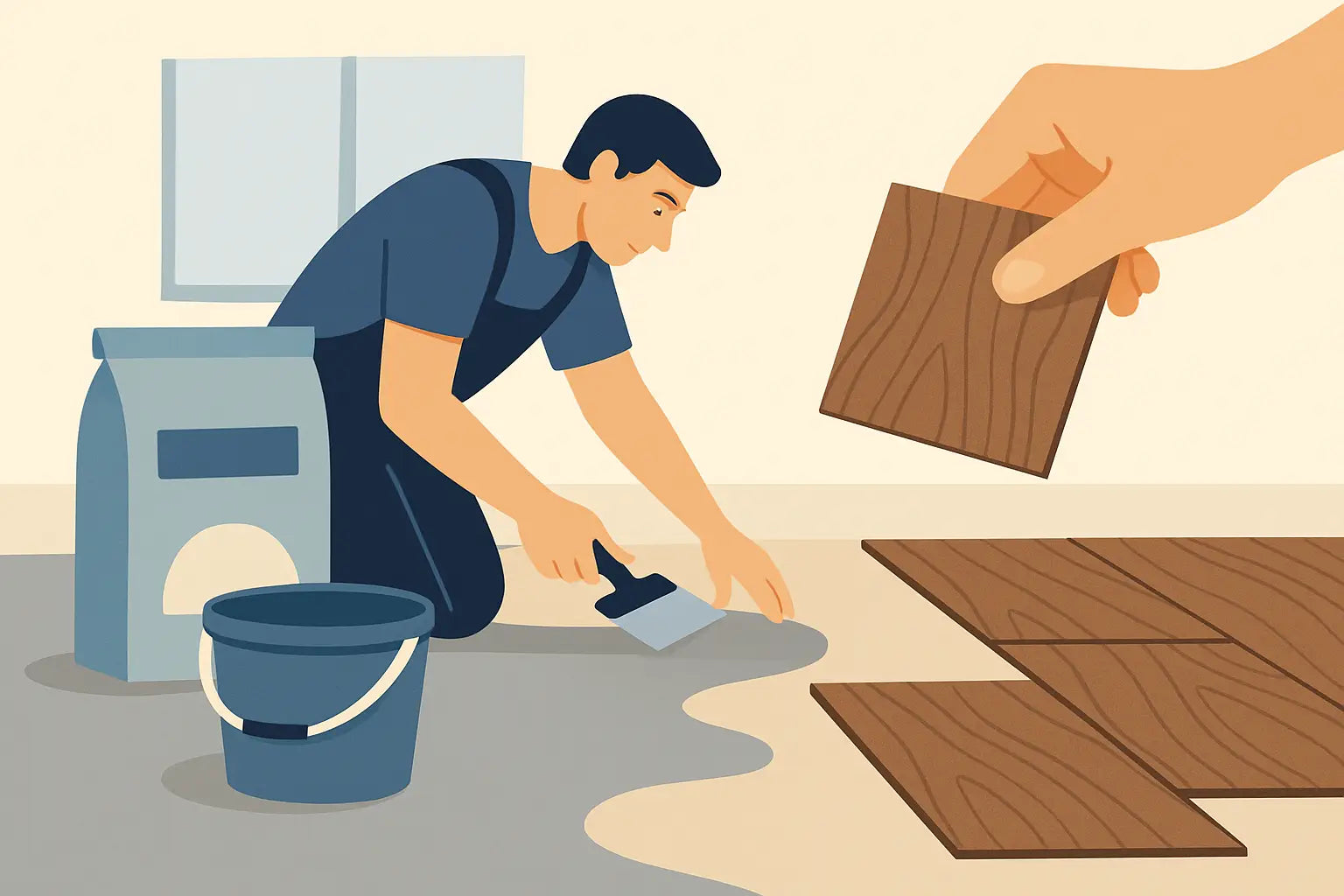
A vinyl floor is only as good as the subfloor beneath it. If it's not level, you'll see and hear it every day: waves in glancing light, creaking click connections, or traced edges with glue-down vinyl. The right filler for vinyl flooring therefore determines the difference between "looks good" and "lasts permanently." Here you'll learn when you need to level, which compound suits your system, and how to avoid common mistakes.
The Essentials at a Glance
- When to level? As soon as you see edges, hollows, or light gaps with a straightedge – almost always with glue-down vinyl.
- Which compound? Usually a self-leveling floor leveling compound, approved for your subfloor (absorbent/non-absorbent) and potentially underfloor heating.
- Primer is essential – it binds dust, regulates absorbency, and creates adhesion.
- Underlay ≠ Leveling: Unevenness should be leveled, not "padded away."
- Patience during drying: Wait for readiness for covering, not just a dry surface.
Table of Contents
- When you need to level at all
- Which filler? The types
- Click vs. Glue-down: different requirements
- Subfloor check: what matters where
- Don't forget the primer
- Layer thickness & drying
- Avoid common mistakes
- Frequently asked questions
- Conclusion
When you need to level at all
Leveling compound comes into play when the floor is not level enough, when there are joints, tile grids, or breakouts, or when you want to prepare an old subfloor so that adhesive and vinyl will work reliably later. Typical cases: old tiles in the hallway, leveled areas in screed, worn floorboards in old buildings.
"Level" in practice means: no noticeable edges, no hollows, no bumps. Check this with a long straightedge. If you see light gaps underneath, you should level – and not try to cover it up with an underlay. Underlays are not leveling compounds: they follow the unevenness and can even put additional stress on click connections.
Which filler? An overview of types
In stores, you'll encounter terms like leveling compound, self-leveling compound, floor filler, or repair filler. For vinyl flooring, you usually need a self-leveling floor leveling compound that creates a smooth, flat surface – for example, the Bostik SL C350 Universal Leveling Compound. Repair fillers, on the other hand, are more for local damage.
Pay attention to what the compound is approved for: for residential areas, for underfloor heating, for certain layer thicknesses, for absorbent or non-absorbent subfloors. For glue-down vinyl, it can be a particularly fine, low-pore compound, because every texture shows through the thin covering.
Click vs. Glue-down: different requirements
| Click Vinyl | Glue-down Vinyl | |
|---|---|---|
| Why flatness? | so that the click connection is not under tension | because every unevenness shows through on the surface |
| Leveling necessary? | for noticeable unevenness | almost always |
| Consequence of errors | Creaking, open joints, damaged click connections | visible edges, pressure marks, poor adhesion |
Still unsure which system suits you? Then our comparison Click vinyl or glue-down vinyl? will help you.
Subfloor check: what matters where
Before purchasing, check three things: flatness (straightedge), strength (is the subfloor sandy or crumbling?) and moisture (especially with fresh screed). The procedure changes depending on the subfloor:
| Subfloor | What to do |
|---|---|
| Cement screed | prime, then level – usually straightforward |
| Calcium sulphate/Anhydrite screed | grind, bind dust, suitable primer, pay attention to moisture |
| Old tiles | clean, grind, adhesive primer, fill joints |
| Wooden floorboards / OSB | stabilize/screw, often decoupling board layer before leveling |
Don't forget the primer
Leveling compound only holds as well as its adhesion to the subfloor. A primer binds residual dust, regulates absorbency, and creates an adhesive bridge. On absorbent cement screed, it prevents the compound from setting too quickly and cracking; on dense tiles, the primer is essential to prevent the leveling layer from decoupling. In practice, the primer often makes the difference between "holds" and "comes off in sheets" – plan it in firmly. More on this in the guide Primer before glue-down vinyl.
Layer thickness & drying
Leveling compounds have minimum and maximum layer thicknesses. Too thin won't level properly, too thick prolongs drying and can crack. Stick to the manufacturer's specifications. Readiness for covering is important, not just a superficially dry layer – residual moisture can still be underneath. Cool rooms and high humidity extend the waiting time, strong drafts cause the surface to set too quickly. Especially with glue-down vinyl: if the adhesive meets residual moisture, it will not bond well.
Avoid common mistakes
- Too much water in the bucket: makes the compound more fluid, but weakens its strength – always mix according to dosing instructions.
- Skipping the primer: saves a step, but often costs the entire floor (hollow spots, detachments).
- Leveling on dust: vacuum thoroughly after grinding, otherwise you're leveling on a release layer.
- Covering too early: ignoring readiness for covering – especially fatal with glue-down vinyl.
- Misusing underlay as a leveling compound: leads to pressure marks and joint movement with click vinyl.
Frequently asked questions about leveling compound for vinyl flooring
Do you always have to level under vinyl flooring?
Not necessarily – it depends on the flatness. Click vinyl tolerates slight unevenness, but as soon as you see light gaps, edges, or hollows with a straightedge, you should level. Glue-down vinyl almost always requires a flat, leveled surface.
Which leveling compound is suitable for vinyl flooring?
Mostly a self-leveling floor leveling compound that creates a smooth, flat surface. Pay attention to the approval for your subfloor (absorbent or non-absorbent), for residential areas, and possibly for underfloor heating.
Do you need a primer before applying leveling compound?
Yes, in almost all cases. The primer ensures adhesion, prevents too quick setting on absorbent subfloors, and prevents decoupling on dense surfaces like old tiles.
How long does leveling compound need to dry before installing vinyl?
This depends on the layer thickness, product, and room climate. The readiness for covering is crucial, not just the surface dryness. Especially with glue-down vinyl, you should adhere to the manufacturer's specifications, otherwise the adhesive will not bond well.
Can you use an underlay instead of leveling compound to even out the floor?
No. Underlays follow unevenness instead of leveling it out and can put additional stress on click connections. Unevenness should be leveled.
Conclusion
You won't see the leveling compound later – but you'll feel it with every step. Anyone who checks flatness, strength, and moisture, chooses the right leveling compound, primes cleanly, and waits for the readiness for covering, lays the foundation for a floor that lies quietly and lasts a long time. You can find the right flooring in our Click Vinyl and Glue-down Vinyl collections – or get your free sample in advance.