
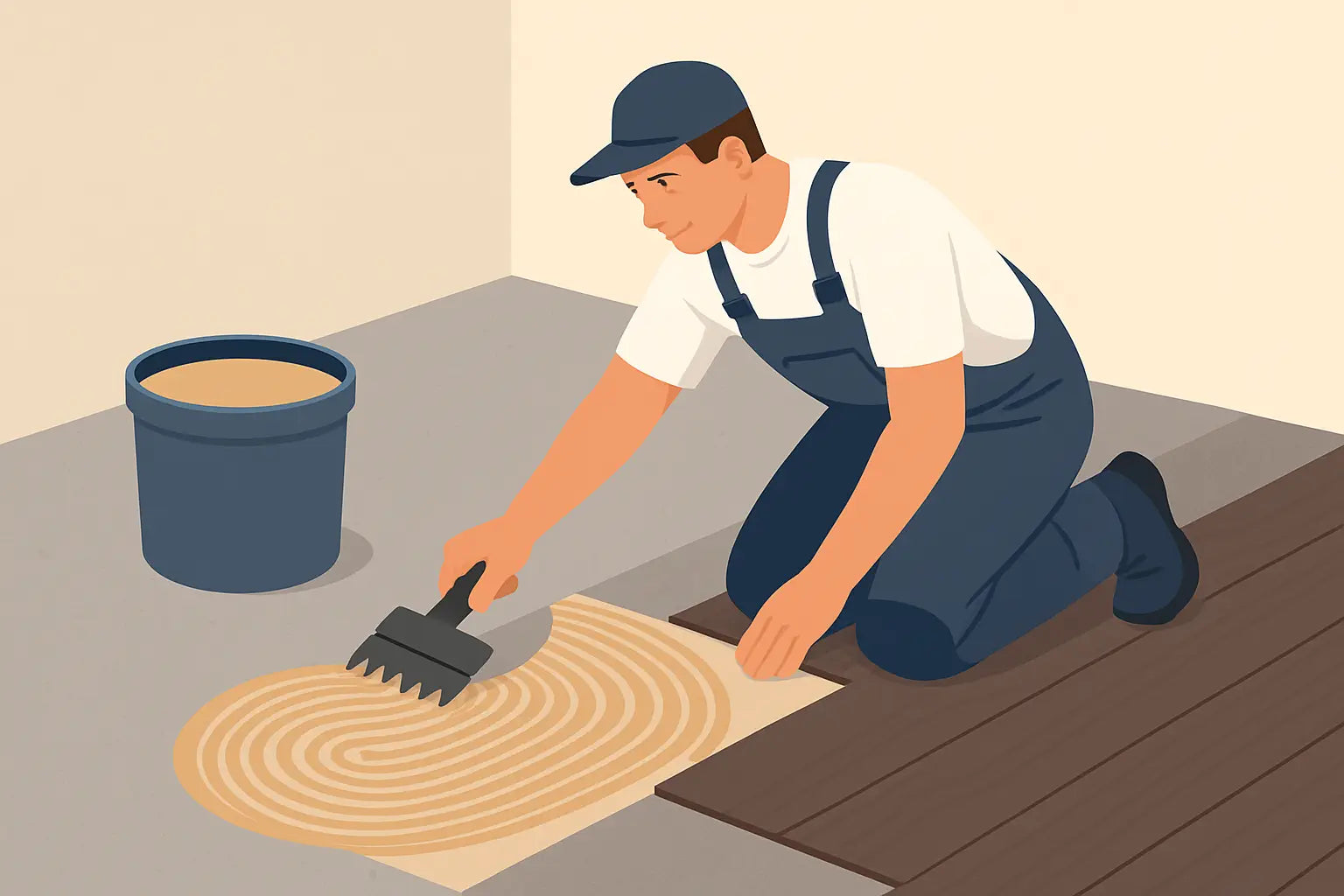
If glue-down vinyl begins to lift at the seams or ripple after a few weeks, it is rarely the fault of the flooring material itself, but almost always the subfloor. This is exactly where you decide if a primer before glue-down vinyl is truly necessary. Working carefully here buys you peace of mind: better adhesion, more uniform joints, and less hassle in the long run.
In a Nutshell
- Usually mandatory: for absorbent screed, non-porous surfaces (tiles), and anywhere residual dust remains after sanding.
- Three functions: binding dust, regulating absorbency, and creating an adhesive bridge.
- No substitute for leveling: primer creates adhesion but does not compensate for unevenness.
- Observe drying times: leveling or gluing too early ruins the bond.
- Only for glue-down vinyl: click vinyl is installed as a floating floor; you do not prime the surface for that.
Table of Contents
- What it's all about
- When it's mandatory vs. optional
- Which subfloors need primer
- Which primer for which problem
- Properly preparing the subfloor
- Avoiding common mistakes
- Frequently asked questions
- Conclusion
What it's all about
Glue-down vinyl is bonded across the entire surface. To ensure the adhesive holds permanently, the primer performs three tasks depending on the subfloor: it binds fine sanding dust (which would otherwise act as a separation layer), regulates absorbency, and creates an adhesive bridge on difficult surfaces. Important: Primer does not replace subfloor preparation; it is the final step before leveling or gluing.
When it's mandatory vs. optional
Whether you need to prime depends on the subfloor, the adhesive system, and the condition of the surface. A primer is generally mandatory for highly absorbent subfloors (cement screed), non-porous surfaces requiring an adhesive bridge, areas with residual dust after sanding, and before applying leveling compound. It is only optional if the subfloor is optimally prepared, load-bearing, clean, and explicitly approved by the system as "primer-free"—which is rare. In everyday renovation, you will almost always encounter mixed surfaces with varying levels of absorbency. In that case, primer is the most affordable form of insurance.
Which subfloors need primer
| Subfloor | Why & what |
|---|---|
| Cement screed / concrete | absorbent and dusty, dispersion primer consolidates and equalizes |
| Calcium sulfate / anhydrite | moisture-sensitive, bind sanding dust, use suitable primer, check moisture |
| Old tiles / non-porous surfaces | smooth & dense, bonding primer as an adhesive bridge, often requires additional leveling |
| OSB / wood-based boards | expands & contracts, often requires primer + reinforcement + leveling |
Which primer for which problem
There is no such thing as a "universal primer"; what matters is the specific problem you are solving. For absorbent subfloors, a dispersion primer is usually used to close pores and consolidate the surface, for example, the Bostik GRIP A500 primer. For dense, smooth surfaces, you need a bonding primer to act as an adhesive bridge. If the manufacturer of your leveling compound or adhesive requires a specific product, it is not a sales tactic but a matter of system integrity. You can read more about the installation process in our guide Leveling compounds for vinyl flooring.
Properly preparing the subfloor
- Check load-bearing capacity: If something is sandy, chalky, or flaking, it must be removed. Primer is not a universal adhesive.
- Ensure flatness: Glue-down vinyl is thin and highlights every ridge; use leveling compound for uneven areas.
- Vacuum thoroughly: Remove dust completely after sanding; otherwise, you will be priming the dust.
- Apply primer evenly: Do not apply too heavily (avoid shiny films) or too thinly; do not leave puddles.
- Respect drying times: Follow the manufacturer's specified timeframes; do not proceed with work "on a hunch." -->
Avoiding common mistakes
- Priming a weak subfloor: The primer holds, but the underlying surface comes loose.
- "Priming instead of leveling": Unevenness will still show through.
- Incorrect primer: e.g., using standard dispersion on dense tiles, which leads to adhesion problems.
Frequently asked questions about priming before glue-down vinyl
Is priming always necessary before glue-down vinyl?
In most renovation cases, yes. It is mandatory for absorbent subfloors, non-porous surfaces requiring an adhesive bridge, and anywhere residual dust remains after sanding. It is only unnecessary on optimally prepared, explicitly approved surfaces.
Which primer matches which subfloor?
For absorbent subfloors, typically a dispersion primer that closes pores and consolidates. For dense, smooth surfaces like old tiles, a bonding primer acts as an adhesive bridge.
Can I skip leveling if I use primer?
No. Primer creates adhesion and regulates absorbency but does not compensate for unevenness. If the subfloor is uneven, leveling remains mandatory.
How long does the primer need to dry?
This depends on the product. Leveling or gluing too early can ruin the bond; strictly adhere to the manufacturer’s drying times and windows of operation.
Does click vinyl also require a primer?
No. Click vinyl is installed as a floating floor and is not glued down, so priming the surface is not necessary. This topic applies only to the full-surface bonding of glue-down vinyl.
Conclusion
Do not treat priming as an optional extra, but as a fixed part of your project planning. It is often the difference between "holding fast" and "peeling up in sheets," making it the most affordable insurance against expensive rework. You can find the right flooring in our glue-down vinyl collection, or order your sample in advance.