
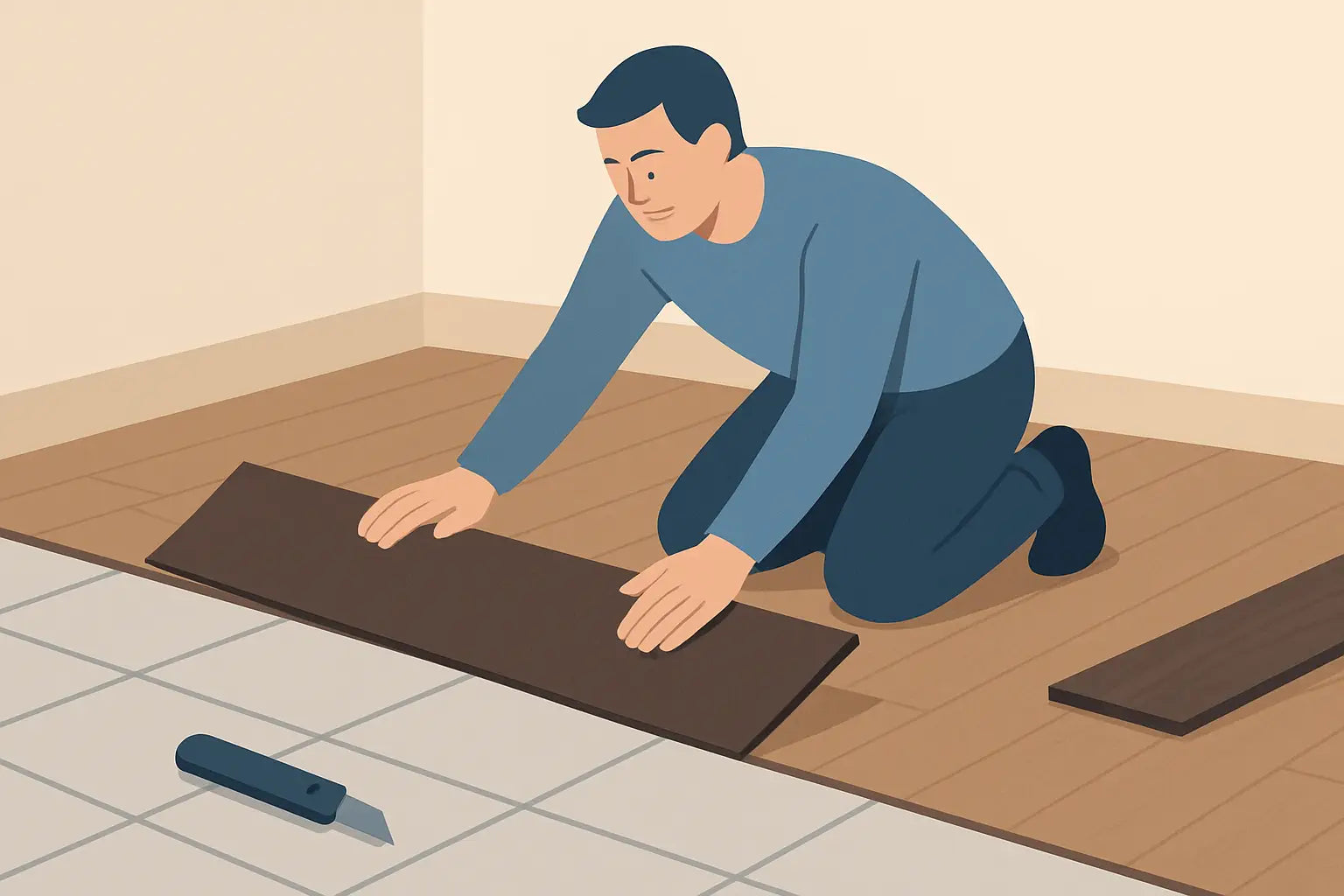
Anyone who has ever walked across cold, hard tiles in the kitchen or hallway knows the feeling: visually okay, but in everyday life, no longer what you imagine "home" to be. Vinyl is often the quick modernization – without the mess and downtime that almost always comes with chiseling out tiles. This is precisely where the core question arises: Can you lay vinyl flooring over tiles, and if so, how, without grout lines showing through later or the floor "working"?
The good news: In many cases, it works very well. The honest truth: It depends on the tiles, the grout, the flatness, and the moisture – and whether you want to lay click vinyl floating or glue down vinyl across the entire surface. If you check these points carefully, you will save yourself complaints, rework, and the frustration when the grout look reappears after a few months.
Laying vinyl flooring over tiles: first check, then decide
Before you order material, a quick "subfloor check" is worthwhile. Tiles are fundamentally a stable, hard subfloor. The problem is usually not the tiles themselves, but rather the geometry: deep grout lines, edges (lippage), loose spots, or a subfloor that is not dry enough.
For practical purposes, three checks are sufficient, which you can start without special equipment: Tap on tiles (hollow-sounding spots are a warning sign), check the flatness with a long spirit level or straightedge, and feel with your hand how pronounced the grout lines and edges actually are. If you already see "waves" in glancing light, click vinyl will lie over it, but it won't automatically "magically make them disappear."
The type of room is also crucial. In the bathroom and utility room, moisture and splash water are more prevalent than in the living room. And in the hallway, point loads and dirt are significantly higher. This influences whether decoupling with an underlay is useful, or whether full-surface gluing is the more stable solution.
Click vinyl or glue-down vinyl on tiles - which suits your project?
Click vinyl is the typical renovation choice because it can be laid quickly and requires a less "perfect" subfloor than gluing. It is laid floating, requires expansion joints at the edges, and usually sits on an underlay, depending on its construction. This can work excellently on tiles – especially if the grout lines are not too deep and the surface is sufficiently level.
Glue-down vinyl is thinner and often appears particularly high-quality because it lies very "firmly" and transitions are flatter. However, it is uncompromising when it comes to the subfloor: every unevenness, every deep grout line, and every edge can show through later. On tiles, this almost always means: filling grout lines, smoothing the surface, priming – only then gluing. However, those who do this cleanly get the most elegant solution, especially with low construction heights or if doors would otherwise scrape.
If you are unsure, think from a risk perspective: Click vinyl is more forgiving, glue-down vinyl rewards perfect preparation with the best appearance.
The subfloor decides: grout lines, flatness and load-bearing capacity
The most common problem when laying vinyl flooring over tiles is what is known as "telegraphing" – grout lines or edges showing through the flooring. The thinner the material and the harder the wear layer, the more likely this is to be visible. With click vinyl with an integrated backing and some thickness, this happens significantly less often than with very thin glue-down vinyl.
As a rule of thumb: deep grout lines and heavily textured tiles should be leveled. Individual raised tile edges are also critical because click connections can be subjected to point loads. This does not immediately lead to damage, but it increases the likelihood of creaking noises, "working" joints, or broken click edges.
Load-bearing capacity in this context means: no loose tiles, no crumbling grout, and no oily residues (e.g., in older kitchens). Loose areas must be removed or stabilized, otherwise you will be building the new floor on a movable foundation.
Preparation: how to make tiles "vinyl-ready"
Cleanliness is not a cosmetic issue, but one of adhesion and flatness. First, remove grease, detergent residues, and silicone residues in edge areas. Especially on floor tiles in kitchens, there is often a film that can later interfere with filler or primer.
After that, you decide how much leveling is necessary. For click vinyl, it is often sufficient to fill deep grout lines and mitigate individual raised edges. For glue-down vinyl, you should prepare the surface so that it feels like a smooth screed. This usually means: suitable primer, filling, letting it dry, sanding if necessary.
Drying times are the point at which many projects falter. Fillers look "hard" after a few hours, but are still moist inside. If you glue too early or cover too early, you risk adhesion problems or deformation. Plan in the time buffer – this is usually cheaper than redoing it afterwards.
Impact sound and construction height: not every tiled floor is "quiet"
Tiles transmit sound very well. A floating click vinyl can significantly improve the walking sensation, but only if the underlay matches the situation. Underlays that are too soft are not automatically better on very hard subfloors – they can put more stress on the click connection because the floor gives way more when walking.
Also pay attention to the construction height, especially at doors and transitions. A few millimeters determine whether doors need to be shortened or whether skirting boards fit neatly. For tight heights, glue-down vinyl shows its strength because it has a much lower profile. In the hallway, however, a slightly more stable construction with click vinyl and a suitable underlay can increase everyday usability.
Installation step by step: how to keep the result predictable
Start with acclimatization: Vinyl should lie in the room for 24 to 48 hours so that the material and room climate can adapt. This reduces tension after installation.
For click vinyl, the laying direction is usually a mix of aesthetics and room geometry. In narrow hallways, laying lengthwise often appears calmer; in large rooms, the light can emphasize the joints more. The most important thing is to align the first row exactly. Every small error there will carry through.
For glue-down vinyl, you ideally work with a clean marking and lay from the room axis so that cuts at the edges are even. The adhesive and trowel notch must match the product. Too little adhesive leads to poor wetting; too much can squeeze up at the joints. Pressing or rolling is not "optional," but part of the adhesion.
In both cases: Transitions and edge finishes are not trivial. Expansion joints with click vinyl must remain free and are later covered by skirting boards. In door areas, matching profiles ensure that nothing frays and that heights are neatly bridged.
Typical mistakes when laying vinyl on tiles - and how to avoid them
The classic mistake is underestimating grout lines. What feels "not so bad" under your fingers can later become clearly visible in glancing light – especially with dark decors or very calm, monochrome designs.
The second mistake is an incorrect combination of underlay and click vinyl. If the underlay is too thick or too soft, the floor may feel comfortable at first, but it can stress the click connection in the long run. Conversely, a hard underlay does little if you actually want to reduce sound.
The third mistake is time pressure with filler and adhesive. Those who ignore drying will pay double later. Especially in old buildings or in rooms with little air exchange, moisture takes longer to dissipate.
And finally: transitions. If doors scrape, profiles are missing, or edge joints are too tight, stress builds up in the material. Vinyl is dimensionally stable, but not "rigid" – it needs space to work.
When it's better to remove the tiles after all
There are cases where "laying over" is not the best solution. If many tiles are hollow, loose, or the subfloor is generally unstable, you are otherwise building on a risk. Very uneven, heavily textured tiles with high edges can also require so much leveling that the advantage of quick renovation is lost.
Another issue is moisture from the subfloor, for example in rooms on the ground or older floor constructions without adequate waterproofing. If you already have odors, dark spots, or permanently damp grout lines here, you should first clarify the cause before laying a new floor covering over it.
Material choice: what renovators should look for in vinyl
For renovations on tiles, it's worth buying not just for appearance. Pay attention to the use class, the total thickness, the type of connection (for click), and whether the manufacturer specifies certain underlays. For heavily used areas such as hallways or kitchens, stable click systems and durable wear layers are often a better investment than the cheapest square meter price.
When comparing brands, it helps to look at the overall system: flooring plus underlay plus finishing profiles plus possibly filler and primer. The "quick deal" only truly becomes a good buy when the accessories are also considered. This is exactly why a specialist dealer with a curated selection is practical – you get flooring and installation accessories from a single source and don't have to guess what goes together. At WaBo Design, many renovators find click vinyl and glue-down vinyl from established lines as well as the right installation products if things are to run quickly and predictably.
Ultimately, however, your room always counts: those who need an absolutely flat, modern look with a low build-up height are often best off with well-prepared glue-down vinyl. Those who want to renovate quickly, cleanly, and with a little more tolerance for error are usually on the safe side with click vinyl.
If you only remember one thing in the end: The floor you see tomorrow depends on the subfloor you take seriously today – and that is exactly where quality pays off in everyday life.