
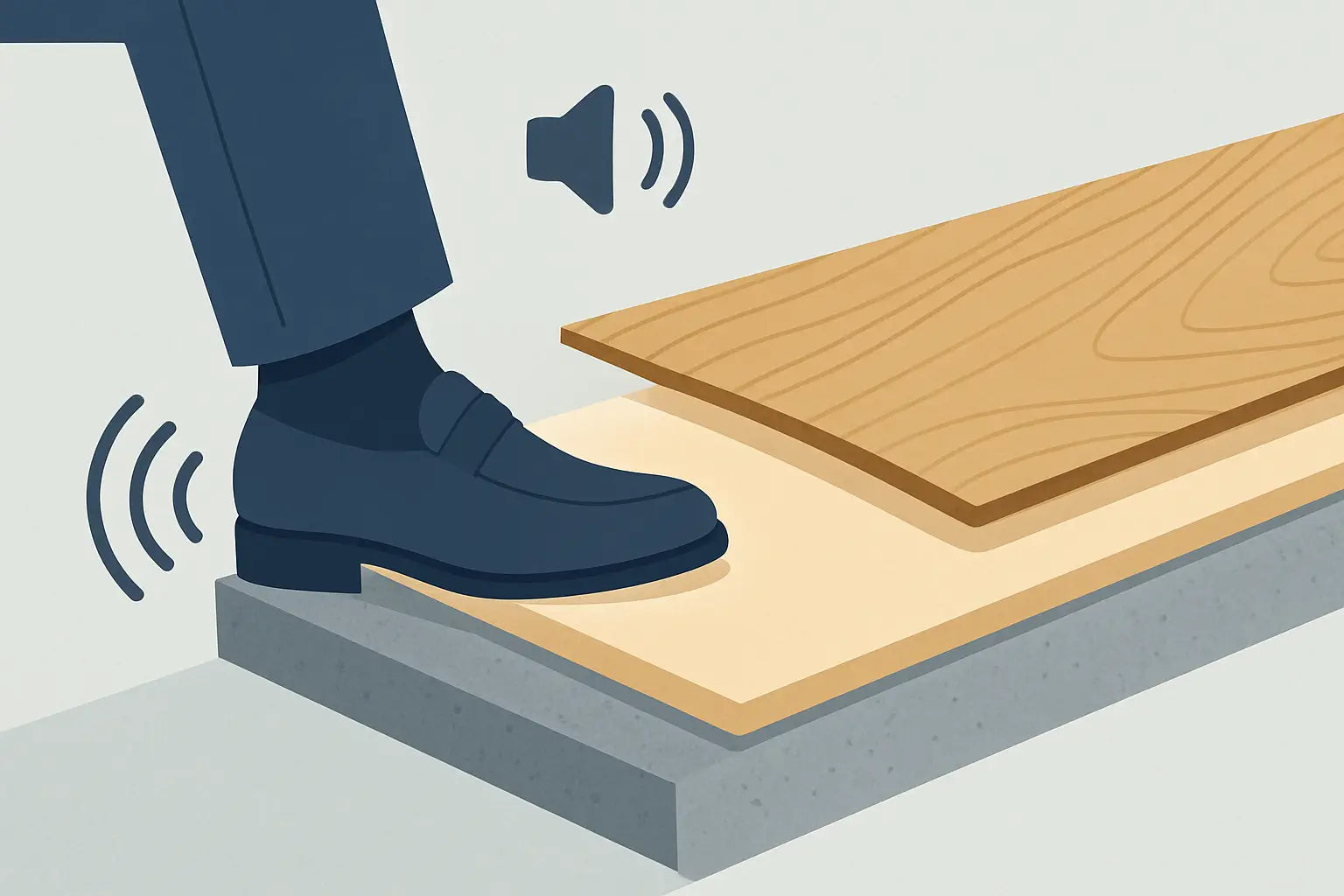
Do you really need impact sound insulation under vinyl – or is it just an expensive extra that eats up money and installation height? The honest answer is: It depends. Click vinyl and glue-down vinyl work technically completely differently, and there are also the subfloor, underfloor heating, sound insulation requirements, and installation height. If you separate these cleanly, you can quickly make a decision that won't creak, sound hollow, or cause warranty issues later. This guide will show you step-by-step when impact sound insulation under vinyl is necessary – and when it's not.
Last updated: June 2026
Read also
Still unsure which flooring is right for you? Our guide "How to find your dream floor" will lead you to the right choice in 4 easy steps.
🎯 Start Floor Finder – incl. Free Samples →Key Takeaways
- Click Vinyl: usually advisable – unless the product already has integrated insulation (in which case additional insulation is often even prohibited).
- Glue-down Vinyl: generally no traditional impact sound insulation – instead, a perfectly leveled, smooth subfloor is crucial.
- Most important metric for Click: not "as thick as possible", but pressure stable. Too soft can damage the click connection.
- Underfloor heating: only use underlays with low thermal resistance (R-value) that are explicitly approved for this purpose.
- Multi-family house: significantly higher sound insulation requirements than in a single-family house – here, the entire floor construction matters.
Table of Contents
- Impact Sound, Walking Sound & The Basic Logic
- Click Vinyl: mostly yes – but not always
- Click Vinyl with Integrated Insulation
- Click Vinyl without Impact Sound Insulation: Is it possible?
- Glue-down Vinyl: rarely insulation, but a perfect subfloor
- Glue-down Vinyl with Impact Sound Insulation
- Click vs. Glue-down: Impact Sound Compared
- The Subfloor Decides
- Underfloor Heating & R-Value
- Installation Height: The Silent Dealbreaker
- Avoiding Common Mistakes
- Decision in 5 Minutes
- Frequently Asked Questions
- Conclusion
Impact Sound, Walking Sound & The Basic Logic
Vinyl is relatively "quiet" because it is more elastic. Our big floor comparison shows how it performs in a direct comparison of vinyl or laminate. Nevertheless, noise arises in two ways: impact sound (steps transmitted into the building structure and thus into rooms below) and walking sound (what you hear yourself in the room when you walk on it). Impact sound insulation primarily targets impact sound – meaning that your neighbors downstairs hear less. Walking sound additionally depends on the material composition, room acoustics, and the weight of the floor. More background on the term can be found in the explanation of impact sound.
Whether impact sound insulation is sensible or even mandatory therefore depends less on "vinyl in general" but on whether your floor is floating, how hard the subfloor is, and what sound requirements you need to meet. In a multi-family house, the issue is much more sensitive than in a single-family house – here, sound insulation requirements according to DIN 4109 apply.
Click Vinyl: mostly yes – but not always
Click vinyl is usually laid floating: The floor is not permanently connected to the subfloor but lies on it as a "panel". Exactly this construction can transmit vibrations and, under unfavorable conditions, amplify noises. Therefore, a suitable underlay is used for many click vinyl projects.
What really matters is not the thickness, but the pressure stability. For floating installation, the underlay must withstand furniture and point loads without permanently yielding. An underlay that is too soft makes the floor noticeably "springy" – which initially sounds pleasant, but often damages the click connection. It can "work" under load, which later manifests as creaking, gap formation, or reduced stability.
Click Vinyl with Integrated Insulation
Many modern click vinyl floors already have an integrated underlay mat – for example, the Liberty Rock 40 Acoustic with factory-fitted impact sound insulation. In this case, additional insulation is not automatically sensible – on the contrary: underlays that are too soft or too thick increase the risk that the click connection will work under load.
If your click vinyl has integrated insulation, always check the manufacturer's installation instructions. Often, "no additional insulation" is explicitly specified, or only very thin, pressure-stable underlays are permitted.
Click Vinyl without Impact Sound Insulation: Is it possible?
Basically yes, but it depends on the product and the subfloor. If your click vinyl already has integrated insulation, you don't need a second one and often shouldn't add one. If it doesn't, you risk hollow sounds, more walking noise, and a more stressed click connection without an underlay, especially on hard screed or tiles. You should only lay click vinyl completely without impact sound insulation if the manufacturer explicitly approves it and the subfloor is even and load-bearing. In multi-family houses, you practically can't do without it due to sound insulation regulations. In short: vinyl flooring without impact sound insulation is possible, but only sensible in clearly defined cases. You can find the right, pressure-stable underlay in our accessories.
Glue-down Vinyl: rarely insulation, but a perfect subfloor
Glue-down vinyl – for example, the Liberty Urban 40 – is fully glued down. This makes it structurally quieter in terms of transmission and very quiet in terms of walking sound, because nothing "floats". Traditional impact sound insulation, as used with click systems, is not normally used here.
The catch: Glue-down vinyl does not forgive subfloor imperfections. Every unevenness, every edge, every hollow can show through later. Therefore, a cleanly leveled, smooth, load-bearing subfloor is the decisive success factor. You can read how to properly prepare it in our guides on filler for vinyl flooring and primer before glue-down vinyl.
If you want to reduce impact sound with glue-down vinyl, this happens via the entire floor structure (screed, decoupling systems, possibly special acoustic underlays explicitly approved for glue-down vinyl) – not via the traditional "foam roll" from the hardware store.
Glue-down Vinyl with Impact Sound Insulation
Glue-down vinyl is fully glued down; a loose foam underlay, as used with click systems, has no place underneath, as it would prevent adhesion. If you still want to improve impact sound with glue-down vinyl, you do so via the overall construction: a firmly adhesive acoustic board or a decoupling system explicitly approved for glue-down vinyl is applied under the adhesive. This is not standard, but in noisy old buildings or multi-family homes, it can be worthwhile. In any case, a level, load-bearing subfloor remains important.
Click vs. Glue-down: Impact Sound Compared
| Aspect | Click Vinyl | Glue-down Vinyl |
|---|---|---|
| Installation | floating | fully glued down |
| Impact Sound Insulation | mostly advisable (unless integrated) | generally no traditional insulation |
| Most Important Metric | Pressure stability of the underlay | Evenness of the subfloor |
| Walking Sound in Room | depending on construction / insulation | very quiet (solid bond) |
| Installation Height | higher (approx. 4–6 mm + underlay) | very flat (approx. 2–3 mm) |
| Underfloor Heating | suitable, underlay must be FBH-compatible | very good (direct heat transfer) |
The Subfloor Decides: Screed, Tiles, Floorboards, Old Covering
The question "Is impact sound insulation necessary under vinyl?" can often be answered more quickly by looking at the subfloor than at the product.
On mineral screed, an underlay is often useful for click vinyl because screed is hard and transmits sound well. A suitable underlay also bridges minimal unevenness – not as a substitute for leveling, but for micro-tolerances.
On tiles, flatness is crucial. Tile joints can show through with click vinyl or promote a hollow sound if the floor is not fully supported. Here, a clean leveling with filler for vinyl flooring or an underlay approved for bridging small joints helps. With glue-down vinyl, leveling is usually unavoidable.
On wooden floorboards or OSB, vibration and movement are more important than "pure insulation." Wooden subfloors work. If they are not sufficiently stable, they can creak – regardless of how good the impact sound insulation is. Here, it is important to: screw down the subfloor, stabilize it, create flatness – and then use a pressure-stable underlay (for click) or suitable preparation (for glue-down).
Old coverings like PVC or linoleum can work depending on their condition and approval, but they are a typical risk factor. Soft, yielding old coverings plus additional insulation can quickly overtax click connections.
Underfloor Heating & R-Value
With hot water or electric underfloor heating, a simple principle applies: every additional layer slows down heat transfer. An underlay is not forbidden – but it must be suitable for it.
The decisive metric is the thermal resistance (R-value) of the entire system of vinyl plus underlay: the lower, the better the structure conducts heat. For vinyl on underfloor heating, a total R-value of around 0.15 m²K/W is considered a practical upper limit. At the same time, the underlay must not be so soft that it yields under heat and load. Especially with click vinyl, the combination of "thermally suitable" and "pressure stable" is crucial.
Installation Height: The Silent Dealbreaker
In renovations, installation height is often the bottleneck: doors, transitions, skirting boards, and kitchen fronts. Impact sound insulation sounds like only 2 mm extra – but together with vinyl thickness and any leveling compound, it can lead to doors needing to be shortened or transition strips becoming unpleasantly high.
If you're planning with a tight installation height, glue-down vinyl is often the more elegant solution, as it doesn't require an underlay and is very low-profile. With click vinyl, the height can only be reduced to a limited extent without losing stability and acoustics.
Avoiding Common Mistakes
The most common mistake is choosing impact sound insulation based on the principle "the thicker, the better." With click vinyl, too thick often means too soft. This doesn't take its toll immediately, but after weeks or months – when the click connection yields under everyday loads.
The second classic: forgetting or incorrectly applying a vapor barrier. On mineral subfloors, a moisture barrier may be required, depending on residual moisture and manufacturer's approval. Some underlays have an integrated vapor barrier, others do not. The important thing is not "always foil," but "as the construction requires."
And thirdly, the "underlay as a problem solver": An underlay is no substitute for an uneven, cracked, or crumbling screed. Anyone who skimps here will pay later with hollow spots, creaking, or visible marks.
Decision in 5 Minutes
If you need a quick, practical decision, ask yourself three questions:
- Click or Glue-down? For click vinyl, a suitable underlay is often advisable; for glue-down vinyl, usually not.
- Integrated insulation in the product? If yes, check the manufacturer's information – additional underlays are often excluded then.
- Subfloor and Goal? Is it about sound insulation in a multi-family house, heat conduction with underfloor heating, or minimal installation height? The choice will differ depending on the priority.
With the room data (subfloor, square meters, heating system, desired vinyl type), this can be narrowed down very reliably. Unsure? Then order your free vinyl sample in advance and talk to us before buying – it saves you from making accessory purchasing mistakes.
Frequently Asked Questions about Impact Sound Insulation under Vinyl
Do you always need impact sound insulation under vinyl?
No. For floating click vinyl, a suitable underlay is usually advisable, while for fully glued-down vinyl, it generally is not. The decisive factors are the installation method, subfloor, and sound requirements – not "vinyl" in general.
Do I still need additional impact sound insulation for click vinyl with integrated insulation?
Normally not. An additional, too-soft underlay can cause the click connection to "work" under load and creak. Check the manufacturer's installation instructions – often, additional insulation is explicitly excluded.
Is click vinyl also possible without impact sound insulation?
Yes, if the manufacturer approves it and the subfloor is even and load-bearing, or if insulation is already integrated. Without an underlay, hollow sounds and a more stressed click connection are otherwise likely. In multi-family homes, insulation is almost always mandatory due to sound regulations.
Which impact sound insulation is best for click vinyl?
Not the thickest, but the most pressure-stable. The underlay must withstand furniture and point loads without permanently yielding. Underlays that are too soft make the floor "springy" and long-term damage the click connection.
Can glue-down vinyl be laid with impact sound insulation?
Not with a loose underlay, as that would prevent adhesion. With glue-down vinyl, you improve impact sound through the overall construction, for example, a firmly adhesive acoustic panel approved for glue-down vinyl.
Which impact sound insulation is suitable for underfloor heating?
One with low thermal resistance (R-value) that still remains pressure stable. Every additional layer slows down heat – therefore, the underlay must be explicitly approved for underfloor heating.
Conclusion
The best impact sound insulation isn't the thickest, but the one that suits your vinyl, your subfloor, and your everyday life. For click vinyl, a pressure-stable underlay is usually advisable – unless insulation is already integrated. For glue-down vinyl, a properly prepared subfloor replaces the insulation. Then the floor feels quiet, remains stable, and does exactly what it's supposed to: make your home better without complications.
Browse our collections Click Vinyl and Glue-down Vinyl – or secure your free sample delivered to your home in advance.
Directly browse: All vinyl floors with integrated impact sound insulation can be found summarized in our overview, filterable by appearance, wear layer, and brand.