
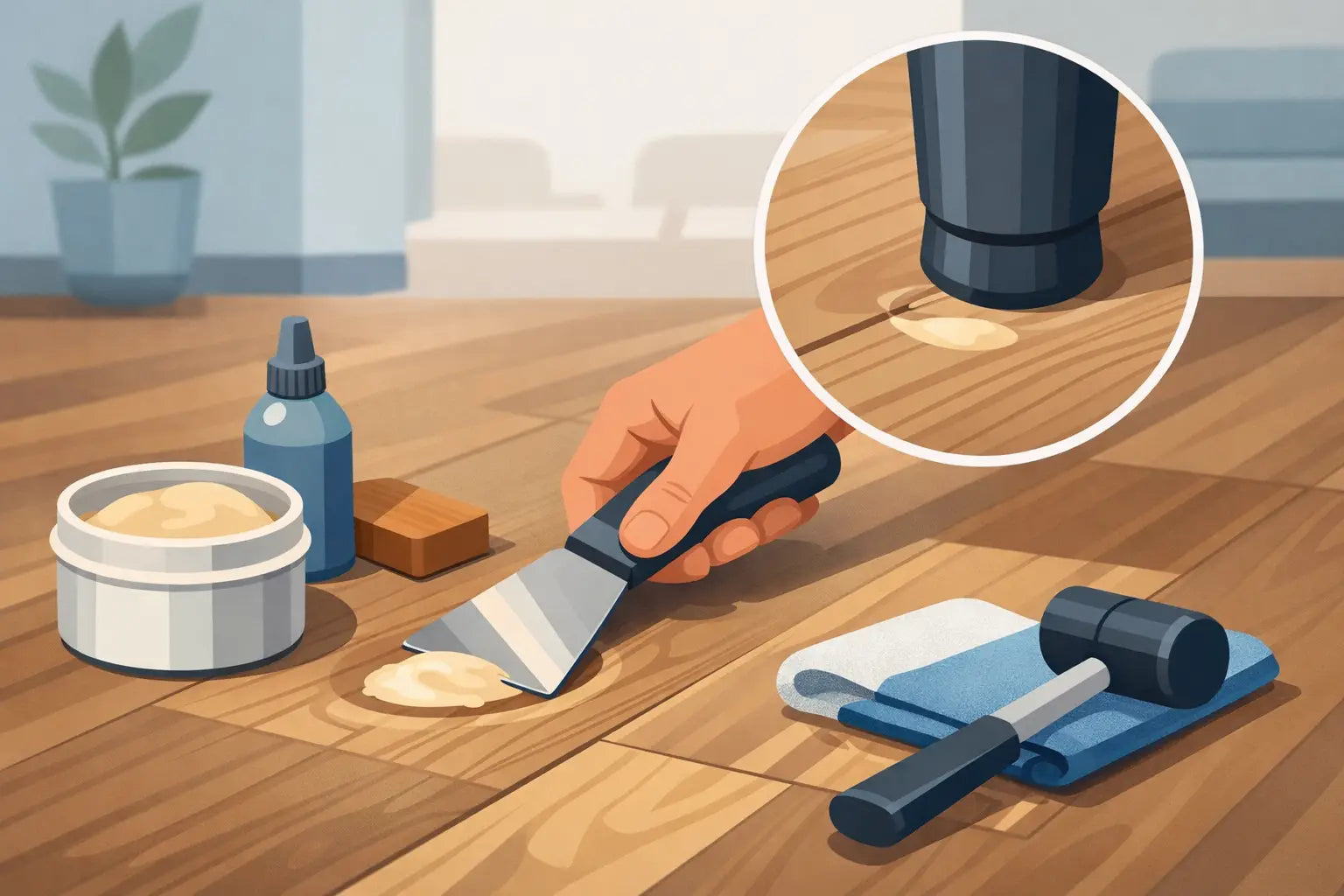
A heavy cabinet has been moved a few centimeters, the office chair has stood in the same place for months, or the sofa rests on feet that are too small – depressions in the floor quickly appear. If you want to repair pressure marks on your vinyl floor, you should first check whether it is real damage or a temporary deformation. This determines whether the area can still be smoothed out or if replacing individual elements is more sensible.
Why do pressure marks appear on vinyl flooring at all?
Vinyl is suitable for everyday use, easy to clean, and durable. Nevertheless, it remains a resilient floor covering. This elasticity is one of the reasons why vinyl is comfortable to walk on and impact noise is often lower than with harder coverings. The disadvantage: localized loads can leave marks.
Pressure marks particularly often occur under furniture with narrow feet, under shelves with high continuous loads, or under chair casters that are not suitable for the respective floor. The subfloor also plays a role. If it is not properly leveled, not even enough, or gives way slightly, the load will show more quickly in the flooring. The damage pattern can differ between glue-down vinyl and click vinyl, but the cause often remains the same – too much weight on too small an area.
Repairing pressure marks on vinyl flooring – first assess the damage correctly
Before you heat, press, or replace anything, it's worth taking a close look. Not every dent is the same. A slight depression without a crack, without an open joint, and without a damaged surface can often still be improved. It becomes more difficult if the wear layer is damaged, edges are raised, or the plank has been visibly compressed.
For click vinyl, you should also check whether the locking system has come loose or become strained due to the pressure mark. For glue-down vinyl, it is crucial whether the covering still adheres fully or is lifting at the edges. If the spot feels rough when you run your hand over it or if the decorative film has changed, simple smoothing is usually no longer sufficient.
Another point is the duration of the load. Fresh pressure marks often respond better to corrective measures than those that have been "burned in" over months or years. This does not mean that older spots are hopeless – but expectations should remain realistic.
What you can try yourself for minor pressure marks
For small, superficial depressions, heat is often the first sensible approach. Vinyl reacts to temperature, becoming somewhat more flexible, and with luck, can partially return to its original shape. A delicate touch is important here. Too much heat can damage the surface, alter the sheen, or permanently warp the material.
The safest method is carefully warmed air at a sufficient distance. The spot should never be locally overheated. Work slowly, test the temperature first in an inconspicuous area, and keep the heat source moving constantly. Immediately afterward, it can help to work the depression with a soft cloth and light pressure. The goal is not to press the floor down, but to gently and evenly guide the surface back into its shape.
Sometimes, simply removing the load and giving the material some time is enough. Especially with shallower pressure marks in living areas, vinyl can partially recover on its own. However, this doesn't always work and is more likely with more elastic qualities than with very rigid constructions.
When home remedies do more harm than good
Many quick fixes circulate online – from using an iron to a steaming hot cloth. Such methods sound practical but carry a clear risk. Excessive heat can alter the decorative layer and wear layer. A small dent can then quickly turn into a visible dull, wavy, or discolored spot.
Strong rubbing, hard spatulas, or pressure with unsuitable tools are also not a good idea. Vinyl surfaces are resistant but not invulnerable. Scratching the structure or damaging the bevel creates a problem that can hardly be disguised visually.
If you are unsure, a simple rule applies: It's better to proceed conservatively and observe the spot than to exacerbate the damage through overzealous action. This is particularly sensible if the floor is still new or part of a larger, uniform area.
If the pressure mark is deeper – repair or replace?
- Opens in a new window.