
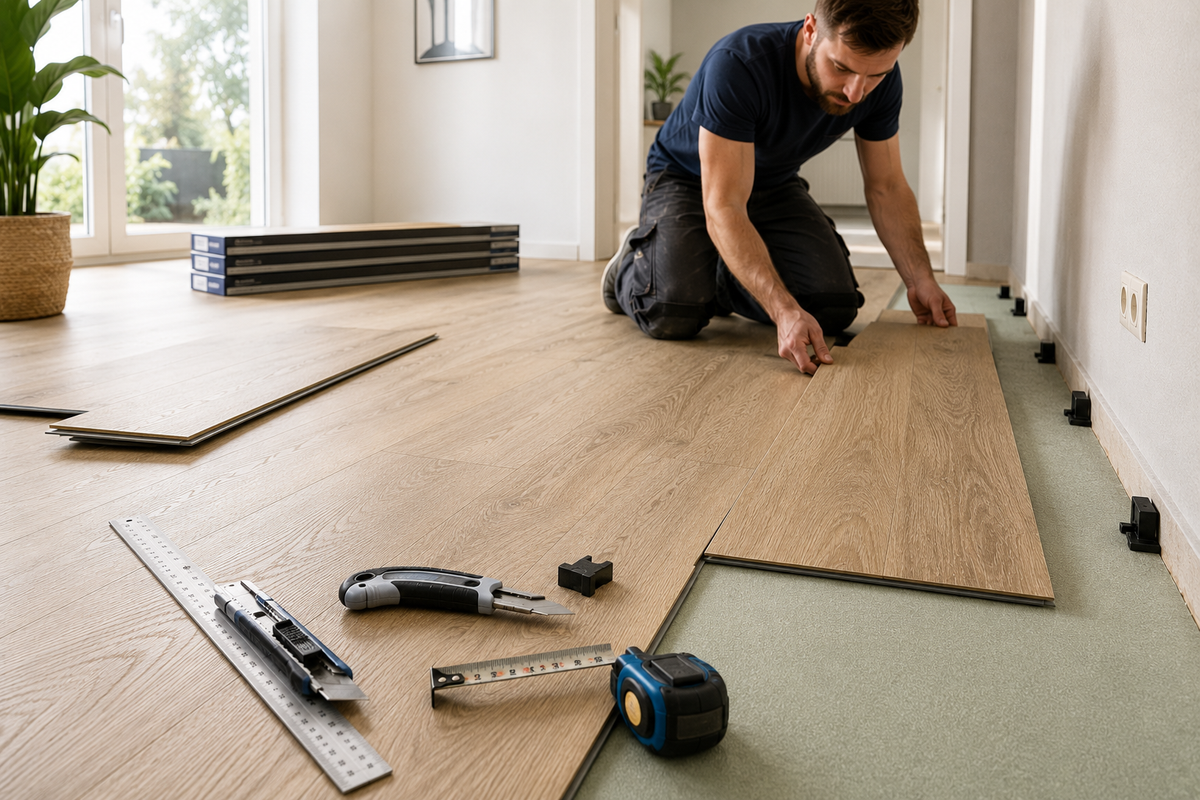
Installing vinyl flooring over wooden floorboards is generally possible in most old buildings and existing apartments, provided the subfloor is properly prepared. Can you simply lay vinyl flooring on existing wooden floorboards, or does the old plank floor need to be laboriously treated first? The honest answer: It depends on the levelness, stability, and condition of the floorboards, and these are exactly the points we will clarify here step by step.
The most important points in brief
- Wooden floorboards must be firmly screwed down, dry, and low-vibration before installing vinyl flooring over them.
- You should level out joints and unevenness of about 2 mm or more over a length of 1 m before installation.
- Click vinyl with an underlay is more forgiving of minor unevenness than fully glued-down vinyl flooring.
- Old varnish, wax, or loose paint residues must be removed or at least sanded down.
- A moisture test of the subfloor is mandatory, especially for floorboards over basements or crawl spaces.
Table of Contents
- Requirements: When vinyl flooring on wooden floorboards is possible
- Checking levelness: How level the floorboards really need to be
- Preparing wooden floorboards: Screwing, sanding, filling
- Moisture and subfloor inspection
- Click vinyl or glue-down vinyl on wooden floorboards: which fits better
- Impact sound and noise reduction
- Installation step by step
- Common mistakes when installing on wooden floorboards
- Frequently asked questions
- Conclusion
Requirements: When vinyl flooring on wooden floorboards is possible
An old plank floor is fundamentally a suitable substrate for vinyl flooring as long as three conditions are met: The boards are firm and do not vibrate, the surface is sufficiently level, and the floor is permanently dry. Creaky, loose, or significantly sagging boards are not a reason to abandon the project, but they must be repaired before installing the vinyl. For very old or listed historic floorboards, it is worth getting a brief assessment from a specialist company beforehand so you do not have to perform touch-ups after the installation.
Checking levelness: How level the floorboards really need to be
Vinyl flooring is thin and flexible, which is why it reflects every unevenness in the subfloor. As a rule of thumb: You should level out deviations of more than 2 mm over a measuring span of 1 m; for glue-down vinyl, an even stricter standard applies. It is best to check the floorboards at several points in the room with a long straightedge or spirit level, particularly at the transitions between individual floorboards and along the edges near the walls.
Preparing wooden floorboards: Screwing, sanding, filling
First, screw loose floorboards firmly to the substructure with wood screws so that no movement is possible. Countersink protruding nail heads and sand down sharp edges and splinters. Old coats of varnish, wax, or oil must be at least roughened so that any subsequent filler or adhesive will adhere properly. Afterward, fill larger joints and uneven areas with a flexible, fiber-reinforced leveling compound suitable for wooden substrates. If you are installing glue-down vinyl afterward, our guide on priming before glue-down vinyl shows you when a primer is mandatory. In the case of very uneven floorboards, a dry subfloor base made of plywood or OSB boards is often a safer solution than simple leveling compound.
Moisture and subfloor inspection
Wooden floorboards over unheated basements, crawl spaces, or on ground floors without a continuous moisture barrier can absorb moisture from below. Since vinyl flooring is diffusion-tight, trapped moisture can damage the boards in the long term. Therefore, use a moisture meter before installation to check if the wood moisture is within the normal range and, if in doubt, ensure better ventilation or sealing from below before laying the vinyl flooring.
Click vinyl or glue-down vinyl on wooden floorboards: which fits better
In practice, click vinyl has often proven its worth on wooden floorboards because it is installed floating with an underlay and compensates for minor unevenness without requiring the floorboards themselves to be completely free of movement. Glue-down vinyl, by contrast, requires an especially level, stable, and absorbent subfloor because it is glued over the entire surface, meaning every irregularity will show through directly. The following table provides an overview of the key differences for installation on wooden floorboards.
| Criterion | Click vinyl (floating) | Glue-down vinyl (full-surface) |
|---|---|---|
| Requirement for levelness | Moderate, small unevenness is tolerated | High, subfloor must be very level |
| Preparation of boards | Screwing, filling coarse joints | Screwing, full-surface leveling, potentially installing boards |
| Underlay | Usually separate or integrated from the factory | Not applicable, as it is fully glued |
| Removal | Simple, as it is not glued | Laborious, as it is firmly bonded |
If the plank floor is firmly screwed down and level, Rigid vinyl with a solid SPC core is the most likely to forgive small residual unevenness.
Impact sound and noise reduction
Wooden floorboards conduct impact sound differently than a screed floor; therefore, in apartments with neighbors below you, an impact sound insulation under the vinyl flooring is worth the investment. A suitable underlay not only reduces noise transmission but also simultaneously compensates for minor unevenness in the boards, which improves the subsequent aesthetics and durability of the floor. Our guide on impact sound insulation under vinyl explains when insulation is truly necessary and what matters when choosing an underlay.
Installation step by step
First, clean the floorboards thoroughly and check them for firm fastening. Then, sand or fill any uneven areas and let the floor dry for at least 48 hours. Afterward, have the appropriate vinyl flooring product as well as a suitable underlay ready and let the room acclimatize. Finally, install the vinyl flooring along the direction of the room's flow, maintain an expansion gap at the walls, and use appropriate accessories such as skirting boards and transition profiles for a clean finish.
Common mistakes when installing on wooden floorboards
The most common mistake is to underestimate unevenness and install directly without checking, which leads to visible waves or clicking noises later on. Equally risky is not securing loose boards beforehand or failing to check for moisture in the subfloor. Lack of an expansion gap at walls and doors also regularly leads to problems when the floor expands slightly due to temperature fluctuations. You can get a complete overview of the typical pitfalls in the guide The 8 most common mistakes when installing vinyl flooring.
Frequently asked questions
Can you cover every wooden floor with vinyl flooring?
Basically yes, as long as the boards are firm, sufficiently level, and remain permanently dry. You must replace or repair severely damaged or rotten boards beforehand.
Do you have to sand down the boards before installation?
Complete sanding is not always necessary. It is important that old layers of varnish or wax are roughened so that filler or adhesive will adhere to them.
How much leveling compound do you need for old wooden floorboards?
This depends heavily on the condition of the boards. For slight unevenness, a thin layer is usually sufficient; for deeper joints and height differences, significantly more material may be required.
Is click vinyl or glue-down vinyl the better choice on wooden floorboards?
For most wooden floors, click vinyl with an underlay is recommended, as it compensates for minor unevenness better than fully glued-down vinyl.
Do you need an additional underlay on wooden floorboards?
In most cases yes, especially if you want to reduce impact sound and compensate for minor unevenness.
Conclusion
Installing vinyl flooring over wooden floorboards is quite feasible with the right preparation and is a space-saving alternative to building up the entire floor from scratch. Firm, dry, and sufficiently level boards are crucial, as is the right choice between click vinyl and glue-down vinyl. Anyone who follows these points will end up with a stable, durable floor without any nasty surprises after installation. Whether you take on the installation yourself or hire a specialist company is something you can decide after reading our guide Installing vinyl flooring: DIY or hire a pro.
For your wooden floor
On firm, screwed-down floorboards, rigid vinyl with an SPC core is the most likely to forgive minor residual unevenness. The Floor Finder shows you which flooring suits your room.
View Rigid Vinyl 🎯 Start Floor Finder