
Vinyl flooring in the office is long since no longer just an alternative to carpeting, but for many companies the first choice, because it is low-maintenance, robust, and can be laid in just a few hours. However, not every variant stands up equally well to the daily rolling of office chairs, the customer traffic in the reception area, and the high hygiene requirements in an open-plan office. Is vinyl flooring in the office really the right choice, or are you better off with carpet tiles or laminate? In this guide, we show you what really matters when it comes to usage class, office chair castors, impact sound, and maintenance so that your office floor still looks good even after years of continuous use.
- Vinyl flooring is generally very well suited for offices, provided you look for usage class 33 or higher.
- For office chairs, you need soft castors (type W) on vinyl flooring; hard castors (type H) are intended for carpet.
- Click vinyl can be removed again in the event of a move or change of tenant, while glue-down vinyl sits more solidly in areas with high foot traffic.
- A floor with integrated impact sound insulation noticeably reduces rolling noise in open-plan offices.
- With the right care, a vinyl office floor lasts for many years without visible wear.
- Is vinyl flooring suitable for offices?
- Which usage class does vinyl flooring need in an office?
- Office chairs on vinyl flooring: which castors fit?
- Do you need a floor protection mat?
- Click vinyl or glue-down vinyl for the office?
- How loud is vinyl flooring in the office?
- Maintenance and cleaning in the office routine
- Which look fits the office?
- Frequently asked questions
- Conclusion
Is vinyl flooring suitable for offices?
Yes, vinyl flooring is suitable for offices, provided you choose the appropriate usage class and installation height. Unlike carpeting, the plastic flooring made of polyvinyl chloride (more on the material at Wikipedia) hardly absorbs any moisture or odors and can be cleaned in a few minutes with a vacuum cleaner or mop. For reception areas, meeting rooms, and open-plan offices with a lot of foot traffic, this is a clear advantage over textile coverings, which quickly show stains and wear patterns. It is only important that you do not choose the floor as you would for your living room, but specifically pay attention to the demands of everyday commercial use.
Which usage class does vinyl flooring need in an office?
The usage class determines how much rolling traffic, weight, and foot traffic your vinyl floor can permanently withstand in the office. For a home office with occasional client visits, a medium commercial class is often sufficient; for an open-plan office with many workstations, you should go for a higher class.
| Usage class | Stress/Usage level | Suitability for offices |
|---|---|---|
| 23 | medium residential use | only for quiet single offices without chairs with castors |
| 32 | moderate commercial use | suitable for small offices with little foot traffic | 33 | heavy commercial use | standard recommendation for offices with office chairs and daily operation |
| 34 | very heavy commercial use | ideal for open-plan offices, hallways, and reception areas |
You can find more background on classification in our guide to usage class 33 for vinyl flooring. For most offices with desks and mobile pedestals, this class is the safe choice.
Office chairs on vinyl flooring: which castors fit?
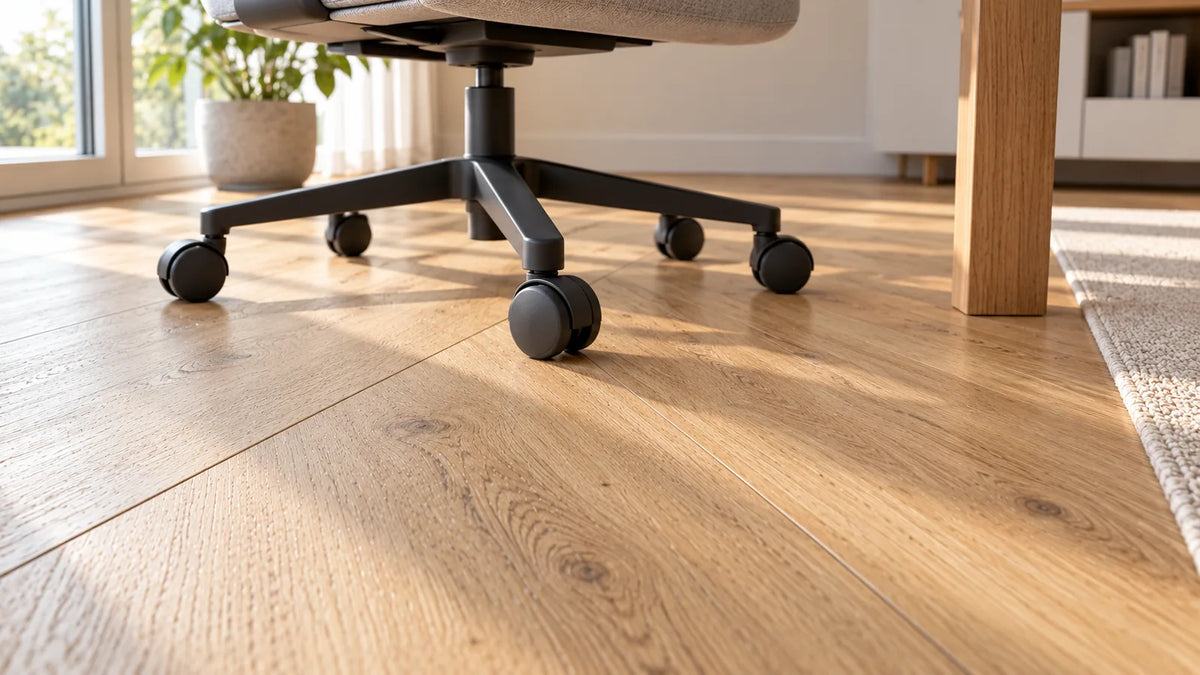
Soft castors (type W) belong on office chairs used on vinyl flooring, not the hard castors (type H) intended for carpet and other textile coverings. The German Social Accident Insurance (DGUV) explicitly recommends in its guide for VDU and office workplaces to adapt the type of castor to the flooring: hard castors on soft flooring, soft castors on hard flooring like vinyl or parquet. Soft castors on hard flooring reduce rolling resistance while simultaneously protecting the wear layer of your vinyl floor because they distribute pressure over a larger surface area. When buying new office chairs, simply look for the manufacturer's specification "for hard floors" or "soft castors".
Do you need a floor protection mat?
A floor protection mat is usually not necessary under vinyl flooring in an office if the office chair castors match the flooring and the wear layer is sufficiently thick. In cases of very high stress, for example at a workstation in shift operation with multiple users, a mat can still make sense because it prevents localized wear in the same spot. In that case, it is important to have a mat without PVC plasticizers that is compatible with the vinyl flooring and does not leave permanent discoloration.
Click vinyl or glue-down vinyl for the office?
Both click vinyl and glue-down vinyl are suitable for office spaces; the choice depends primarily on the duration of use and the frequency of remodeling. Click vinyl can be removed without leaving residue in the event of a change of tenant or move and is therefore an advantage for fixed-term lease agreements. Glue-down vinyl lies more solidly when fully bonded under heavy mobile pedestals and filing cabinets, and is often the more durable solution for areas with very high foot traffic, such as the reception area. For floors with a particularly high usage class and a lot of rolling traffic, robust COREtec click vinyl has also proven itself in commercial use.
How loud is vinyl flooring in the office?
Vinyl flooring in the office can be more audible than carpet without additional measures because rolling noises from office chairs and heels strike the hard surface directly. A vinyl floor with integrated impact sound insulation noticeably reduces these noises and ensures a quieter working atmosphere, especially in open-plan offices. When selecting, pay attention to the floor's impact sound value and, if possible, combine it with textile elements such as carpet runners in walking and meeting areas.
Maintenance and cleaning in the office routine
The easiest way to clean vinyl flooring in the office is daily with a dry or slightly damp mop; a mild, pH-neutral cleaning agent without wax or polish is sufficient once a week. You should avoid scouring agents and strongly alkaline cleaners because they attack the surface seal and make the floor appear dull more quickly. Detailed step-by-step tips on home remedies and the correct cleaning frequency can be found in our guide Cleaning and maintaining vinyl flooring.
Which look fits the office?
Light to medium wood looks have proven their worth for office spaces because they make scratches and dust less visible than very dark or very light decors. Stone looks are well-suited for reception areas and hallways because they appear high-quality and harmonize visually with tiles or natural stone. It is best to order a sample set in advance to test the color effect under your office lighting, as artificial light often alters wood and stone decors more strongly than the daylight in a living room.
Frequently asked questions
Is vinyl flooring suitable for an office?
Yes, with usage class 33 or higher, vinyl flooring is suitable for almost any office, from single offices to open-plan offices.
Which office chair castors fit vinyl flooring?
Soft castors (type W) belong on office chairs used on vinyl flooring; hard castors (type H) are intended for carpet.
Does vinyl flooring in the office need a floor protection mat?
With matching castors and a sufficient usage class, a mat is usually not necessary; in shift operation, it can still reduce localized wear.
How loud is vinyl flooring compared to carpet?
Without impact sound insulation, vinyl flooring is more audible; with a floor with integrated impact sound insulation, the difference compared to carpet is significantly reduced.
Click vinyl or glue-down vinyl: what is better for the office?
Click vinyl is suitable for fixed-term leases and frequent remodeling; glue-down vinyl sits more solidly during long-term use and under heavy furniture.
How often must vinyl flooring in the office be cleaned?
Daily dry or slightly damp mopping is enough; a more thorough cleaning with a pH-neutral cleaner is sufficient once a week.
Conclusion
Vinyl flooring in the office is an excellent choice if you pay attention to usage class 33 or higher, appropriate office chair castors, and, if necessary, a floor with integrated impact sound insulation. In this way, the floor will withstand daily rolling traffic, customer traffic in the reception area, and weekly cleaning for many years without losing its appearance.
Ready for your new office floor? Discover robust vinyl floors for everyday commercial life.
Discover vinyl floors