
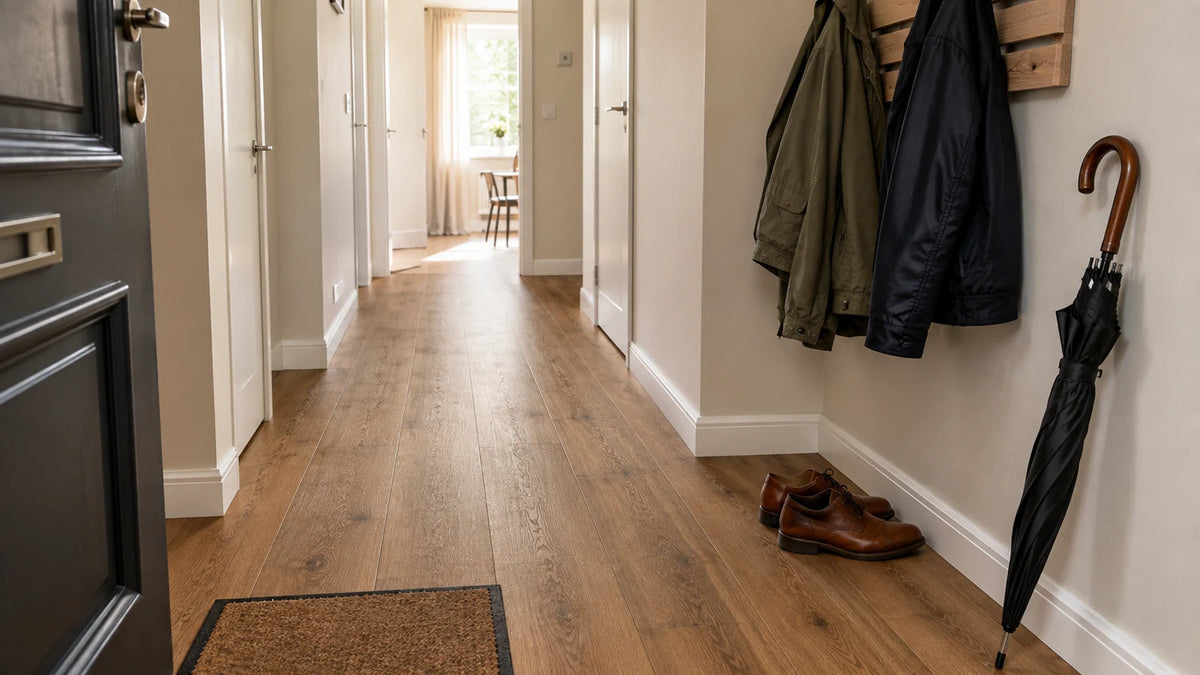
Vinyl flooring in the hallway has to withstand more than in any other room: street shoes, umbrellas, strollers, and the daily commute from indoors to outdoors take their toll on the flooring day after day. Does vinyl flooring really stand up to this constant strain, or does it wear out faster in the hallway than elsewhere? The short answer: With the right usage class, the appropriate wear layer, and a few installation tricks, vinyl flooring in the hallway is one of the most durable solutions available.
Key takeaways at a glance
- Vinyl flooring is particularly well-suited for the hallway if you choose usage class 33 (or higher) and a wear layer of 0.3 mm or more.
- Click vinyl is a good fit for rental apartments and those planning to move later on; glue-down vinyl is the more permanent solution for very high traffic areas.
- Textured surfaces in stone or tile looks hide dirt and fine scratches in the entryway much better than glossy decors.
- Underlayment for impact sound insulation noticeably reduces walking noise in the hallway, especially with tile or stone-look decors.
- Expansion gaps and transition profiles to living rooms, kitchens, or stairwells are mandatory in the hallway, not an optional extra.
Table of contents
- Why vinyl flooring is a great choice for the hallway
- What requirements the hallway places on flooring
- Usage class and wear layer: what you need for the hallway
- Click vinyl or glue-down vinyl in the hallway: which is better?
- Appearance and color: what best hides dirt and scratches
- Installation in the entryway and at transitions
- Care and cleaning in a high-traffic hallway
- Frequently asked questions about vinyl flooring in the hallway
- Conclusion
Why vinyl flooring is a great choice for the hallway
The hallway is your home's calling card and, at the same time, the room subject to the most daily wear and tear. As a flooring option for the hallway, vinyl scores points over tiles and parquet in several ways: it is water-resistant against splashes and damp shoe soles, pleasantly warm underfoot, significantly quieter to walk on than tiles, and can be installed in virtually any look, from wood to stone. Unlike natural wood parquet, vinyl flooring does not swell up when occasionally exposed to moisture from wet umbrellas or shoes.
What requirements the hallway places on flooring
Before you decide on a specific decor, it is worth looking at the actual stress the floor will face in the hallway:
- Foot traffic: The hallway is crossed multiple times daily by all residents and guests, often in street shoes.
- Moisture and dirt: Wet shoes, umbrellas, and road grit in winter place additional stress on the surface.
- Point loads: Shoe cabinets, dressers, and coat racks often stand in the same spot permanently.
- Transitions: The hallway usually connects several rooms, resulting in expansion joints and differences in height.
Therefore, flooring for the hallway must not only be robust but also easy to maintain and dimensionally stable at the transitions.
Usage class and wear layer: what you need for the hallway
For a private hallway, we recommend at least usage class 23; in areas with heavy public traffic or in apartment buildings, usage class 33 is preferable. The wear layer—the transparent protective layer over the decor—should not be less than 0.3 mm in the hallway; for very high levels of stress, 0.5 mm is the safer choice.
| Wear layer | Recommended for | Suitability for hallway |
|---|---|---|
| 0.2 mm | Bedrooms, rooms with low traffic | Insufficient |
| 0.3 mm | Living rooms, standard hallways | Well-suited |
| 0.4 to 0.5 mm | Entryways, commercially used hallways | Very well-suited |
Click vinyl or glue-down vinyl in the hallway: which is better?
When it comes to installation in the hallway, you have the choice between click vinyl and glue-down vinyl. Click vinyl floats on the subfloor and can be quickly removed, making it ideal for tenants or if you plan to redesign the hallway later. Glue-down vinyl bonds firmly to the subfloor, transfers impact sound better, and is the more robust choice for high-traffic entryways and hallways in apartment buildings.
Check out our click vinyl range or our glue-down vinyl range to compare the right decors for your hallway.
Appearance and color: what best hides dirt and scratches
In the hallway, dust, road grit, and fine scratches appear faster than in quieter rooms. Textured surfaces in stone or tile optics with medium to dark colors hide this much better than very light or glossy decors. If you prefer a lighter look, you should opt for a pronounced texture rather than a high-gloss finish so that footprints and dust are less noticeable.
Installation in the entryway and at transitions
The hallway usually borders several rooms, which is why transition profiles and expansion gaps are especially important here. Always leave an 8 to 10 mm gap at walls and door frames to allow the floor to expand during temperature fluctuations. At transitions to the living room, kitchen, or stairwell, matching profiles ensure a clean finish without tripping hazards. Underlayment for impact sound is particularly worthwhile in the hallway, as it is used heavily and often with street shoes. You can read more about clean transitions in our guide on planning expansion gaps for click vinyl.
Care and cleaning in a high-traffic hallway
Regular sweeping or vacuuming removes coarse dirt and road grit before it can scratch the surface. For damp cleaning, a well-wrung mop with clear water or a mild, pH-neutral cleaner is completely sufficient. A doormat placed directly at the entrance significantly reduces the amount of dirt that reaches the floor and further protects the wear layer.
Frequently asked questions about vinyl flooring in the hallway
Is vinyl flooring suitable for the hallway, or are tiles a better choice?
Yes, vinyl flooring is very well-suited for the hallway. It is water-resistant against splashes, warmer, and quieter than tiles and is easier to replace if necessary.
What usage class does vinyl flooring need in the hallway?
For a standard private hallway, usage class 23 is sufficient; for heavy public traffic or in apartment buildings, you should opt for usage class 33.
Click vinyl or glue-down vinyl in the hallway – what lasts longer?
Glue-down vinyl is usually slightly more durable in continuous use because it bonds firmly to the subfloor. Click vinyl is more flexible if you intend to move or change the flooring later on.
How do I prevent scratches from shoes and dirt in the hallway?
A doormat at the entrance, regular sweeping, and a textured, rather dark surface help the most. Felt gliders under shoe cabinets and dressers additionally protect against pressure marks.
Do I need impact sound insulation under vinyl flooring in the hallway?
Impact sound insulation is recommended because the hallway is one of the most frequently walked-on rooms. It noticeably reduces walking noise and compensates for minor unevenness in the subfloor. You can find suitable systems in our vinyl flooring with impact sound insulation collection.
How can I create a clean transition to the living room or stairwell?
By using matching transition profiles and providing sufficient expansion gaps at the walls. This keeps the floor flexible during temperature fluctuations while keeping the transition looking seamless.
Conclusion
With the right usage class, a sufficient wear layer, and well-thought-out installation, vinyl flooring in the hallway is one of the most durable and easy-care solutions for the highest-traffic room in your home. Whether you choose click vinyl for a rental apartment or glue-down vinyl for permanent use, selecting the right look will help you hide the signs of everyday life instead of letting them bother you.
Ready for your new hallway floor?
Order samples now and test the look and texture right at home. 3 pieces for €19.95, fully credited upon purchase.
View vinyl flooring range