
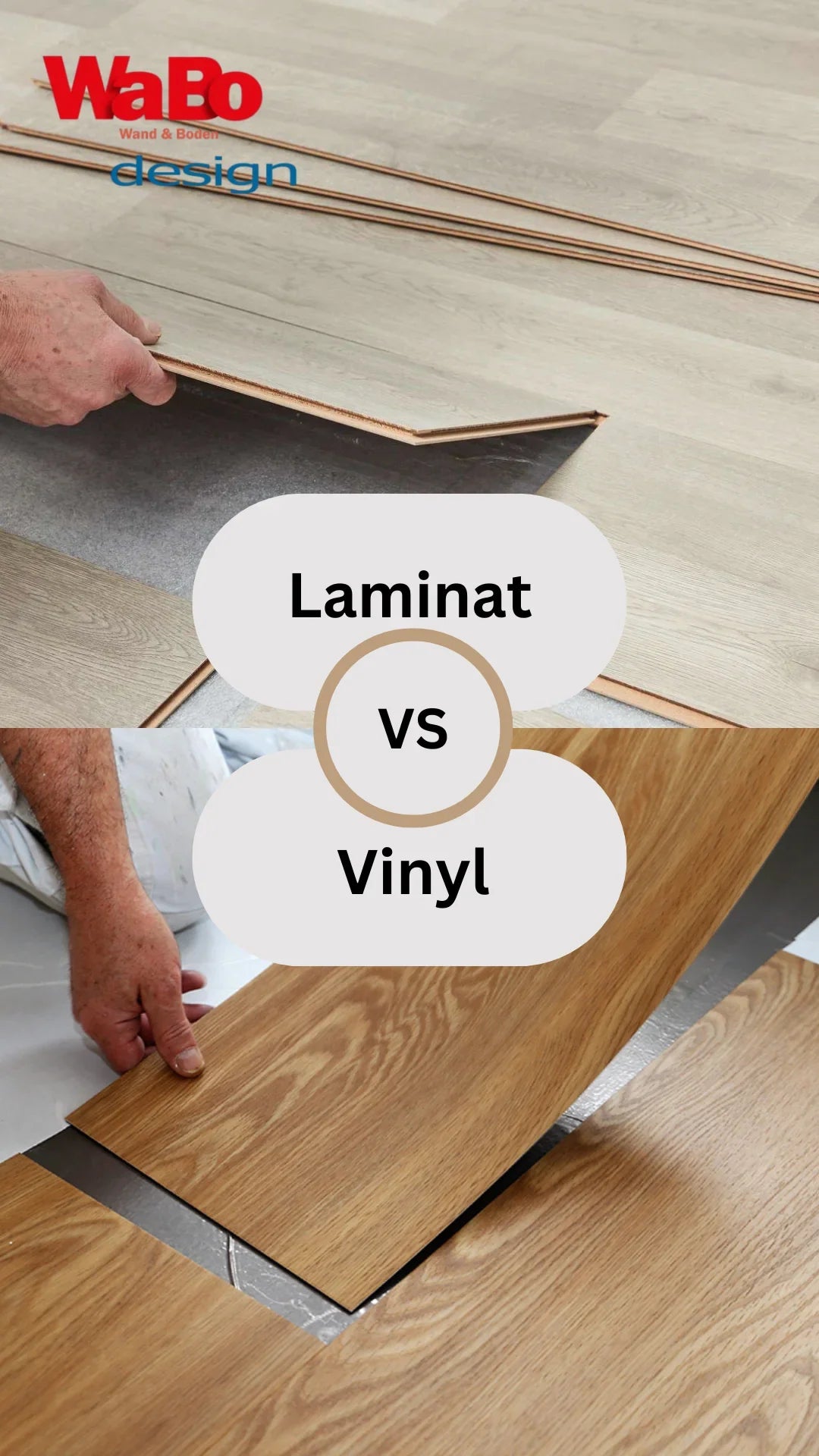
Vinyl or laminate, which flooring is really the better choice? Both look like wood, both are affordable and quick to install. But when it comes to water resistance, walking comfort, durability, and price, they are worlds apart. In this honest comparison, we'll give you the facts straight: where vinyl is clearly ahead, where laminate scores points, and which floor suits your room, your budget, and your everyday life.
Last updated: July 2026
Read also
Have you decided on vinyl, but aren't sure which one yet? Our guide "How to find your dream floor" leads you to the right choice in 4 simple steps.
🎯 Start Floor Finder, incl. samples →The most important points at a glance
- Vinyl wins with water: it is waterproof and therefore ideal for bathrooms, kitchens, and hallways. Laminate swells up if exposed to standing water.
- Vinyl is more comfortable: softer, warmer underfoot, and quieter when walking. Laminate feels harder and cooler and makes more of a clicking sound.
- Laminate is cheaper: usually €10–30/m² compared to €20–60/m² for vinyl.
- Appearance: Vinyl offers a greater variety of decors (wood and stone), while laminate impresses with a very natural wood look.
- Summary: Wet rooms, underfloor heating & comfort → Vinyl. Tight budget in dry rooms → Laminate.
Table of contents
- The comparison table at a glance
- Material & structure
- Water & moisture
- Walking comfort, warmth & impact sound
- Appearance & design
- Durability & scratches
- Cost comparison
- Installation & installation height
- Underfloor heating
- Care & cleaning
- Environment & health
- Which floor for which room?
- Vinyl or laminate in the living room?
- Frequently asked questions
- Conclusion & recommendation
Vinyl flooring vs. laminate: the comparison table at a glance
| Criterion | Vinyl flooring | Laminate |
|---|---|---|
| Material | PVC, elastic | HDF wood fiber board + decor layer |
| Water resistance | ✔ waterproof | ✘ swells when wet |
| Suitable rooms | all, including bath & kitchen | mainly dry living areas |
| Walking feel | soft & warm underfoot | harder & cooler |
| Impact sound | quieter | louder (clicking sound) |
| Variety of looks | very large (wood & stone) | natural wood look |
| Scratch resistance | robust (depending on wear layer) | very scratch-resistant |
| Underfloor heating | very good (esp. glue-down vinyl) | suitable, higher resistance |
| Installation height | flat (approx. 2–6 mm) | higher (approx. 7–12 mm) |
| Price per m² | approx. €20–60 | approx. €10–30 |
| UV/light resistance | better | can fade |
Material & structure
The core of vinyl flooring consists of the plastic PVC, making it elastic, robust, and resistant to moisture. Modern variants have a stable SPC (Stone Polymer Composite) core and a protective wear layer. You can find more background on the material in the expert overview of PVC floor coverings.
Laminate, on the other hand, consists of a high-density fiberboard (HDF) with a printed decor layer and a transparent protective layer (overlay). The wood core makes laminate pleasantly stable underfoot, but it is also its weakness once water enters the picture.

Water & moisture, the biggest difference
This is where vinyl's clearest advantage lies: it is waterproof. Spills, wet shoes, or mopping water are not a problem, making it ideal for the kitchen, hallway, utility room, and, with the right installation, even the bathroom.
Laminate is sensitive to moisture: if water penetrates the joints, the wood fiber board will swell, and the damage is usually irreparable. For this reason, laminate is only suitable to a limited extent for damp rooms. If you want a waterproof floor, there is hardly any way around click vinyl or fully glued-down glue-down vinyl.
Walking comfort, warmth & impact sound
Vinyl feels warmer and softer under your feet because the material is elastic. It is also quieter to walk on; many vinyl floors have integrated impact sound insulation. Laminate feels harder and cooler and produces the typical "clacking" walking noise, especially without a suitable underlay.
You can read about how much insulation you really need and what to look for in the underlay in our guide on impact sound insulation under vinyl.
Appearance & design
Today, both floorings imitate wood deceptively well. Vinyl offers a greater variety of decors, from light oak and smoked oak to stone and tile looks, often with synchronous embossing where the texture follows the grain. Laminate scores with very natural-looking wood finishes and a pleasantly "authentic" feel on the surface.
Tip: How a look works in a room depends heavily on lighting and wall color. Lay out a sample at home before you commit, which will save you from bad purchases.
Durability & scratches
Both floorings are durable if the quality is right. The utilization class is decisive (UC 21–23 for residential areas, UC 31–33 for heavier use). Laminate is naturally very scratch-resistant. Vinyl is robust, elastic, and absorbs impacts well; its scratch resistance depends on the thickness of the wear layer. Vinyl is generally more UV-resistant in sunlight, while laminate can fade over the years.
Cost comparison
In terms of price, laminate is ahead: good quality is often available from about €10–30 per m². Vinyl usually ranges between €20 and 60 per m², depending on the wear layer, structure, and brand. Both can be easily installed yourself as a click system, which saves on labor costs. To be fair, include accessories in your calculation: underlay, baseboards, transition profiles, and possibly leveling compound. Over the lifetime of the floor, the price difference relative, especially if laminate has to be replaced prematurely in a damp room.
Laminate or vinyl: costs in detail
A calculation example for a 20 m² room (material only):
- Laminate: approx. €10 to €30/m² = around €200 to €600
- Vinyl: approx. €20 to €60/m² = around €400 to €1,200
- Accessories (underlay, baseboards, profiles): usually an additional €100 to €250
Important: Anyone who installs laminate in a damp room and has to replace it later often pays more in the end than they would have with waterproof vinyl.

Installation & installation height
Both floorings are available as click systems for floating installation, ideal for DIYers and rental apartments. Vinyl is additionally available as a glue-down version, which is bonded to the entire surface and has a particularly low installation height. This is where a practical advantage lies: at approx. 2–6 mm, vinyl is significantly flatter than laminate (approx. 7–12 mm). In renovations with limited installation height, specifically doors and transitions, this can be the deciding factor. The prerequisite for both: an even, dry subfloor.
Underfloor heating
Both floorings are generally suitable for underfloor heating. Vinyl, especially thin glue-down vinyl, conducts heat particularly well because the layer is thin and sits directly on the floor. Due to its wood core, laminate has a somewhat higher thermal resistance. It is important for both to adhere to the manufacturer's approval and the correct heating protocol.
Care & cleaning
Vinyl is very easy to care for: vacuum or sweep, mop with a damp cloth, and you're done. You clean laminate similarly, but you must be more consistent about using very little water, as moisture damages the joints. For both, the rule applies: use felt gliders under furniture, place floor mats at entrances, and remove stains quickly. You can find detailed instructions in our guide Cleaning and caring for vinyl flooring.
Environment & health
Laminate consists largely of wood and is considered a renewable raw material. Vinyl is a plastic product, but modern floorings are subject to strict EU regulations, avoid harmful plasticizers, and are increasingly produced with recycled content; SPC vinyl with a hard core contains no plasticizers at all. For both, look for quality seals like the "Blue Angel" and low-emission products if healthy living is important to you.
Which floor for which room?
- Bathroom, kitchen, hallway, utility room: clearly vinyl, due to water resistance.
- Living & bedroom: both possible. Vinyl if you like it warm underfoot and quiet; laminate if the budget is tight.
- With underfloor heating: advantage vinyl (better heat conduction), ideally glue-down vinyl.
- Rental apartment & DIY: both are easy to install and remove as a click system.
Are you still wavering between click and glue-down vinyl? Then our comparison Click vinyl or glue-down vinyl? How to decide will help you further.
Vinyl or laminate in the living room?
In the living room, your personal requirements for comfort and budget are the deciding factors. Vinyl is warm to the touch, quieter to walk on, and pleasantly soft; it's ideal if you like a cozy atmosphere, often walk barefoot, or have underfloor heating. Laminate scores with a very natural wood feel and a lower price, as long as the room stays dry and your budget is limited. For open-plan living-dining areas that transition into the kitchen, vinyl plays to its strength of water resistance. Tip: Lay out a sample in your living room beforehand and evaluate the color and feel in the actual room light before you commit.
Frequently asked questions: Vinyl or laminate
What is better, vinyl or laminate?
It depends on the room. Vinyl is waterproof, warm underfoot, and quieter, ideal for damp rooms and high comfort. Laminate is cheaper and very scratch-resistant, good for dry living rooms with a tight budget.
What is cheaper, vinyl or laminate?
Laminate is usually cheaper (approx. €10–30/m²) than vinyl (approx. €20–60/m²). Over the lifetime of the floor, the difference relative, especially if laminate has to be replaced prematurely in damp rooms.
Is vinyl or laminate better for the bathroom?
Definitely vinyl. It is waterproof, while laminate will swell up in the presence of standing water. Waterproof click or glue-down vinyl is suitable for the bathroom.
What lasts longer, vinyl or laminate?
Both last for many years if the quality is good. The utilization class is the decisive factor. Laminate is very scratch-resistant, while vinyl scores with moisture and UV resistance.
What is better for underfloor heating?
Vinyl, especially thin glue-down vinyl, conducts heat faster than laminate. Both must be explicitly approved for underfloor heating.
Vinyl or laminate in the living room: which is better?
Both work. For comfort, warmth underfoot, and quiet walking, we recommend vinyl, especially with underfloor heating or an open transition to the kitchen. If the room is dry and the budget is tight, laminate is a good, cheaper choice.
Can you install vinyl directly on top of laminate?
Yes, click vinyl can be installed floating over solid, level laminate as long as the subfloor is dry, clean, and installed firmly. Pay attention to the installation height at doors and transitions. Loose or damaged laminate should be removed beforehand.
Is vinyl or laminate better for allergy sufferers?
Both are good for allergy sufferers because they are smooth and, unlike carpet, do not act as dust traps. Vinyl is additionally joint-tight and can be easily wiped with a damp cloth. For both, look for low-emission products, for example with the Blue Angel.
How can I tell if I have vinyl or laminate?
Vinyl feels warmer and slightly elastic, and it sounds dull when tapped. Laminate is harder, cooler, and sounds hollower. At a cut edge, you can see the light wood fiber board on laminate, while vinyl shows a dense plastic core.
Conclusion & recommendation
Vinyl and laminate look similar but perform differently in everyday life. Vinyl wins in terms of water resistance, walking comfort, impact sound, and versatility; it is the better choice for the bathroom, kitchen, hallway, underfloor heating, and for anyone who likes a cozy home. Laminate is the more affordable option with a natural wood feel for dry living rooms with a tight budget. If you are thinking long-term and want flexibility, you will be better off with vinyl in most cases.
Browse through our collections of click vinyl and glue-down vinyl, or secure your sample to be sent home beforehand and compare in peace in your actual room lighting.