
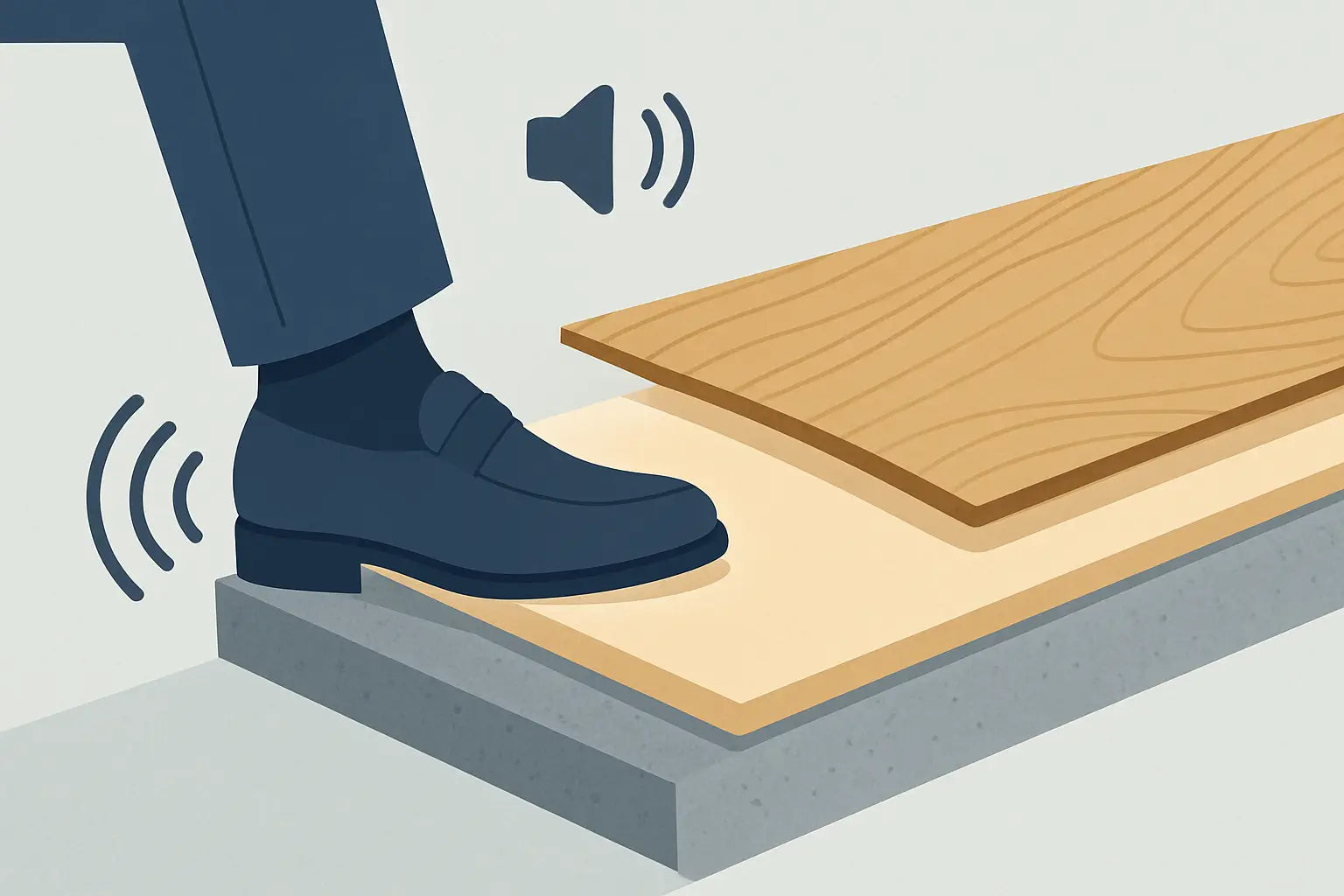
Do you really need impact sound insulation under vinyl, or is it just an expensive extra that wastes money and build height? The honest answer is: It depends. This is because click vinyl and glue-down vinyl function in completely different ways, and there are additional factors such as the subfloor, underfloor heating, sound insulation requirements, and the total build height. If you clearly distinguish between these, you will quickly make a decision that won't creak, sound hollow, or cause warranty issues later on. This guide will show you, step by step, when impact sound insulation under vinyl is necessary and when it is not.
Last updated: August 2026
The Shortcut
Don't want to calculate underlay requirements? These click vinyl floors already have impact sound insulation built-in. Alternatively, let our tool find the right floor for your room in just a few clicks.
View floors with insulation → 🎯 Start Floor FinderThe most important facts in brief
- Click vinyl: Usually makes sense, unless the product already has integrated insulation (in which case additional insulation is often prohibited).
- Glue-down vinyl: Generally no classic impact sound insulation; instead, a perfectly leveled and smooth subfloor is what counts.
- Most important metric for click: Not "as thick as possible," but pressure-resistant. Too soft can damage the click joints.
- Underfloor heating: Only use underlays with a low thermal resistance (R-value) that are explicitly approved for this purpose.
- Multi-family housing: Significantly higher sound insulation requirements than in a single-family home; the entire floor assembly counts here.
Table of contents
- Impact sound, walking sound & the basic logic
- Click vinyl: usually yes, but not always
- Click vinyl with integrated insulation
- Click vinyl without impact sound insulation: is it possible?
- Glue-down vinyl: rarely needs insulation, but requires a perfect subfloor
- Glue-down vinyl with impact sound insulation
- Click vs. glue-down: impact sound comparison
- The subfloor determines the outcome
- Underfloor heating & R-value
- Build height: the silent dealbreaker
- Avoiding common mistakes
- Decision in 5 minutes
- Frequently asked questions
- Conclusion
Impact sound, walking sound & the basic logic
Vinyl is relatively "quiet" because it is more elastic. Our major floor comparison shows how it performs in a direct vinyl vs. laminate head-to-head. Nevertheless, noise is generated in two ways: impact sound (footsteps transferred into the structure and thus into rooms below) and walking sound (what you hear yourself in the room when you walk across it). Impact sound insulation is primarily aimed at the former—ensuring your neighbors below hear less. Walking sound additionally depends on the material composition, room acoustics, and the weight of the floor. You can find more background on the term in the definition of impact sound.
Whether impact sound insulation is sensible or even mandatory depends less on "vinyl in general" and more on whether your floor is laid floating, how hard the subfloor is, and what sound insulation requirements you must meet. In multi-family housing, this topic is much more sensitive than in a single-family home, where sound insulation requirements according to DIN 4109 apply.
Click vinyl: usually yes, but not always
Click vinyl is generally laid as a floating floor: the floor is not firmly bonded to the subfloor but lies on top as a "plate." This specific construction can transmit vibrations and, under unfavorable conditions, amplify noise. Therefore, a suitable underlay is used for many click vinyl projects.
What really matters is not the thickness, but the pressure resistance. With floating installation, the underlay must withstand furniture and point loads without permanently yielding. Insulation that is too soft makes the floor feel "springy"; while this might sound pleasant at first, it often harms the click connection. It can "work" under load, which later manifests as cracking, gap formation, or reduced stability.
Click vinyl with integrated insulation
Many modern click vinyl floors already have an integrated underlay mat, such as the Liberty Rock 40 Acoustic, which features factory-applied impact sound insulation. In such cases, additional insulation is not automatically sensible; on the contrary, additional underlays that are too soft or thick increase the risk of the click connection failing under stress.
If your click vinyl has integrated insulation, always check the manufacturer's installation approval. Often, "no additional insulation" is explicitly required, or only very thin, pressure-resistant underlays are permitted.
If you want to save yourself the calculations regarding underlay, R-value, and build height entirely, choose a floor with factory-applied insulation. Our overview of click vinyl with impact sound insulation shows you all the floors where the insulation is permanently bonded to the plank, filterable by look, wear layer, and brand.
Directly to the floor
Insulation is already included, you don't need an extra underlay: Click vinyl with factory-applied impact sound insulation from COREtec, Gerflor, Forbo, Tarkett, CHECK, Moduleo, IPC, Project Floors, and Liberty.
View click vinyl with impact sound insulation →Click vinyl without impact sound insulation: is it possible?
In principle, yes, but it depends on the product and the subfloor. If your click vinyl already has integrated insulation, you don't need a second layer, and you often shouldn't add one. If it doesn't, you risk hollow sounds, increased walking noise, and higher stress on the click connection without an underlay, especially on hard screed or tiles. You should only lay click vinyl completely without impact sound insulation if the manufacturer explicitly approves it and the subfloor is even and load-bearing. In multi-family housing, you practically cannot do without it due to sound insulation requirements. In short: vinyl flooring without impact sound insulation is possible, but only sensible in clearly defined cases. You can find the right pressure-resistant underlay in our accessories section.
Glue-down vinyl: rarely needs insulation, but requires a perfect subfloor
Glue-down vinyl, for example the Liberty Urban 40, is bonded over the entire surface. This makes it structurally quieter in terms of transmission and very quiet regarding walking sound, because nothing is "floating." Classic impact sound insulation, as used with click systems, is usually not used here.
The catch: Glue-down vinyl is unforgiving of subfloor defects. Every unevenness, every edge, every depression can telegraph through to the surface later. Therefore, a cleanly leveled, smooth, load-bearing subfloor is the decisive success factor. You can read how to properly prepare this in our guides on leveling compounds for vinyl flooring and primers for glue-down vinyl.
If you want to reduce impact sound with glue-down vinyl, this is done via the entire floor assembly (screed, decoupling systems, and potentially special acoustic underlays that are explicitly approved for glue-down vinyl), not through the classic "foam roll" from the hardware store.
Glue-down vinyl with impact sound insulation
Glue-down vinyl is bonded over the entire surface; a loose foam underlay like those used for click systems has no place underneath it, as it would make bonding impossible. If you still want to improve impact sound with glue-down vinyl, you must address the entire floor assembly: a bondable acoustic panel or a decoupling system explicitly approved for glue-down vinyl is placed underneath the adhesive. This is not standard, but it can be worth it in noisy older buildings or multi-family housing. In any case, an even, load-bearing subfloor remains essential.
Click vs. glue-down: impact sound comparison
| Aspect | Click Vinyl | Glue-down Vinyl |
|---|---|---|
| Installation | floating | fully bonded |
| Impact sound insulation | usually sensible (unless integrated) | generally no classic insulation |
| Most important metric | pressure resistance of underlay | evenness of the subfloor |
| Walking sound in room | depending on assembly/insulation | very quiet (firm bond) |
| Build height | higher (approx. 4–6 mm + underlay) | very low (approx. 2–3 mm) |
| Underfloor heating | suitable, underlay must be compatible | very good (direct heat conduction) |
The subfloor determines the outcome: screed, tiles, floorboards, old flooring
The question "Is impact sound insulation necessary under vinyl?" can often be answered faster by looking at the subfloor than the product itself.
On mineral screed, an underlay for click vinyl is often sensible because screed is hard and transmits sound well. A suitable underlay also bridges minimal unevenness—not as a substitute for leveling, but for micro-tolerances.
On tiles, it depends on the levelness. Tile joints can telegraph through click vinyl or promote hollow sounds if the floor does not lie flush across the entire surface. Here, a clean leveling with leveling compound or an underlay approved for bridging small joints helps. For glue-down vinyl, leveling is almost always non-negotiable.
On wood floorboards or OSB, vibration and movement are more important than "pure insulation." Wood subfloors work. If they are not sufficiently stable, they can creak regardless of how good the impact sound insulation is. The rule here: screw down and stabilize the subfloor, create levelness, and then use a pressure-resistant underlay (for click) or appropriate preparation (for glue-down).
Old flooring like PVC or linoleum can work depending on condition and manufacturer approval, but they are a typical risk point. Soft, yielding old flooring combined with additional insulation quickly overstrains click connections.
Underfloor heating & R-value
With hot water or electric underfloor heating, a simple principle applies: every additional layer slows down heat transfer. An underlay is not forbidden, but it must be suitable.
The decisive metric is the thermal resistance (R-value) of the entire system (vinyl plus underlay): the lower it is, the better the assembly conducts heat. For vinyl on underfloor heating, a total R-value of around 0.15 m²K/W is considered a practical upper limit. At the same time, the underlay must not be so soft that it yields under heat and load. Especially with click vinyl, the combination of "thermally suitable" and "pressure-resistant" is decisive.
Build height: the silent dealbreaker
In renovations, build height is often the bottleneck: doors, transitions, skirting boards, and kitchen fronts. Impact sound insulation sounds like only 2 mm extra, but together with vinyl thickness and potential leveling compound, it can mean that doors need to be shortened or transition rails become unpleasantly high.
If you are planning with limited build height, glue-down vinyl is often the more elegant solution because it doesn't require an underlay and is very low-profile. With click vinyl, the height can only be reduced to a certain extent without compromising stability and acoustics.
Avoiding common mistakes
The most common mistake is choosing an insulation underlay based on the motto "the thicker, the better." With click vinyl, too thick is often synonymous with too soft. This doesn't take revenge immediately, but rather after weeks or months when the click connection yields under everyday loads.
The second classic mistake: forgetting a vapor barrier or using it incorrectly. On mineral subfloors, a moisture barrier may be required, depending on residual moisture and manufacturer approval. Some underlays have an integrated vapor barrier, others do not. The point is not "always use foil," but "use it as the assembly requires."
And third, the "underlay as a problem solver" fallacy: an underlay is no substitute for an uneven, cracked, or sandy screed. If you cut corners here, you will pay for it later with hollow spots, creaking, or visible telegraphing.
Decision in 5 minutes
If you need a quick, practical decision, ask yourself three questions:
- Click or glue-down? For click vinyl, a suitable underlay is often sensible; for glue-down vinyl, it usually isn't.
- Integrated insulation on the product? If yes, check the manufacturer's specifications; additional underlays are often excluded. If you want to be on the safe side from the start, choose directly from our click vinyl with impact sound insulation.
- Subfloor and goal? Is it about sound insulation in a multi-family home, heat conduction with underfloor heating, or minimal build height? The choice varies depending on your priorities.
With the room data (subfloor, square meters, heating system, desired vinyl type), this can be narrowed down very reliably. Uncertain? Order your vinyl sample beforehand and contact us before purchasing to avoid buying the wrong accessories.
Frequently asked questions about impact sound insulation under vinyl
Is impact sound insulation always necessary under vinyl?
No. For floating click vinyl, a suitable underlay is usually sensible; for fully bonded glue-down vinyl, it generally is not. The decisive factors are the type of installation, subfloor, and sound requirements, not "vinyl" in general.
Do I still need additional impact sound insulation for click vinyl with integrated insulation?
Usually not. An additional, too-soft underlay can cause the click connection to "work" and creak under load. Check the manufacturer's installation approval; additional insulation is often explicitly excluded.
Is click vinyl possible without impact sound insulation?
Yes, if the manufacturer approves it and the subfloor is even and load-bearing, or if insulation is already integrated. Without an underlay, you risk hollow sounds and more stress on the click connection. In multi-family housing, insulation is almost always mandatory due to sound insulation regulations.
Which impact sound insulation is best for click vinyl?
Not the thickest, but the most pressure-resistant. The underlay must withstand furniture and point loads without permanently yielding. Insulation that is too soft makes the floor feel "springy" and harms the click connection in the long term.
Can you install glue-down vinyl with impact sound insulation?
Not with a loose underlay; that would prevent bonding. You improve impact sound for glue-down vinyl via the entire assembly, such as a bondable acoustic panel approved for glue-down vinyl.
Which impact sound insulation fits with underfloor heating?
One with low thermal resistance (R-value) that remains pressure-resistant. Every additional layer slows down heat, so the underlay must be explicitly approved for underfloor heating.
What thickness should the impact sound insulation for click vinyl have?
Not as thick as possible. For click vinyl, a thin, pressure-resistant underlay of around 1 to 1.5 mm is usually ideal. More important than the thickness is the pressure resistance, so the click connection does not work. If the floor already has integrated insulation, do not add more.
Which impact sound insulation for click vinyl on underfloor heating?
One with a low thermal resistance (R-value) that is explicitly approved for underfloor heating while remaining pressure-resistant. As a rule of thumb, the total R-value of the vinyl plus the underlay should not exceed approximately 0.15 m²K/W.
Conclusion
The best impact sound insulation is not the thickest one, but the one that suits your vinyl, your subfloor, and your everyday life. For click vinyl, a pressure-resistant underlay usually makes sense, unless insulation is already integrated. For glue-down vinyl, a cleanly prepared subfloor replaces the need for insulation. Then the floor feels quiet, remains stable, and does exactly what it is supposed to: make your home better in an uncomplicated way.
Browse directly: If you want to buy click vinyl with impact sound insulation, you will find all floors with factory-integrated insulation collected in our overview, filterable by look, wear layer, and brand. For options without integrated insulation, browse our click vinyl and glue-down vinyl collections, or order your sample to your home first.
Touch first, then decide
Order samples to your home and check the color, surface, and click feel in your own room before you commit.
View floors with insulation → Order samples