
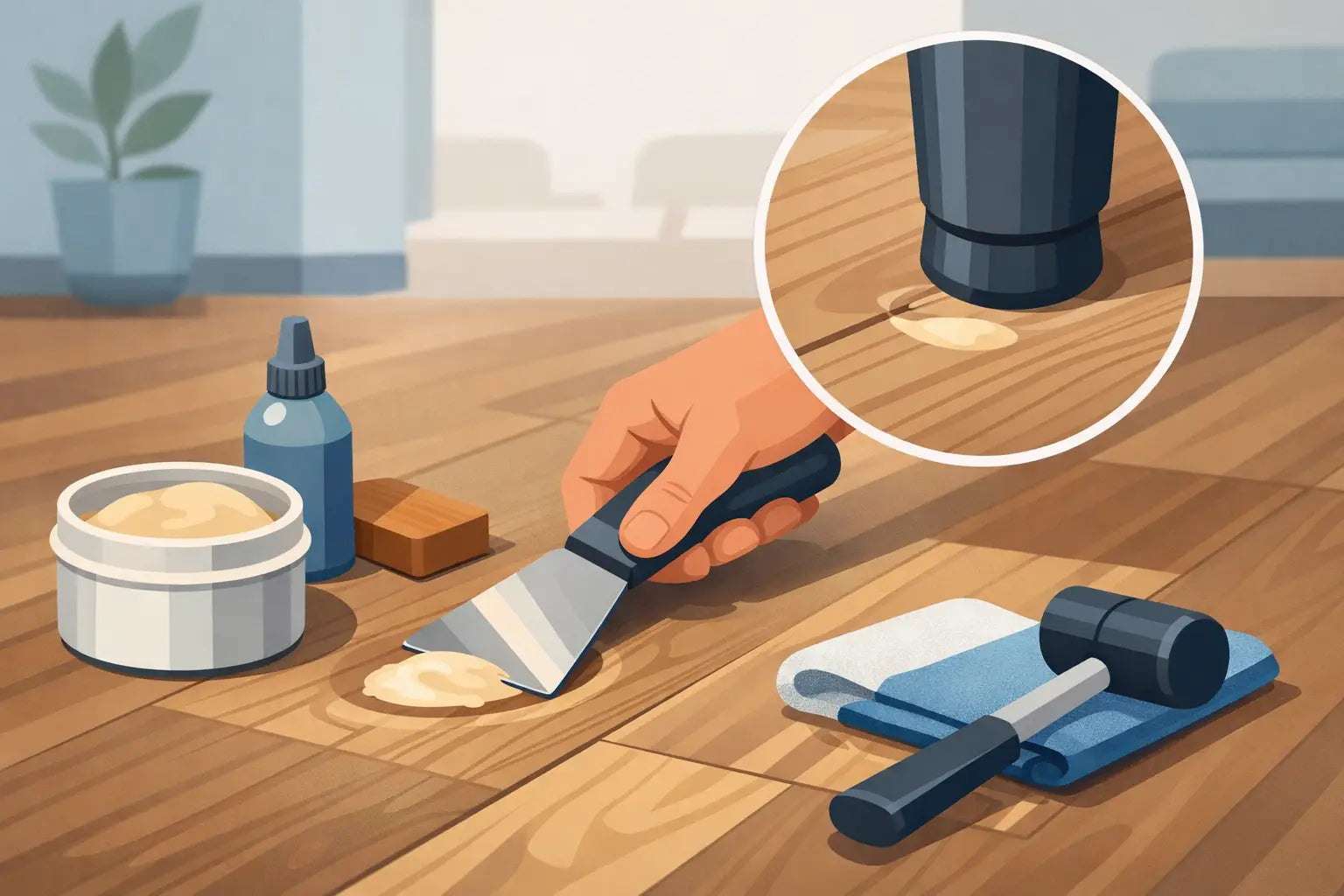
A heavy cupboard has been shifted a few centimeters, the office chair has been in the same spot for months, or the sofa is resting on feet that are too small—and already, indentations are appearing in the floor. Anyone wanting to repair pressure marks in their vinyl flooring should first check whether it is actual damage or merely a temporary deformation. Exactly this determines whether the area can still be smoothed out or if replacing individual elements makes more sense.
Why pressure marks appear in vinyl flooring in the first place
Vinyl is suitable for everyday use, easy to care for, and resilient. Nevertheless, it remains an elastic floor covering. This elasticity is one of the reasons why vinyl is comfortable to walk on and why impact sound is often lower than with harder coverings. The disadvantage: point loads can leave marks.
Pressure marks occur particularly frequently under furniture with narrow feet, under shelves with high constant loads, or under chair casters that are not suitable for the respective floor. The subfloor also plays a role. If it is not properly leveled, not even enough, or if it yields slightly, the load manifests in the covering more quickly. The damage pattern sometimes looks different for glue-down vinyl and click vinyl, but the cause often remains the same: too much weight on too small an area.
Repairing vinyl flooring for pressure marks: first, properly assess the damage
Before you heat, press, or replace anything, it is worth taking a close look. Not every dent is the same. A slight indentation without cracks, open joints, or a damaged surface can often still be improved. It becomes more difficult if the wear layer is damaged, edges are sticking up, or the plank has been visibly compressed.
With click vinyl, you should also check whether the locking system has come loose or become strained due to the pressure point. With glue-down vinyl, the deciding factor is whether the covering is still fully adhered or is peeling at the edges. If the spot feels rough when stroked or the decorative film has changed, simple smoothing is usually no longer sufficient.
Another point is the duration of the load. Fresh pressure marks often respond better to corrective measures than those that have been "set" over months or years. This does not mean that older marks are hopeless, but expectations should remain realistic.
What you can try yourself for light pressure marks
For small, superficial indentations, heat is often the first sensible approach. Vinyl reacts to temperature, becomes somewhat more flexible, and with luck, can partially reshape itself. Fingertip sensitivity is important here. Too much heat can damage the surface, change the gloss, or permanently warp the material.
The safest method is carefully warmed air applied from a sufficient distance. The area should never be overheated at a single point. Work slowly, test the temperature on an inconspicuous area first, and keep the heat source moving constantly. Immediately afterward, it can help to treat the indentation with a soft cloth and light pressure. The goal is not to press the floor downward, but to guide the surface calmly and evenly back into its shape.
Sometimes it is enough just to remove the load and give the material some time. Especially with less deep pressure marks in living areas, the vinyl can partially recover on its own. However, this does not always work and is more likely with more elastic qualities than with very rigid constructions.
When home remedies do more harm than good
Many quick solutions circulate online, from irons to boiling-hot cloths. Such methods sound practical but carry a clear risk. Excessive heat can alter the decorative layer and the wear layer. A small dent then quickly turns into a visible matte, wavy, or discolored spot.
Strong rubbing, hard scrapers, or pressure with unsuitable tools are also not a good idea. Vinyl surfaces are resistant, but not invulnerable. Anyone who scratches the structure or damages the bevel creates a problem that can hardly be masked visually.
If you are unsure, a simple rule applies: It is better to proceed conservatively and observe the area rather than increasing the damage through over-eagerness. This is particularly sensible if the floor is still new or part of a larger, uniform surface.
If the pressure mark is deeper: repair or replace?
Not every pressure mark can be removed with heat. If the material is permanently compressed, torn, or deformed at the edge, there is often no way around a repair involving material replacement. This reveals a practical difference between click vinyl and glue-down vinyl.
With click vinyl, it may be possible to replace a single plank. How complex this is depends on the location in the room. If the damaged element is near the wall, the replacement is usually easier. If it is in the middle of the area, it becomes significantly more demanding. Then you have to work cleanly so that neighboring connections do not suffer.
With glue-down vinyl, replacing individual planks is also possible, but it requires precision. The damaged plank must be cleanly removed, the subfloor prepared, and the new element fitted exactly. Even small dimensional deviations or adhesive residues can remain visible later. For experienced DIY enthusiasts, this is doable; for many private customers, professional support is the safer choice.
The subfloor also determines the result
Anyone wanting to repair pressure marks in vinyl flooring understandably looks at the surface first. Often, however, the real cause lies underneath. Unevenness, incompletely cured leveling compound, old coverings that are too soft, or poorly prepared subfloors facilitate pressure marks.
If a replaced plank becomes noticeable again after a short time, it is worth looking downward. High-quality vinyl flooring can only perform as well as the base on which it lies. This applies to new builds just as much as to renovations. Especially with glue-down vinyl, an exactly prepared subfloor is crucial, while click vinyl additionally benefits from a suitable, system-compatible insulation or underlayment.
For buyers who are planning a new build or renovating, this is not a side issue. If you value brand quality, you should not skimp on accessories. Floor leveling compound, primer, suitable casters, or furniture glides cost significantly less than a later partial repair.
How to avoid new pressure marks in everyday life
The best repair is the one that never becomes necessary. Pressure marks cannot always be prevented completely, but they can be significantly reduced. A better distribution of the load is crucial. Furniture with small, hard feet should be equipped with suitable felt pads or load distributors. For very heavy pieces, broader contact surfaces are more sensible than point feet.
In the home office, it is worth taking a close look at the chair casters. Soft, floor-friendly casters and a suitable protective mat can make all the difference, especially if the same area is loaded daily. For beds, kitchen islands, or cupboards, it also helps not to view the weight statically, but to consider the actual surface area of the support.
It is also important not to push furniture across the floor. Even if this does not cause scratches, it increases the pressure load at individual points. It is better to lift or work with suitable transport aids.
Is repair economically worthwhile?
This depends on the damage pattern, the floor type, and the available replacement material. A single, inconspicuous pressure mark in a side room does not necessarily need to be fixed immediately. In an open living area with a continuous surface, the same spot quickly looks more distracting. Then the visual appearance plays a greater role than pure function.
If you still have residual material from the installation, replacing individual elements is significantly easier and usually more economical. Without a suitable reserve, it can become more difficult. Colors, designs, and production batches vary slightly depending on the series. Especially with brand-oriented floors, the replacement material should therefore match the existing surface as exactly as possible.
For many renovators, this is the point where quality in purchasing pays off. Those who rely on established collections and plan cleanly often have a better hand in later repairs than those who choose short-term special offers without long-term availability.
When it is better to get professional help
As soon as the surface is torn, joints open, multiple planks are affected, or the subfloor might be involved, things quickly become technical. This also applies if underfloor heating is involved or if glue-down vinyl has to be removed and re-glued. Experiments are not worth it here.
A specialist company or an easily accessible specialist dealer can often assess whether a local repair is realistic based on photos. For customers who are already considering a renovation, the question may also arise whether point-by-point rework is still worthwhile or whether a partial area should be rebuilt. WaBo Design starts exactly here: with a clear selection of strong-brand vinyl flooring and the accessories that are crucial for a clean, resilient installation.
Pressure marks are annoying, but not automatically a case for a complete floor replacement. Those who check calmly, proceed carefully, and do not overlook the cause often save time, money, and unnecessary effort, and ensure that the floor does what it is supposed to do in everyday life: look good and function reliably.