
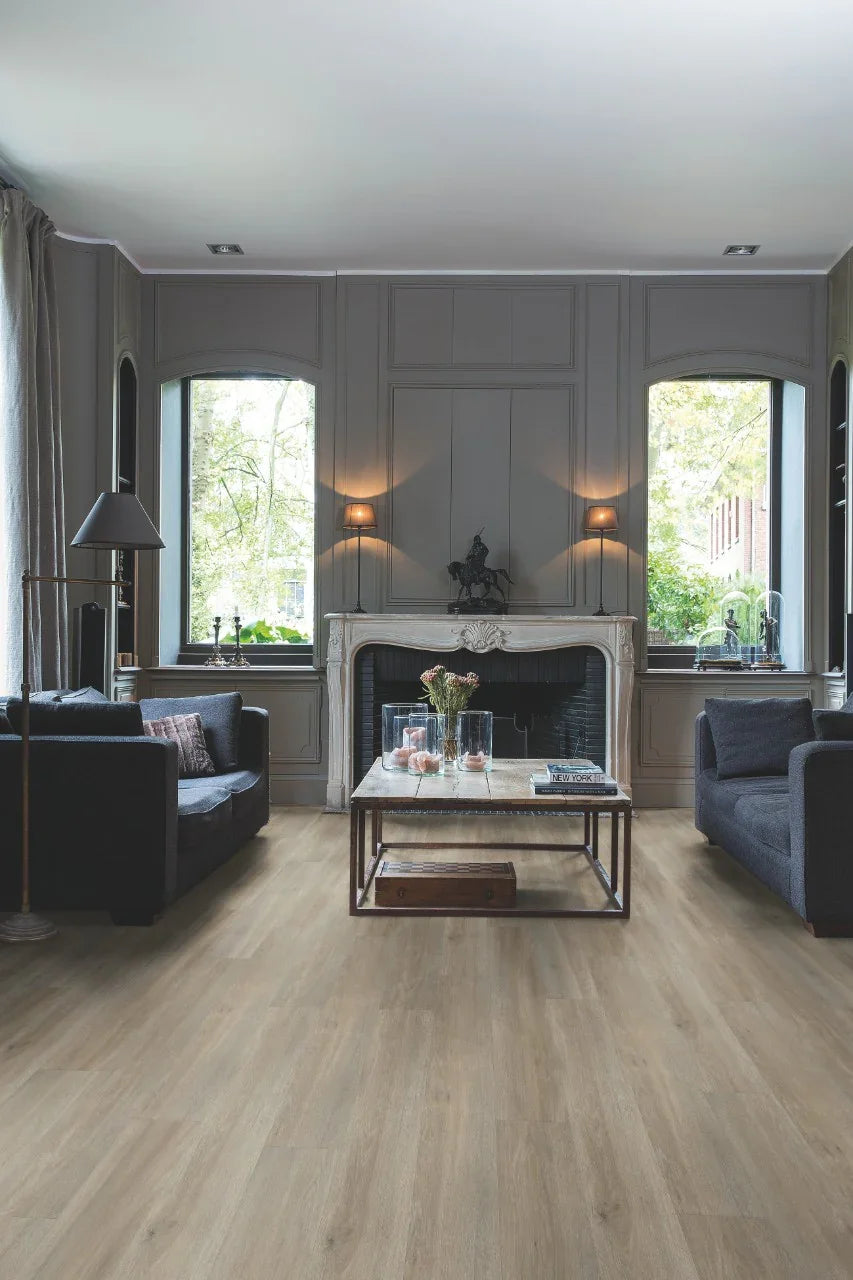
Not all vinyl is created equal. There are worlds of difference between an affordable DIY-store floor and a high-quality designer floor, even if you can’t always tell at first glance. To ensure you don't cut corners in the wrong places, we’ll show you how to recognize a good vinyl floor: from the wear layer and usage class to the core structure, embossing, and emissions. With this checklist, you can evaluate any vinyl floor from our range yourself before you buy.
The essentials in brief
- Wear layer is the most important feature: for living areas at least 0.3 mm, preferably 0.4–0.55 mm.
- Usage class 23 (heavy residential) or 31–33 for high-traffic areas.
- Stable core (e.g., SPC) ensures dimensional stability and compressive strength.
- Authentic embossing (texture follows the grain) looks premium and hides signs of wear.
- Emissions: look for quality marks like the "Blue Angel" (Blauer Engel).
Table of contents
- Wear layer, the most important feature
- Usage class
- Structure & core (SPC)
- Visuals & embossing
- Emissions & certificates
- Frequently asked questions
- Conclusion
Wear layer, the most important feature
The wear layer is the transparent protective coating on the very top. It determines how scratch- and abrasion-resistant the floor is, and therefore how long it stays looking good. Rule of thumb:
| Wear layer | Suitable for |
|---|---|
| 0.3 mm | light residential use (bedrooms, low traffic) |
| 0.4–0.55 mm | normal to heavy residential use (living rooms, hallway) |
| 0.7 mm and more | high traffic / commercial |
Important: The wear layer is not the total thickness of the floor. A 5 mm floor with a 0.3 mm wear layer may wear out faster than a thinner one with a 0.55 mm layer.
Usage class
The usage class (NK) summarizes durability and area of application: NK 21–23 for the residential area (23 = heavy), NK 31–33 for commercial or high-traffic areas. For a normal home, NK 23 is a safe choice; for hallways, entrances, or home offices with caster chairs, it is better to choose NK 32–33.
For kitchens and hallways, it is worth checking out our vinyl floors for the kitchen, where only floors from usage class 32 are available.
Structure & core (SPC)
High-quality click vinyl floors often have an SPC core (Stone Polymer Composite). This makes the floor dimensionally stable, pressure-resistant, and less sensitive to temperature fluctuations—a clear mark of quality. Also, look for clean, solid click connections (for click vinyl) and uniform thickness.
You can find floors with a rigid core collected under Rigid vinyl and SPC vinyl flooring.
Test quality yourself
You can feel the embossing, core, and wear layer better on a sample than in any photo. Order up to 3 samples to your home and compare them directly.
Order samples 🎯 Start floor finderVisuals & embossing
Good vinyl flooring doesn't just look printed; it feels real, too. With synchronized embossing, the surface texture follows the grain exactly, which looks much higher quality than a smooth film and hides small signs of wear better. Matte surfaces and fine bevels (V-grooves) enhance the authentic appearance.
Emissions & certificates
Modern vinyl floors are subject to strict EU regulations and are free from harmful plasticizers. If healthy living is important to you, look for low-emission products and quality marks like the Blue Angel. SPC vinyl with a hard core does not require any plasticizers at all. Established brands like COREtec, Moduleo, Tarkett, or Liberty provide verifiable technical data for this.
Frequently asked questions
How do you recognize a good vinyl floor?
By a sufficiently thick wear layer (from 0.3 mm, preferably 0.4–0.55 mm in living areas), appropriate usage class, stable core (SPC), authentic embossing, and low-emission materials with quality marks.
How thick should the wear layer be?
For normal living areas at least 0.3 mm, preferably 0.4–0.55 mm. High-traffic areas or commercial use require 0.7 mm or more.
Which usage class is good for living rooms?
NK 23 is a safe choice for residential areas. For hallways, entrances, or home offices with caster chairs, NK 32–33 is more robust.
Is SPC vinyl better?
SPC vinyl is particularly dimensionally stable, pressure-resistant, and temperature-stable, making it good for large areas, exposure to sunlight, and underfloor heating. For many living situations, it is the more robust choice.
Conclusion
You can’t recognize a good vinyl floor by price alone, but by the technical specifications: wear layer, usage class, core, embossing, and emissions. If you compare these points, you will make the right purchase the first time. To see how vinyl compares to laminate, check out our vinyl vs. laminate comparison. Browse our collections of click vinyl and glue-down vinyl, or get your sample in advance.