
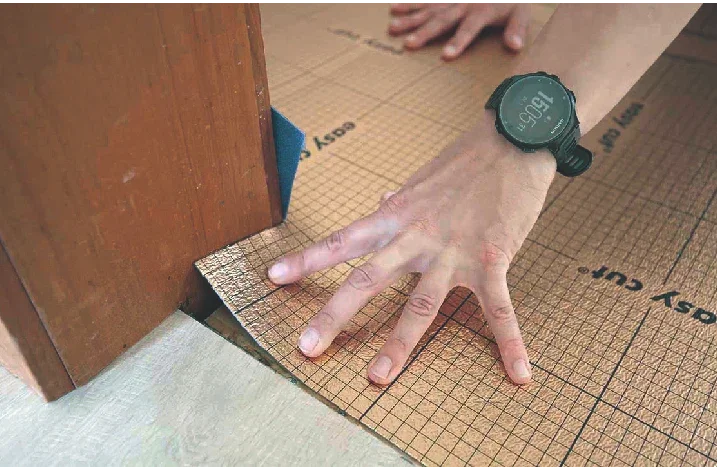
What actually goes under vinyl flooring? The honest answer: It primarily depends on whether you are installing click vinyl (floating) or glue-down vinyl (fully bonded). This is because both systems require completely different substructures. Here is an overview, including a table that will make the decision easy for you.
Last updated: June 2026
The most important points in brief
- Click vinyl: level, dry subfloor + vapor barrier if necessary + underlay (unless integrated).
- Glue-down vinyl: NO underlay; instead, primer + leveling compound, then bond directly.
- Always: Subfloor must be clean, dry, and level.
- Vapor barrier: usually mandatory for click vinyl on mineral subfloors (screed).
- Integrated underlay? Then NO additional underlay.
Table of contents
- The answer at a glance
- Under click vinyl (floating)
- Under glue-down vinyl (bonded)
- Prerequisite: the subfloor
- Frequently asked questions
- Conclusion
The answer at a glance
| Layer | Click vinyl (floating) | Glue-down vinyl (bonded) |
|---|---|---|
| Vapor barrier | yes, on screed/mineral (unless integrated) | not applicable |
| Underlay / acoustic insulation | yes, unless integrated | no (solid bond) |
| Primer | no | yes |
| Leveling compound | for unevenness | almost always |
Under click vinyl (floating)
Click vinyl is not glued down but lies freely on the subfloor. Depending on the situation, the following is placed underneath:
- Vapor barrier: On mineral subfloors like screed, residual moisture can rise; a PE vapor barrier film protects the floor. Some underlays have this integrated.
- Underlay / acoustic insulation: makes the floor quieter and compensates for micro-unevenness. Important: pressure-resistant, not too soft, otherwise the click connection will suffer. If your vinyl already has an integrated underlay, do NOT put an additional one underneath. Details in the guide Underlay for vinyl flooring.
The easiest option is a floor that already includes insulation: Click vinyl floors with integrated underlay do not need a separate underlay. Rigid vinyl with an SPC core is particularly forgiving with small uneven areas.
No underlay calculations
For click vinyl with built-in underlay, no extra underlay is placed underneath. The floor finder will show you which one suits your room.
🎯 Start floor finder View floors with insulationUnder glue-down vinyl (bonded)
Glue-down vinyl is bonded across the entire surface; here, no underlay and no insulation is placed underneath, just a cleanly prepared subfloor. Specifically, this means:
- Primer: binds dust, regulates absorbency, creates adhesion; see Primer before glue-down vinyl.
- Leveling compound: makes the surface smooth, as every bit of unevenness would show through the thin covering; see Leveling compound for vinyl flooring.
Prerequisite: the subfloor
Regardless of the system, the subfloor must be clean, dry, load-bearing, and level. Before installing, check three things: flatness (with a straight edge), strength (is it sanding or crumbling?), and moisture (especially with fresh screed). Only when the foundation is right should you build on it. Still unsure whether to choose click or glue-down? Then Click vinyl or glue-down vinyl? will help you further.
Frequently asked questions
What must be placed under click vinyl?
On a level, dry subfloor: if necessary, a vapor barrier (on screed) and a pressure-resistant underlay, unless the product already has an integrated one.
Is a vapor barrier needed under vinyl?
For floating click vinyl on a mineral subfloor (screed), usually yes, to keep rising residual moisture away. Some underlays have the vapor barrier integrated.
What goes under glue-down vinyl?
No underlay and no insulation; instead, primer and leveling compound for a solid, smooth subfloor. Glue-down vinyl is bonded directly over the entire surface.
Does vinyl with integrated insulation need an underlay?
No. An additional underlay would make the floor too soft and overload the click connection. On a mineral subfloor, a thin vapor barrier may still be necessary; observe manufacturer specifications.
Conclusion
The system determines what must go under the vinyl flooring: click vinyl may require a vapor barrier and a pressure-resistant underlay; glue-down vinyl requires primer and leveling compound instead of an underlay. Both share the need for a clean, level, and dry subfloor. Browse through click vinyl and glue-down vinyl, or get your sample in advance.